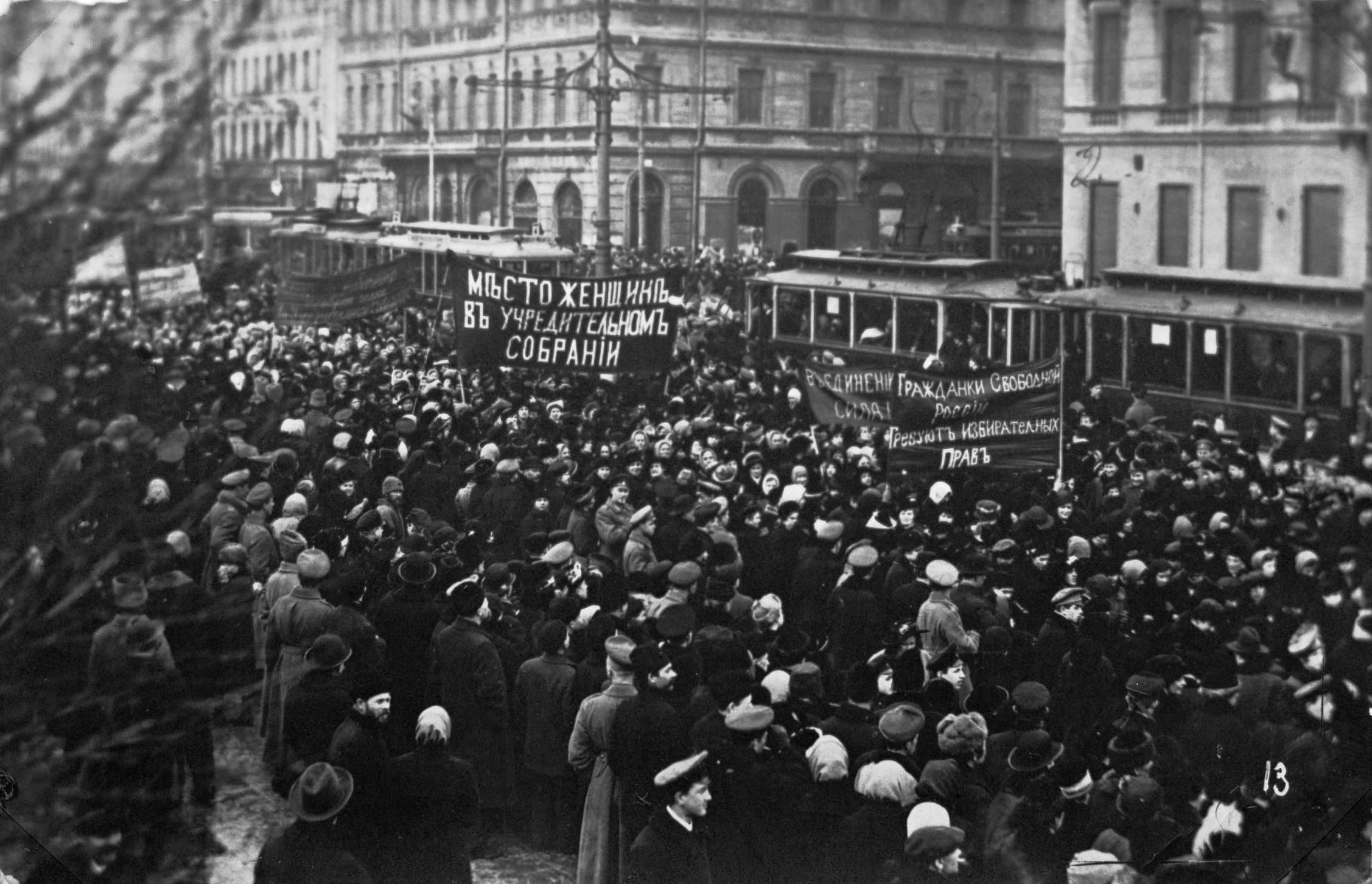
In the crucible of 1917, amid the devastating defeats of World War I and crippling shortages of bread, the Russian Empire began to unravel from within.
In the freezing winter months of early 1917, the Russian Empire was a structure hollowed out from within, waiting for a gust of wind to topple it. The crisis did not begin in the conspiratorial basements of professional revolutionaries, but in the breadlines of Petrograd and the snow-choked trenches of the Eastern Front. Russia’s participation in World War I had turned a chronic systemic fragility into an acute terminal collapse. To finance the conflict, the imperial government printed millions of roubles, unleashing an inflation that quadrupled prices by 1917. Farmers, unable to buy manufactured goods with depreciated currency, hoarded their grain and reverted to subsistence farming, leaving the imperial capital starving. When the Ottoman Empire joined the Central Powers, closing the Mediterranean trade routes, it choked off Russia’s remaining economic oxygen. The Tsar, Nicholas II, made the fatal error of taking personal command of the army in 1915, tying the prestige of the three-hundred-year-old Romanov dynasty directly to the meat-grinder of military defeat. Behind him in the capital, he left Tsarina Alexandra—German-born and deeply distrusted—and her confidant, the mystic Grigori Rasputin, whose erratic influence over ministerial appointments poisoned the regime’s reputation even among its staunchest aristocratic defenders. By the time a cabal of nobles murdered Rasputin in December 1916, the rot had reached the foundation.
The collapse, when it arrived in March 1917—February by the Julian calendar still used in Russia—was swift and remarkably absolute. What began as bread riots and strikes in Petrograd mutated into a revolution when the military garrison mutinied, refusing to fire on the crowds. Members of the Duma, the parliament established after the abortive 1905 Revolution, realized the Tsar could no longer govern. On March 15, Nicholas II abdicated, ending Romanov rule. In his stead, two rival bodies stepped into the vacuum of power, creating an unstable arrangement known as "Dual Power." The Provisional Government, composed of liberal politicians from the Duma and led by the upper-class Prince Lvov, held the nominal machinery of state, commanding the bureaucracies and international relations. But domestic legitimacy lay with the Petrograd Soviet, a spontaneously organized council of workers and soldiers. While the Provisional Government insisted on honoring Russia's alliance and continuing the war, the Soviets held the true allegiance of the working and soldiering classes, wielding veto power over domestic transport, militias, and communications. Across the country, the social fabric tore open. Workers protested the grueling eleven-hour workdays, dangerous conditions, and shrinking wages, while in the vast rural interior, peasants acted on a simple, ancient conviction: that the land belonged to those who worked it. They began seizing and redistributing the estates of the gentry.
10 links to entries not yet ingested in the Library.
Into this fractured landscape stepped Vladimir Lenin. Returning from exile in Switzerland with the assistance of German funds—Germany correctly betting that his presence would destabilize their wartime enemy—the leader of the Bolshevik faction of social democrats brought a sharp, uncompromising clarity to the chaos. While moderate socialists like the Mensheviks and Socialist Revolutionaries co-operated with the Provisional Government, Lenin rejected all compromise. His program was brilliant in its simplicity, condensed into the slogan: "Peace, Land, and Bread." He promised an immediate end to the war, the legal transfer of land to the peasantry, and food for the starving cities. In July, a premature, chaotic uprising of workers and soldiers in Petrograd, known as the July Days, was suppressed by the Provisional Government, forcing Lenin back into hiding and leading to a crackdown on his party. Yet the government, now led by Alexander Kerensky, refused to exit the war, launching disastrous new offensives that further shattered army morale. Seizing the moment, the Bolsheviks formed their own armed worker militias, the Red Guards.
The denouement of the Provisional Government arrived on November 7 (October 25), 1917. In a swift, precisely targeted armed insurrection, Bolshevik Red Guards and mutinous soldiers occupied key government buildings, post offices, and railway stations in Petrograd, bloodlessly overthrowing the Provisional Government. Proclaiming the Russian Soviet Federative Socialist Republic, the Bolsheviks moved quickly to consolidate power and fulfill their promises. To buy the survival of their infant regime, they signed the humiliating Treaty of Brest-Litovsk with Germany in March 1918, surrendering vast territories of the former empire. To protect their fragile state from internal subversion, they established the Cheka, a ruthless secret police and revolutionary security service that initiated the Red Terror, a campaign dedicated to uncovering and eliminating "enemies of the people." Fearing German advances on Petrograd, Lenin relocated the capital inland to the ancient fortress of Moscow, signaling a permanent turn away from the Western-looking window of Peter the Great.
The October Revolution did not end the struggle; it initiated one of the most savage conflicts of the twentieth century. From 1918 to 1922, Russia was consumed by a multi-front civil war. The Bolshevik "Reds," organized with ferocious administrative discipline by Leon Trotsky into the new Red Army, faced the "Whites"—a loose coalition of monarchists, liberals, right-leaning army officers, and anti-Bolshevik socialists who wished to restore the imperial order or establish a conservative republic. The civil war was fought with limitless cruelty on both sides. It convulsed every province, every city, and every ethnic minority enclave of the old empire. Foreign powers intervened, sending troops and supplies to aid the Whites, which only allowed the Bolsheviks to paint themselves as defenders of the nation. In the countryside, peasants navigated a shifting nightmare, often supporting the Reds only because they feared a White victory would return the landlords to their estates.
By 1922, the Red Army had emerged victorious. The White armies were broken, their leaders defeated, and millions of upper-class, intellectual, and anti-Bolshevik Russians fled into permanent exile. Out of the ashes of the old empire, the Bolsheviks—now renamed the Communist Party—began reorganizing the territory. They established Soviet power in Ukraine, Byelorussia, Georgia, Armenia, and Azerbaijan, binding these national republics together with Russia under a single flag. In late 1922, they officially declared the creation of the Union of Soviet Socialist Republics. The Russian Revolution had not only demolished a centuries-old autocracy; it had forged the world's first socialist state, creating a ideological and geopolitical titan that would dominate global politics, inspire global revolutions, and shape the balance of power for the next six decades.