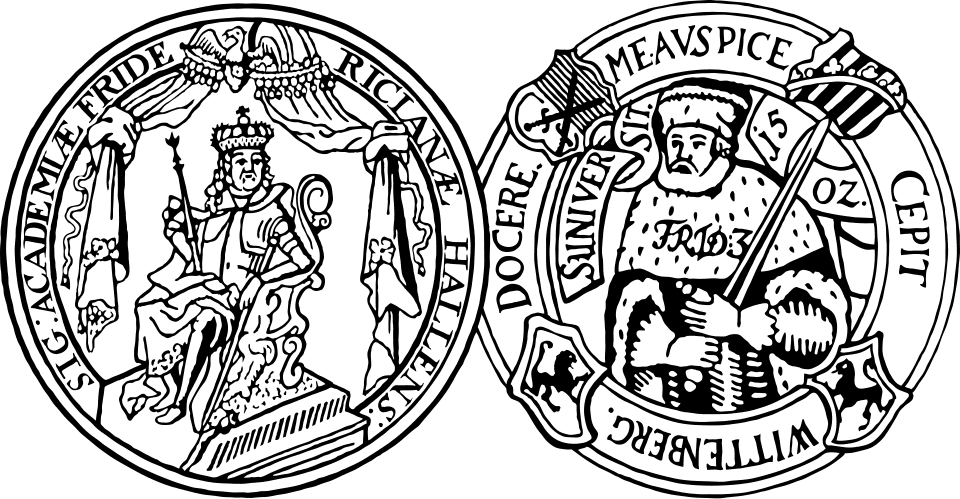
Long before it was formally joined into a single institution, the intellectual DNA of Martin Luther University Halle-Wittenberg was defined by rebellion against established orthodoxy.
When Albert of Brandenburg, the Archbishop of Mainz, first read Martin Luther’s Ninety-five Theses, his outrage was directed not only at the rebellious monk but at the institution that shielded him. Geographically and ecclesiastically subordinate to Albert, the Electorate of Saxony had recently birthed a new intellectual center, founded in 1502 by Frederick the Wise: the University of Wittenberg. To the Archbishop, this upstart academy was nothing less than a breeding ground for heretical ideas, a dangerous engine of Renaissance humanism operating on the fringes of the empire. He was entirely correct. Under the intellectual stewardship of Philipp Melanchthon and the theological fury of Luther himself, Wittenberg did not merely host the Protestant Reformation; it became its laboratory and its fortress, eventually absorbing Luther’s own home, the Lutherhaus, into its physical campus. This was an institution so deeply etched into the early modern imagination that when William Shakespeare and Christopher Marlowe sought a credible intellectual home for their most tormented, introspective thinkers—Prince Hamlet, Horatio, and Doctor Faustus—they sent them to study at Wittenberg.
Parallel to this Saxon crucible of faith and rebellion was the University of Halle, established in 1694 by Frederick III, the Elector of Brandenburg who would soon crown himself the first King in Prussia. If Wittenberg was born of the desire to challenge Rome, Halle was designed to challenge the very nature of academic inquiry. In the late seventeenth and early eighteenth centuries, Halle emerged as the beating heart of Prussian Pietism, but its true legacy lay in a radical restructuring of the intellect. It was here that Christian Thomasius shattered centuries of academic tradition by delivering his lectures not in the elite, insulating cocoon of Latin, but in German. It was here that Christian Wolff championed a systematic rationalism so potent that it would later shape the philosophical awakening of Immanuel Kant. Halle became what many historians consider the first "modern" university. By prioritizing rational inquiry over religious orthodoxy, introducing novel modes of instruction, and ceding unprecedented control to the professors themselves, Halle pioneered a liberal model of higher education. This spirit of academic freedom was later adopted by the University of Göttingen and, ultimately, became the blueprint for the modern research universities of North America.
The physical union of these two intellectual giants was a casualty of the Napoleonic Wars. Closed in 1813 amidst the chaos of French occupation, the University of Wittenberg lost its independent existence. When the Congress of Vienna redrew the map of Europe in 1815, granting the town of Wittenberg to Prussia, the Prussian state engineered a marriage of administrative convenience and historical symmetry: in 1817, Wittenberg was merged into the University of Halle. Yet, the dual identity of the institution remained somewhat latent until November 10, 1933, when it officially took the name by which it is known today: Martin Luther University Halle-Wittenberg.
+ 12 further connections to entries not yet ingested
The year of that renaming, 1933, was no historical coincidence. It was the year the National Socialists seized power in Germany, and the renaming of the university after the great German reformer was swept up in the regime’s complex efforts to align historic German identity with its own ideology. Under the Nazi dictatorship, the university’s proud tradition of academic liberalism was systematically dismantled. More than a dozen professors were expelled as the regime purged the faculty of political dissidents and those deemed undesirable under racial laws. In their place, the authorities transferred academics from other German institutions—universities that were considered "better" or more prestigious at the time. This practice of dumping politically compromised, ideologically suspect, or troublesome scholars in Saxony-Anhalt led to a grim, whispered nickname among German academics: Halle-Wittenberg became known as the academic "Vorkuta," after the notorious, frozen coal-mining center of the Soviet Gulag system.
Despite these dark mid-century decades, the legacy of the twin universities is preserved in a remarkable roll call of pioneers who walked their halls. It was here that Anton Wilhelm Amo studied, historicized as the first scholar of Sub-Saharan African descent known to have attended a European university. It was here that Dorothea Erxleben defied the deep-seated gender exclusions of the eighteenth century to become the first female medical doctor in Germany. The university nurtured Georg Cantor, the mathematical revolutionary who formulated set theory and reshaped the human understanding of infinity, and Hermann Ebbinghaus, the psychologist who pioneered the experimental study of memory. Its legacy stretched across the Atlantic through alumni like Henry Melchior Muhlenberg, the patriarch of the Lutheran Church in America, and his son Frederick Muhlenberg, who would serve as the first Speaker of the United States House of Representatives. In later eras, the university produced Nobel laureates of the caliber of Emil Adolf von Behring, Gustav Ludwig Hertz, Hermann Staudinger, and Karl Ziegler, as well as Hans-Dietrich Genscher, the statesman who would guide Germany through the delicate diplomacy of reunification as its longest-serving Foreign Minister.
Today, Martin Luther University Halle-Wittenberg operates as a modern public research university, the largest and oldest in Saxony-Anhalt. While its primary campus is situated in the city of Halle, the historic town of Wittenberg remains anchored to the institution through the Leucorea Foundation, which serves as the university's convention center. The physical campus is a living museum of scientific and cultural history, home to a botanical garden founded in 1698 and a historic observatory designed in 1788 by Carl Gotthard Langhans. The university’s nine faculties—ranging from theology, law, and medicine to three distinct faculties of natural sciences and three of philosophy—exist alongside an elite cluster of external research institutes. The German Academy of Sciences Leopoldina, the Max Planck Institute for Social Anthropology, and the Fraunhofer Institute for Mechanics of Materials, among others, form a dense scientific ecosystem around the university.
This serious, research-driven character is balanced by a deep connection to the cultural heritage of central Germany. The university's Collegium musicum, which includes an academic orchestra founded in 1779 and a prestigious choir established in 1950, draws talented student musicians from every discipline. Each year, the choir performs at the international Handel Festival in Halle, the birthplace of George Frideric Handel, bridging the gap between rigorous scientific inquiry and the artistic traditions of the region.
From the rebellious Saxon theology of the sixteenth century to the Prussian rationalism of the Enlightenment, Martin Luther University Halle-Wittenberg has served as an anchor for the German intellectual tradition. It has survived the fractures of religious war, the administrative reorderings of the nineteenth century, and the deep moral compromises of the twentieth. In its modern form, collaborating with institutions from Tokyo to Paris, Alabama to Moscow, it remains a monument to the enduring, complex project of human learning—a place where the ghosts of Hamlet, Luther, and the pioneers of modern reason continue to cast their long shadows.