Thread · 6 entries
Three decolonizations
From an Andean rebellion in 1780 to French Algeria in 1962 — six places where empires stopped being empires.
The word 'decolonization' tends to evoke the 1950s and '60s, but the work of unmaking empire began much earlier and is far from finished. The six entries here trace one possible path: starting in the Andes the night Túpac Amaru II raised a rebellion against the Spanish corregidor, moving through the wars of independence Bolívar fought to a conclusion, the parallel Portuguese departure from Brazil, and then the twentieth-century unwinding of British India, Dutch Indonesia, and French Algeria. None of them ended in a settled order, but each is a hinge.
- 01
Cusco region, November 1780. A descendant of the last Inca emperor stops a Spanish corregidor on the road, executes him, and lights the largest indigenous rebellion the Andes had seen since the Conquest.
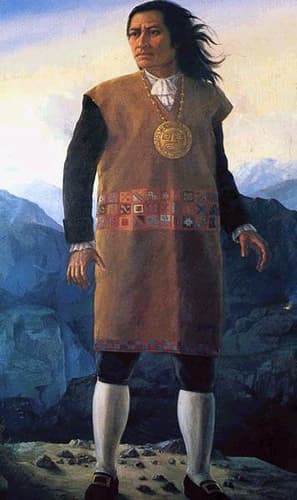
Túpac Amaru II
person · 1738 CEIn the autumn of 1780, a wealthy indigenous nobleman and muleteer named José Gabriel Condorcanqui Noguera took a step from which there was no turning back.
- 02
Spanish America, 1810s-1820s. The strategic genius of the wars of independence — and, after them, the political imagination that almost held a continental federation together before it broke into the modern republics.

Simón Bolívar
person · 1783 CEIn the ruins of a young widower’s grief lay the seeds of an imperial collapse.
- 03
1822. The Portuguese prince regent, in exile from Napoleon, opts to stay and declare independence himself rather than return to Lisbon as a subordinate. A peaceful break, on paper, but the slavery question stays open until 1888.
Brazil
organization · 1822 CEThe arrival of the Portuguese explorer Pedro Álvares Cabral in 1500 initiated a transformation of the South American continent, leading to the founding of its first city, São Vicente, in 1532 and the establishment of a colonial economy…
- 04
Midnight, 15 August 1947. The transfer of power happens, the partition begins, and the institutional shape of postcolonial South Asia is fixed in the hardest possible weeks.
Dominion of India
event · 1947 CEWhen the British Crown relinquished its jewel on 15 August 1947, it did not leave behind a finished republic, but a transitional creation known as the Dominion of India.
- 05
Sukarno declares independence two days after the Japanese surrender in 1945; the Dutch fight for four more years before agreeing. The world's largest Muslim-majority nation is the result.

Indonesia
organization · 1945 CEScattered across more than seventeen thousand islands between the Indian and Pacific oceans, the territory that became the Republic of Indonesia has functioned for millennia as a vital global crossroads.
- 06
1954-1962. The war of independence that French opinion would not call a war until decades later. Ends colonial Algeria, ends the Fourth Republic, and writes much of postwar French politics.
Algeria
organization · 1962 CEFor millennia, the vast territory of Algeria has served as a crossroads where empires collided and merged, from the ancient Phoenicians, Numidians, and Romans to the Arab Muslim migrations that reshaped its cultural fabric from the seventh…