Person · 1371 CE – 1433 CE · Imperial China
Zheng He
- Also known as
- Ceñ He
- Ch'en Huw
- Chang Fò
- Che Čeng
- Cheng Ho
- Cheng Ho
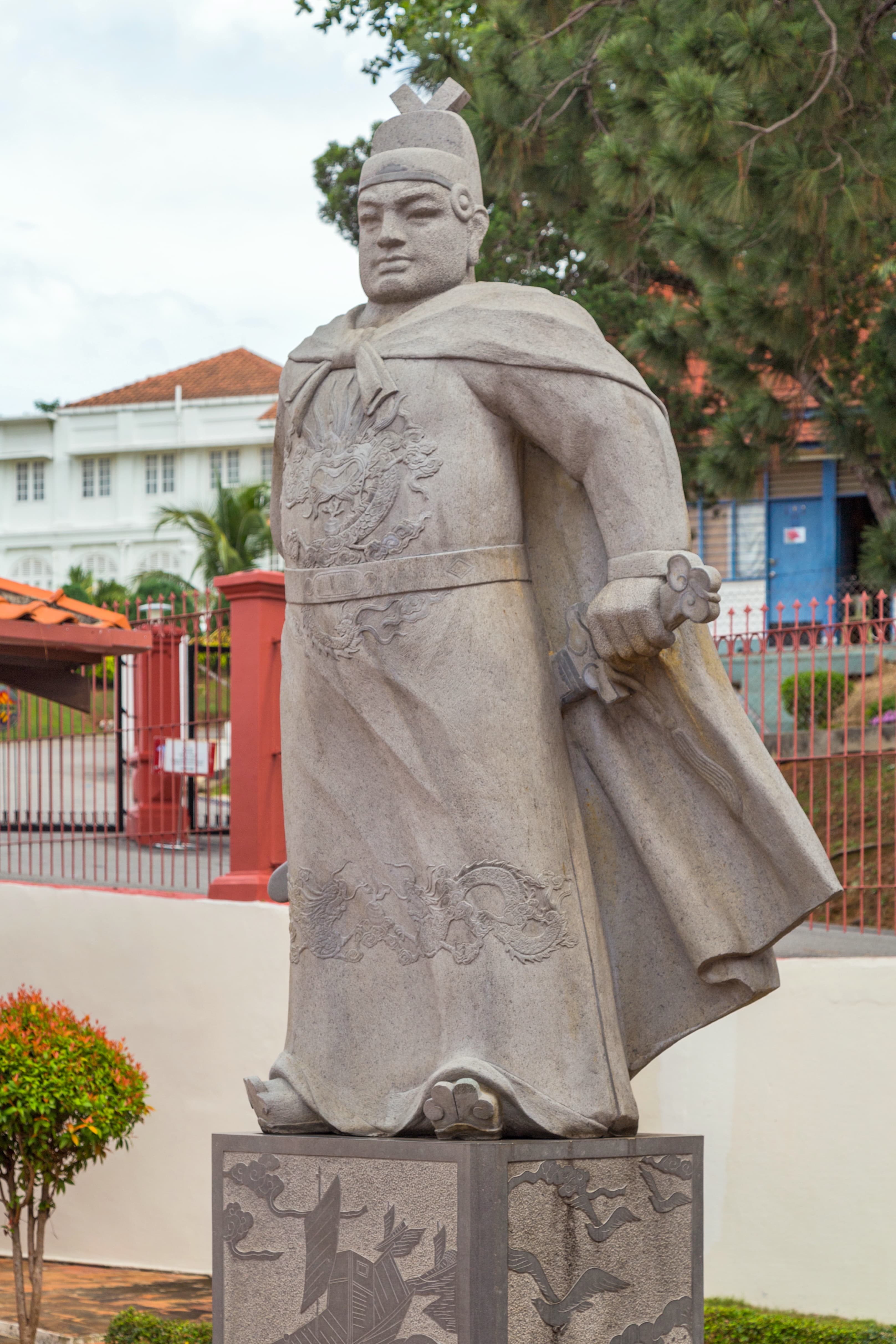
In the autumn of 1382, a Ming army swept through the Yunnan province, claiming the life of a Muslim man named Ma Hajji and forever altering the destiny of his young son, Ma He.
In the autumn of 1381, a Ming army marched into the high, rugged valleys of Yunnan to extinguish the last pocket of Mongol rule in China. In the chaos of the conquest, a ten-year-old Muslim boy named Ma He was captured along a roadside by General Fu Youde. When the general demanded to know the whereabouts of the Mongol pretender to the region's throne, the boy answered defiantly that the prince had already plunged himself into a lake. Impressed by his boldness but unmoved by his youth, the imperial forces took the boy prisoner. Like many young captives of the Ming transition, he was castrated, stripped of his childhood, and assigned as an enslaved eunuch servant to the household of Zhu Di, the Prince of Yan. He was tall for his age, destined to grow into a physically imposing man, seven chi tall with a waist five chi in circumference, high cheekbones, a loud voice like a bell, and glaring eyes. Yet no one watching the young captive march away from the ruins of his home could have predicted that this boy would one day command the largest wooden armada the world had ever seen, steering the majesty of the Ming Empire across the Indian Ocean to the shores of East Africa.
Placed in the northern frontier post of Beiping under Zhu Di’s direct supervision, Ma He bypassed the systemic illiteracy imposed on imperial palace eunuchs by the reigning Hongwu Emperor, who deeply distrusted the class. Zhu Di, eleven years older than Ma He, valued intelligence and military capability near his volatile border with the hostile Mongol tribes. Ma He grew up in the saddle, learning the art of war on the dusty northern plains. He accompanied his prince on his first military expedition in March 1390, witnessing the psychological collapse and surrender of the Mongol commander Naghachu. When the Hongwu Emperor died, a brutal civil war erupted as the new Jianwen Emperor attempted to strip the regional princes of their armies. Ma He proved indispensable to his master’s survival. In 1399, he successfully defended Beiping’s critical city reservoir against imperial forces. By 1402, Zhu Di’s armies overthrew the nephew and seized the capital of Nanjing. To reward the eunuch who had fought by his side from the northern wastes to the Yangtze, the newly crowned Yongle Emperor bestowed upon him the imperial surname "Zheng," elevating him to Grand Director of the Directorate of Palace Servants.
The Yongle Emperor’s ambitions did not stop at the borders of China. Eager to establish a militaristic presence in the Indian Ocean, monopolize international trade networks, and extend the imperial tributary system, he ordered the construction of an unprecedented "treasure fleet." Rumors also persisted that the first voyage was secretly designed as the largest waterborne manhunt in Chinese history, aimed at capturing the deposed Jianwen Emperor, who was whispered to have escaped the burning palace in Nanjing. To lead this colossal undertaking, the emperor chose Zheng He. The scale of the preparations was staggering. A foreign language institute was founded in Nanjing simply to train the translators needed for the expedition. On July 11, 1405, the first fleet departed from Suzhou. It was a floating city: 317 ships, including massive "treasure ships" that legend claimed were twice as long as any wooden vessel ever recorded, carrying nearly 28,000 soldiers, sailors, diplomats, and astronomers on four decks.
Though the scale of Zheng He’s armada was entirely new, the waters he navigated were not. He followed ancient, well-mapped trade routes that Chinese, Arab, and Indian merchants had traveled since the Han dynasty. Yet Zheng He’s presence transformed these merchant lanes into corridors of imperial power. Though he was born a Muslim—the descendant of Sayyid Ajjal Shams al-Din Omar, a governor of Yunnan under the Mongol Empire—Zheng He operated with a fluid spiritual diplomacy. Before his ships cleared the coast, he sought the protection of Lingshan Hill’s Muslim saints in Quanzhou, but he also offered deep devotion to Tianfei, the Taoist patron goddess of seafarers, attributing his survival on the open ocean to her divine grace. Across seven epic voyages between 1405 and 1433, the fleet visited Java, Sumatra, Siam, India, the Horn of Africa, and the Arabian Peninsula. They traded gold, silver, fine silks, and blue-and-white porcelain for exotic treasures. From the Swahili Coast, Zheng He brought back zebras, ostriches, camels, and ivory. The arrival of a giraffe from Malindi caused a sensation at the imperial court; scholars declared it to be the mythical qilin, a physical manifestation of heaven’s favor on the Yongle Emperor’s reign.
Yet the life of the grand admiral was constantly subject to the shifting political winds of Nanjing. When the Yongle Emperor died in 1424 while Zheng He was on a diplomatic mission to Sumatra, the incoming Hongxi Emperor immediately halted all further maritime expeditions, viewing them as an extravagant drain on the treasury. Zheng He was reassigned to the southern capital of Nanjing, serving as its military defender and overseeing the construction of the Great Bao'en Temple. Even under the next ruler, the Xuande Emperor, Zheng He’s position required careful navigation; he was once formally reprimanded by the court when he attempted to pass off the costs of building certain temples onto the imperial treasury. Yet his competence remained unmatched, and in 1430, the Xuande Emperor relented, commissioning Zheng He to undertake a seventh and final voyage to the "Western Ocean."
It was during or shortly after this final expedition, around 1433, that the great admiral died. With his passing, the era of Chinese maritime expansion came to an abrupt end. Succeeding emperors, facing renewed Mongol threats on the northern land borders and influenced by isolationist Confucian scholar-officials, withdrew the fleets, let the great treasure ships rot in their berths, and banned the construction of multi-masted vessels. Zheng He’s legacy became not the beginning of a Chinese global empire, but a singular, glittering epoch of what might have been. He left behind a legacy inscribed on stone steles along the Chinese coast, thanking the goddess Tianfei for guiding his path across the dark, boundless waters, having connected the markets of Nanjing to the ports of East Africa, leaving a memory of an empire that once looked outward to the sea.
Connected to
- religionIslam631 CE
- citizen ofMing dynasty1368 CE
- worked forYongle Emperor1360 CE
+ 11 further connections to entries not yet ingested