Concept · 1271 CE – 1368 CE · Imperial China
Yuan dynasty
- Also known as
- cesarstvo velikega kana
- dinasti Yuan
- Dinastia Yuan
- dinastia Yuan
- dinastija Juan
- dinastía Yuan
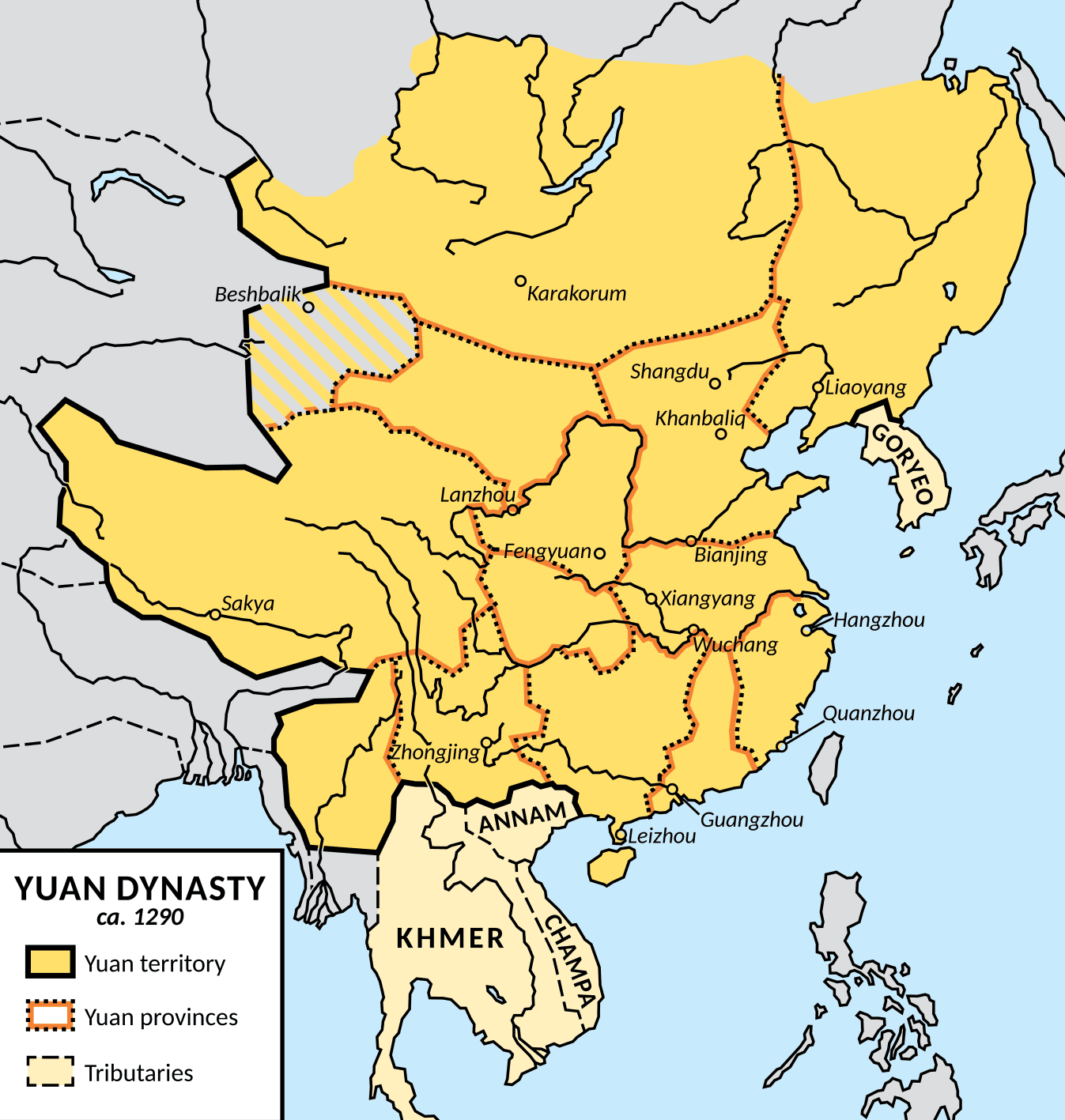
When Kublai Khan laid claim to the Mandate of Heaven in 1271 CE, he did something no non-Han ruler had ever accomplished: he established a dynasty, the Great Yuan, that would eventually bring the entirety of China proper under foreign rule.
In the autumn of 1271, Kublai Khan, the grandson of Genghis Khan and claimant to the grand khaganate of the Mongol Empire, issued an imperial edict that departed from the vocabulary of the Eurasian steppe. He did not invoke the eternal blue sky of Mongol theology, nor did he declare himself merely the ruler of the horseback-riding peoples. Instead, he reached into the dense, cryptic text of the I Ching—the Chinese Classic of Changes—specifically a passage praising the cosmic, primal force of creation: dà zāi Qián Yuán, "Great is Qián, the Primal." With this cosmological reference, Kublai proclaimed the birth of the Great Yuan. By assuming the mantle of a traditional Chinese emperor, complete with the claim to the Mandate of Heaven, he sought to bind the fluid, expansive power of the Mongol conquests to the ancient, sedentary lineage of Chinese Dynastic succession, stretching back to the legendary Three Sovereigns and Five Emperors. Yet this was not a simple act of cultural submission. It was a grand, deliberate synthesis: a nomadic empire transforming itself into a cosmopolitan world state, with its administrative heart rebuilt over the ruins of old northern capitals.
The creation of the Yuan dynasty was born out of a profound fracture within the Mongol world. Following the death of Möngke Khan in 1259 during his campaign against the southern Chinese, the vast empire constructed by Genghis Khan fractured into civil war. Challenged by his brother Ariq Böke for the supreme title of Great Khan, Kublai found himself desperately needing the material wealth, agricultural surplus, and human talent of northern China to sustain his armies. He courted the Han Chinese population by modeling his government on traditional bureaucracies, adopting the Chinese era name of Zhongtong, and building schools for Confucian scholars. Though his brother eventually surrendered in 1264, the political fabric of the Mongol Empire was permanently torn. The three western Mongol realms—the Golden Horde, the Chagatai Khanate, and the Ilkhanate—drifted into functional autonomy, leaving Kublai to build a new kind of empire centered in East Asia. To anchor this vision, he moved his primary capital from the windswept grasslands of Karakorum in Mongolia to a grand, newly designed metropolis. Constructed near the old Jurchen capital of Zhongdu, this new seat of power was named Khanbaliq, known to his Chinese subjects as Daidu, the "Great Capital"—the site of modern Beijing.
While Kublai presented himself as a Confucian sage-emperor to his Chinese subjects, the internal structure of the Yuan state was designed to keep the conquerors distinct from, and dominant over, the conquered. After suppressing a dangerous rebellion led by the Han official Li Tan in 1262, Kublai grew deeply wary of relying too heavily on local elites. The society he constructed was subsequently codified into a rigid four-tiered class system. At the apex were the Mongols themselves. Below them were the —the "colored-eye" foreigners, largely Central Asians, Persians, and Europeans, whom the Mongols trusted to collect taxes and manage the finances of the state without local family entanglements. Third came the , the inhabitants of the former Jin dynasty of northern China, which included Han Chinese, Jurchens, and Khitans. At the very bottom were the , the Southern Chinese, who made up the vast majority of the population but were viewed with the greatest suspicion by the court. To maintain this hierarchy, Kublai rejected proposals to revive the traditional Confucian imperial examinations, which had for centuries allowed southern literati to dominate the state apparatus.
Connected to
- had as citizenKublai Khan1215 CE
- followed byMing dynasty1368 CE
- had as citizenYongle Emperor1360 CE
+ 12 further connections to entries not yet ingested