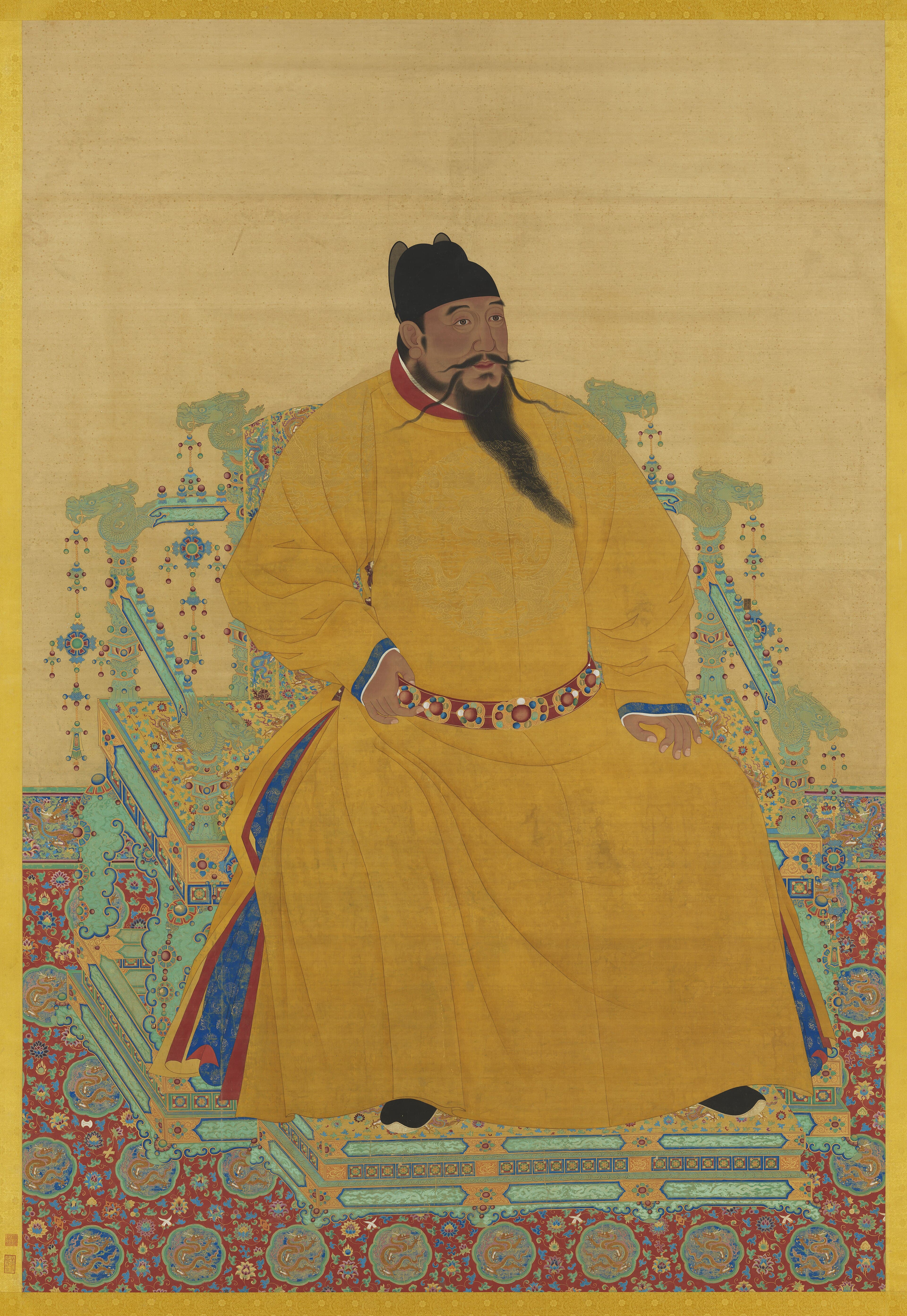
In 1402, a prince of the Ming dynasty named Zhu Di seized the imperial throne from his nephew after a devastating three-year civil war.
In the spring of 1402, the skies over Nanjing were choked with the ash of a burning palace. Inside, the young Jianwen Emperor—who had spent his brief four-year reign attempting to strip his powerful uncles of their regional fiefdoms—vanished into the flames, leaving behind a charred ruin and a vacuum of legitimacy. Standing amidst the smoke was his uncle, Zhu Di, the Prince of Yan. For three years, this battle-hardened warlord had waged a devastating civil war under the banner of the Jingnan campaign: a "campaign to clear away disorders," ostensibly undertaken to rescue his nephew from corrupt advisors. When the smoke cleared, the pretense was dropped. Zhu Di, the fourth son of the Ming dynasty’s founder, seized the Dragon Throne and took the reign name Yongle—“Perpetual Happiness.” It was a title of supreme irony, inaugurating a reign characterized by relentless expansion, monumental construction, violent usurpation, and an obsessive need to rewrite the past to justify a stolen crown.
To understand the Yongle Emperor, one must look to the northern frontier, where he spent his formative years. Born in 1360 as Zhu Di, he was the son of Zhu Yuanzhang, a peasant rebel leader who overthrew the Mongol-led Yuan dynasty to establish the Ming. Raised in Nanjing under a regime of strict discipline and tutored by Confucian scholars like Kong Keren, the young prince found his true calling not in philosophy or poetry, but in the saddle. In 1370, he was named the Prince of Yan, with his fief centered at Beiping, the former Yuan capital. When he arrived there in 1380, he entered a cultural borderland. Beiping was a city recovering from famine and war, heavily influenced by decades of Mongol rule. Here, the young prince learned the realities of imperial defense. He trained a private guard, married the daughter of the legendary general Xu Da, and spent years disguised as an ordinary soldier to understand the lives of those he would command. By the 1390s, Zhu Di had earned a reputation as a brilliant military strategist, personally leading campaigns deep into the Mongolian steppe, capturing enemy commanders, and winning the fierce loyalty of his soldiers.
Yet, as his military prestige grew, his political standing shrank. When his eldest brother, the crown prince, died in 1392, the court bypassed Zhu Di in favor of his young nephew, Zhu Yunwen, strictly adhering to the principles of primogeniture. The new emperor, reigning as Jianwen, immediately recognized the threat posed by his battle-tested uncles and began systematically stripping them of their titles and armies. Zhu Di, realizing his turn would soon come, struck first in 1399. The resulting civil war was brutal, but Zhu Di’s tactical genius and deep organizational experience—forged during his youth in the military training camps of Fengyang—ultimately triumphed over the inexperienced imperial generals.
+ 12 further connections to entries not yet ingested
Upon taking the throne, Yongle faced a crisis of legitimacy. To cure the stain of usurpation, he embarked on a campaign of historical erasure. He ordered the imperial records altered, claiming that he, rather than a concubine (who may have been Mongolian or Korean), was the legitimate son of his father’s primary wife, Empress Ma. He ordered the systematic execution of his nephew’s supporters, yet unlike his paranoid father, he ultimately moved away from continuous bloody purges, choosing instead to build a stable, highly professional bureaucracy. To win the hearts of the scholarly elite, he commissioned the monumental Yongle Encyclopedia, a gargantuan task employing some two thousand scholars who synthesized the entirety of Chinese knowledge, eclipsing all previous collections. He also systematized Neo-Confucian texts to serve as the standard curriculum for the imperial civil service exams, ensuring that future generations of bureaucrats would be trained in a uniform orthodoxy loyal to the state.
But Yongle's grandest project was the physical relocation of the empire's heart. He elevated his old power base of Beiping to the status of a second capital, renaming it Beijing. Between 1407 and 1420, hundreds of thousands of artisans, laborers, and soldiers transformed the northern city into a sprawling monument to imperial authority. At its center rose the massive complex of the Imperial City and the Forbidden City, designed to mirror the celestial order on Earth. To feed this new capital and the massive armies stationed along the northern border, Yongle ordered the reconstruction and expansion of the Grand Canal, a colossal engineering feat that linked the agricultural abundance of the southern Yangtze valley directly to the halls of power in the north.
From this new northern stronghold, Yongle looked outward, pursuing an aggressively active foreign policy designed to project Chinese hegemony across the known world. His gaze stretched far beyond the traditional borders of China. He dispatched diplomatic and military missions to Korea, Japan, the Philippines, Manchuria, and the Timurid Empire of Central Asia. Most spectacularly, he sponsored the epic maritime voyages of his trusted court eunuch, Zheng He. Between 1405 and 1433, Zheng He led seven massive armadas of "treasure ships" across the Indian Ocean, reaching the shores of Southeast Asia, India, Persia, and the coast of East Africa, returning with foreign emissaries, exotic tribute, and tales of distant lands.
Yet, for all his global reach, Yongle’s greatest obsession remained the dusty, windswept northern frontier. The Mongols, though fractured into the Uriankhai, the eastern Mongols, and the western Oirats, remained an existential threat. The emperor played these factions against one another, alternately offering trade and launching massive military strikes. Driven by the need to personally monitor this volatile border, Yongle led five grueling campaigns into Mongolia. He died in August 1424, while returning from his final expedition into the steppe, having exhausted his treasury and his own health in wars that ultimately failed to secure the northern frontier or successfully pacify his southern campaign in Đại Việt (modern-day northern Vietnam).
The Yongle Emperor left behind an empire drastically transformed. He took a dynasty that was introspective and defensive and turned it into an expansive, outward-looking colossus. By moving the capital to Beijing, he permanently shifted the geopolitical axis of China northward, a decision that would shape the destiny of the region for centuries to come. The Forbidden City he built remains the enduring symbol of Chinese imperial majesty, and the grand, outward-facing vision of his reign—epitomized by Zheng He's sails and the scholars of the great encyclopedia—remains one of the most remarkable chapters in the history of global statecraft.