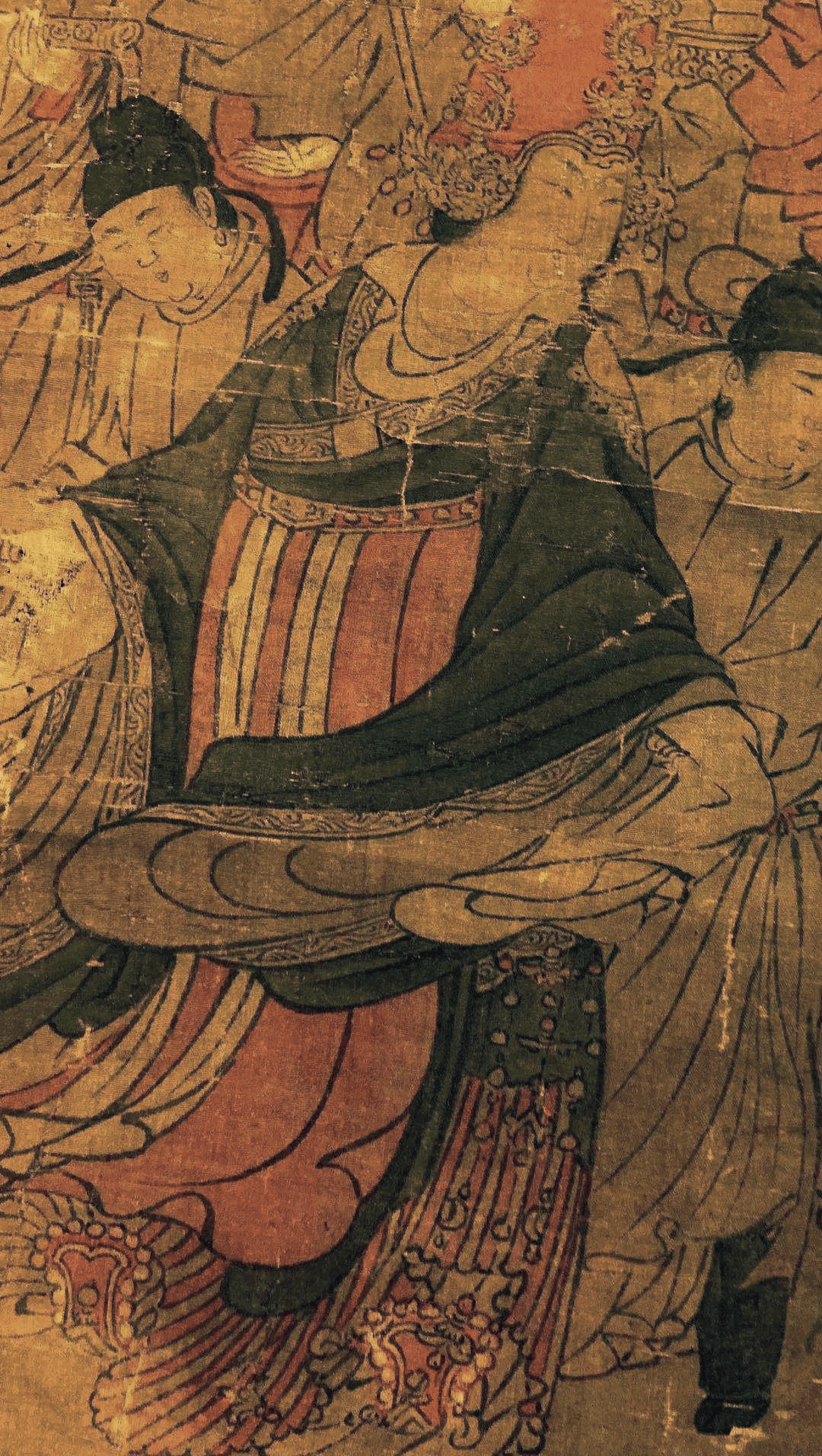
For more than four decades, the entire machinery of the Chinese empire turned on the ambition of a single woman who began her rise as a teenage imperial concubine.
On the nineteenth day of October in the year 690 CE, the imperial capital of Luoyang bore witness to a transformation that shattered more than a millennium of dynastic precedent. Wu Zhao, a sixty-six-year-old woman who had entered the imperial palace fifty-two years earlier as a low-ranking teenage concubine, formally ascended the dragon throne. She did not rule behind a screen, nor did she govern as a dowager regent for an underage heir; instead, she claimed the title of Huangdi—the imperial supreme ruler—becoming the first and only undisputed female sovereign in Chinese history. To mark this new epoch, she proclaimed the founding of the Zhou dynasty, deliberately interrupting the rule of the Li family’s Tang dynasty. For the grand ceremony, she donned a yellow robe, a garment traditionally reserved for the sole use of the male emperor, signaling to her subjects and the ancestral spirits that she was the absolute, legitimate ruler of the realm. This act of self-coronation was the culmination of three decades of meticulous political maneuvering, during which she had outlived one emperor, dominated another, and systematically sidelined her own sons. Yet, her accession was not merely a personal triumph of political survival; it was a profound institutional revolution. To secure her crown in a society governed by deeply patriarchal Confucian ideals, Wu was forced to dismantle the traditional aristocratic power structures of seventh-century China, replacing them with a highly centralized, merit-based state apparatus that permanently altered the social fabric of the empire.
The foundation of Wu’s early reign was built upon a calculated combination of state-sponsored terror and administrative vigilance. Recognizing that the established aristocratic families of the northwest—the powerful Guanzhong elite who had formed the backbone of the Tang court—viewed her as an illegitimate usurper, she moved swiftly to neutralize them. Beginning during her regency in 684 CE, and continuing into the first decade of her reign as emperor, she deployed a ruthless network of secret police. Figures such as Suo Yuanli, Zhou Xing, and the notorious Lai Junchen were empowered to root out dissent, utilizing a systematic apparatus of anonymous informants, torture, and forced confessions. To facilitate this climate of constant monitoring, Wu ordered the installation of copper mailboxes outside imperial government buildings, inviting citizens of any social standing to submit secret reports of treason directly to her. These reports were not merely filed away; the sovereign personally reviewed them, ensuring that the threat of imperial retribution remained constant. The resulting purges targeted twelve entire collateral branches of the imperial Li family and resulted in the wholesale execution, forced suicide, or exile of veteran officials and aristocratic clans. The climate of fear was codified in the , a chilling instructional text written by her secret police chiefs detailing methods to extract confessions under extreme duress. Yet, while traditional historians have often focused solely on the bloodletting of these purges, the modern historical consensus reveals a more complex governance. Wu’s administration of terror was highly selective and transactional; she grasped the absolute power of reward and punishment, and if she discovered that an official brought to power by her favor was incompetent, she would dismiss or execute them without hesitation. Sima Guang, the Song dynasty historian who was otherwise deeply critical of her reign, admitted that because she possessed sharp observation and excellent judgment, the most talented individuals of the era were ultimately eager to be employed in her service.
From the archives
Wu Zetian in formal court dress. Tang-era depiction, reproduced from a later painted album.
Public domain · via Wikimedia Commons
The deliberately blank stele at the Qianling Mausoleum — Wu Zetian's tomb has no inscribed assessment of her reign.
CC BY-SA · via Wikimedia Commons
Tang China c. 700 CE — the empire Wu Zetian ruled at its mature reach into central Asia.
Indeed, the most enduring legacy of Wu’s fifteen-year Zhou dynasty lies in her sweeping reforms of the imperial bureaucracy, particularly her restructuring of the civil service examination system. Before her ascendency, the Tang state was largely dominated by a hereditary oligarchy, where high offices were the birthright of northwest aristocratic families. To bypass this hostile elite and construct an alternative base of loyal bureaucrats, Wu dramatically expanded the recruitment pool for the civil service. She opened the examinations to candidates from the North China Plain and other previously disenfranchised regions, allowing both commoners and lower-tier gentry to compete on an equal footing. In 693 CE, she formally expanded the testing regimen, elevated its importance as the primary channel for administrative placement, and personally introduced palace and military examinations designed to assess talent based strictly on merit rather than pedigree or familial connections. Under her patronage, the successful examination graduates formed a new, fiercely loyal elite within the capital. This administrative class owed its status entirely to the sovereign, effectively neutralizing the old aristocracy and creating a highly professionalized civil service. To assist in bypassing the traditional chancellery, Wu also turned to the "North Gate Scholars"—a group of mid-level officials selected for their literary brilliance who worked within the private quarters of the palace. These scholars drafted ideological treatises, compiled educational manuals, and offered confidential policy advice, allowing the female emperor to govern without relying on the established ministries.
Beyond the halls of civil administration, Wu demonstrated a remarkable grasp of ideological legitimization, masterfully using religion to justify her unprecedented status. Confronted with Confucian texts that declared a female ruler to be as unnatural as a "hen crowing at dawn," she looked instead to Buddhism to establish her sovereign authority. In 690 CE, on the eve of her accession, she patronized a group of orthodox Buddhist monks, including her associate Xue Huaiyi, who compiled the Commentary on the Meanings of the Prophecies About the Divine Sovereign in the Great Cloud Sutra. This text, translated from an earlier Sanskrit manuscript, highlighted a dialogue between the Buddha and the Devi of Pure Radiance, in which the Buddha prophesied that the Devi would be reincarnated in a female body to rule over a great empire. Wu systematically distributed this commentary throughout her territories and ordered the construction of a Great Cloud Temple (Dayun Temple) in every prefecture of the capital regions of Luoyang and Chang'an. To further transcend the limitations of her gender, she associated herself with the cosmic figures of Maitreya, the future Buddha, and Vairocana, adopting their iconography and claiming to be a living bodhisattva. This religious patronage was paired with massive state construction projects, including her financing of the colossal Maitreya statue at the Longmen Grottoes in 673 CE, for which she contributed twenty thousand cash of her own funds. While she elevated Buddhism above Taoism, she did not entirely abandon traditional state rites. In 666 CE, during the reign of her husband Emperor Gaozong, she had participated in the sacred feng and shan sacrifices on Mount Tai. In an unprecedented breach of protocol, Wu led a procession of court ladies up the sacred mountain to offer sacrifices to the earth deity immediately after the emperor had made his offerings to heaven, visually linking herself to the most ancient rituals of imperial legitimacy.
This sophisticated domestic policy was matched by a highly active, if occasionally volatile, foreign policy designed to defend and expand the empire's borders. Wu’s reign coincided with the High Tang period, an era of immense cultural confidence and military projection. She utilized the fubing system—a network of self-supporting soldier-farmer colonies that provided a readily available military force at minimal expense to the state treasury—to maintain garrison forces along the vast northern and western frontiers. Her military commanders engaged in protracted, often bloody campaigns against the Tibetan Empire, the Western Turks, and the Khitans. While her armies suffered severe setbacks, such as a major defeat against the Tibetan generals of the Gar clan in the spring of 696 CE, her strategic persistence yielded major territorial achievements. In 692 CE, she commissioned General Wang Xiaojie to launch a decisive campaign that successfully recaptured the crucial Four Garrisons of the Western Regions—Kucha, Yutian, Kashgar, and Suyab—which had been lost to the Tibetans decades earlier, thereby securing China's dominance over the lucrative Central Asian trade routes. Along the northern frontier, her administration faced a dangerous rebellion in 696 CE led by the Khitan chieftains Li Jinzhong and Sun Wanrong. When the initial imperial forces sent to suppress the uprising were defeated, Wu utilized delicate diplomacy and costly concessions to secure an alliance with Qapaghan Qaghan of the Second Turkic Khaganate, who launched devastating flank attacks against the Khitan base of operations. By 697 CE, the Khitan threat was entirely neutralized. Through these campaigns, Wu managed to protect the integrity of the empire's borders during a time of immense external pressure, ensuring that the economic and cultural life of the central plains could flourish undisturbed.
Within the vibrant court of Luoyang—which Wu had elevated to the status of a coequal capital and renamed the Divine Capital—the sovereign fostered a brilliant literary culture. She was an accomplished writer herself; forty-six of her poems were later collected in the Complete Tang Poems, and sixty-one of her essays were preserved in the Collected Tang Essays. She sponsored the creation of massive anthologies, such as the Collection of Precious Glories (Zhuying ji), and established institutes to produce biographies of exemplary women, such as the Collection of Biographies of Famous Women. Her court served as the primary crucible for the stylistic development of the "new style" regulated verse (jintishi), pioneered by court poets like Song Zhiwen and Shen Quanqi. Furthermore, Wu sought to leave a permanent mark on the Chinese language itself by commissioning her relative Zong Qinke to design a series of newly modified Chinese characters. Among these was the character Zhao (曌), which she adopted as her personal name. Formed by placing the character for "light" or "clarity" (ming) over the character for "sky" or "void" (kong), the symbol represented her self-image as a celestial force, a brilliant light shining from the heavens down upon the mortal realm.
As the eighth century dawned, however, the domestic stability of Wu's court began to decay under the weight of her advancing age and the rising influence of her personal favorites. In her later years, her governance grew increasingly extravagant, and she relied heavily on two young brothers, Zhang Yizhi and Zhang Changzong, whom she elevated to high courtly ranks and created as dukes. As she fell seriously ill in the winter of 704 CE, she withdrew into her private chambers, permitting only the Zhang brothers to see her while shutting out her senior chancellors and ministers. This isolation sparked widespread panic and rumors of an impending usurpation by the favorites. The tension culminated on February 20, 705 CE, in what became known as the Shenlong Coup. A coalition of senior officials, including Zhang Jianzhi and Huan Yanfan, allied with key military generals and won the crucial support of Wu’s eldest surviving son, the former Emperor Zhongzong. The conspirators marched on the palace, executed the Zhang brothers in the outer courtyard, and surrounded the Changsheng Hall where the ailing sovereign lay. Confronted by her ministers and her son, the eighty-one-year-old Wu was forced to yield. On February 22, an edict was issued in her name passing the imperial seal to her son, and the next day, the Tang dynasty was formally restored, bringing an end to the brief Zhou interlude.
Wu Zhao spent her final months in quiet retirement at the auxiliary Shangyang Palace, stripped of her sovereign authority but still treated with the formal honors due to a retired monarch. She died on December 16, 705 CE. In her final days, she issued an edict requesting that she not be interred under the title of an independent Huangdi, but rather as "Empress Consort Zetian Dasheng," choosing to be buried alongside her husband, Emperor Gaozong, in the joint Qianling Mausoleum. This final act of pragmatism was a characteristic gesture from a woman who understood that her historical legacy would be shaped by the Confucian scholars who followed her. In the centuries after her death, that legacy became a highly contested battleground. Traditional historians, steeped in Neo-Confucian orthodoxy, systematically vilified her, using her reign as a cautionary tale of the chaos that allegedly ensues when women step outside the domestic sphere. They accused her of poisoning her eldest son, strangling her infant daughter, and ruling through a reign of terror, while ignoring the broad social and economic stability that her subjects enjoyed. Yet, other historians recognized that under her steady, long-term administration, the empire grew stronger, the borders were secured, and the administrative reforms she introduced laid the essential groundwork for the cultural heights of the High Tang era under her grandson, Emperor Xuanzong. Ultimately, Wu Zhao remains an enigmatic figure of towering historical importance—a ruler whose rise to power was written in blood, but whose institutional reforms democratized the Chinese bureaucracy and forever broke the monopoly of the medieval aristocracy. Her reign leaves us with a profound historical question: can the violent, autocratic methods she used to seize and maintain her throne be separated from the administrative brilliance and social mobility that her dynasty bequeathed to subsequent generations?