Event · 1336 CE – 1646 CE · Southern Indian Empires
Vijayanagara Empire
- Also known as
- Bisnaga
- Carstvo Vijayanagara
- Empayar Vijayanagara
- Empèri de Vijayanagar
- Imperi de Vijayanagara
- Imperio Vijayanagara
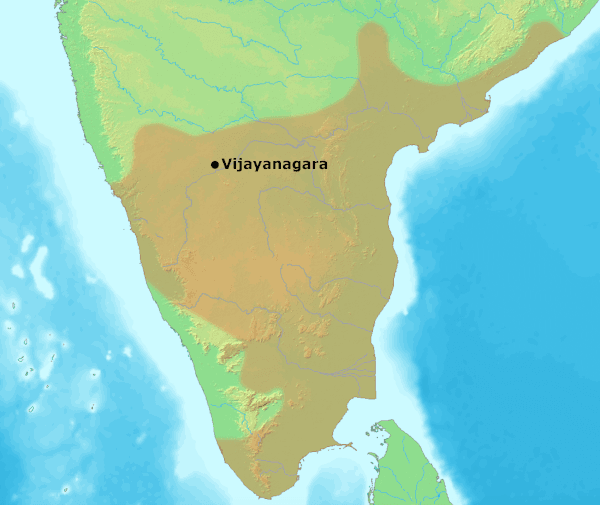
To the medieval European travelers who braved the journey to southern India, it was known as the Kingdom of Narasinga, a land of such immense wealth and architectural ambition that its fame echoed far beyond its borders.
In the dry, boulder-strewn basin of the Tungabhadra River, where the landscape of central Karnataka rises in spectacular, chaotic heaps of gray and pink granite, there once stood a city that European travelers described with a mixture of disbelief and awe. To the Portuguese merchant Domingo Paes, writing in the early sixteenth century, it was "as large as Rome, and very beautiful to the look," a place of endless orchards, active conduits of sweet water, and markets overflowing with rubies, diamonds, and silks. This was Vijayanagara—the "City of Victory"—the pulsing heart of an empire that, at its zenith, commanded almost the entirety of the Indian peninsula south of the Krishna River. Yet this metropolis did not begin in grand imperial ambition, but rather in the desperate, defensive reflex of a fractured subcontinent.
By the early fourteenth century, the old political order of the southern Deccan had been systematically shattered. The ancient and prosperous Hindu kingdoms of the region—the Yadavas of Devagiri, the Kakatiyas of Warangal, and the Hoysalas of Halebidu—had one by one crumpled under the relentless southwards thrust of the Delhi Sultanate. When the small breakaway kingdom of Kampili, situated near the banks of the Tungabhadra, was besieged and defeated by the forces of Sultan Muhammad bin Tughluq around 1327, its populace chose jauhar—ritual mass suicide—over submission. Out of this vacuum of destruction and resistance, the Vijayanagara Empire was born in 1336. Founded by two brothers, Harihara I and Bukka Raya I of the Sangama dynasty, the new state was conceived as a bulwark against northern expansion. Whether the brothers were Carnatic commanders of the declining Hoysalas or Telugu officers fleeing the ruin of Warangal remains a subject of historic debate, but their mission was singular: to gather the scattered remnants of the southern kingdoms under a single, unifying banner.
The early decades of the empire were defined by rapid, aggressive consolidation. Operating initially from the northern bank of the Tungabhadra at Anegondi, the founders quickly realized the strategic vulnerability of their position to northern cavalry raids. Bukka Raya I relocated the capital to the south bank, renaming it Vijayanagara, a site naturalistically fortified by rugged hills and the sweeping arc of the river. From this mountain-ringed stronghold, the Sangama kings launched campaigns that annexed the Reddys of Kondavidu, subdued the Sultanate of Madurai, and secured the vital western port of Goa. By the late fourteenth century, Harihara II could justly claim to be the "master of the eastern and western seas." Yet this rise to prominence provoked a permanent, existential rivalry with the Bahmani Sultanate to the north. For two centuries, the fertile, alluvial doab between the Krishna and Tungabhadra rivers became a bloody chessboard, contested in a cycle of invasions, fragile treaties, and demands for tribute that saw hundreds of thousands of gold coins, war elephants, and pearls trade hands to temporarily buy peace.
Connected to
- followsDelhi Sultanate1206 CE
- contains · foundedHampi
- religionHinduism
- had as citizenKrishnadevaraya1471 CE
+ 6 further connections to entries not yet ingested