Person · 1441 CE – 1493 CE · Andean Civilizations
Túpac Inca Yupanqui
- Also known as
- Amaru Inca Yupanqui
- Inca Tupac Yupanqui
- Inca Túpac Yupanqui
- İnka Tupak Yupankui
- Inka Yupanki
- Topa Inca
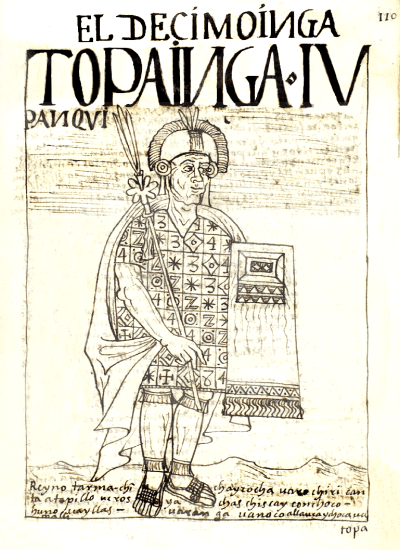
The expansion of the Inca Empire was not a gradual seepage of culture, but a series of explosive, calculated campaigns led by a prince who reshaped the geography of western South America before he even inherited the throne.
In the high, thin air of the Andes, where the earth rises to meet the sun, power was traditionally measured by how far a man could walk. But sometime around the year 1470, a young prince named Túpac Inca Yupanqui stood on the Pacific coast near Tumbes and looked west across a flat, gray horizon that offered no footholds. According to Spanish chroniclers who arrived decades later, a group of maritime merchants had recently sailed into port on great balsa-wood rafts fitted with cotton sails, bearing tales of distant, wealthy islands named Nina Chumpi and Hawa Chumpi—the islands of fire and the outer belt. For a prince whose father, Pachacuti, was busy transforming the kingdom of Cusco into the Tawantinsuyu, the "region of four provinces," the horizon was not a boundary but an invitation. Túpac Inca, possessed of what contemporary accounts described as lofty and ambitious ideas, ordered the construction of an immense fleet of sailing rafts. He embarked with twenty thousand chosen men into the open Pacific, vanishing for nearly a year. When he returned, his vessels carried gold, brass chairs, dark-skinned captives, and the preserved skin and jawbone of an unknown beast.
This voyage, recorded by the chronicler Pedro Sarmiento de Gamboa and debated by modern scholars who wonder if the Inca reached Mangareva or Easter Island, captures the peculiar, expansive genius of the tenth Sapa Inca. Túpac Inca Yupanqui was a ruler who refused to accept the natural limits of geography. Before his death in 1493, he would stretch the borders of the Inca world to their absolute geographic extremes, marching armies from the humid cloud forests of the Ecuadorian Andes down to the sun-bleached deserts of coastal Peru, and southward into the cold plains of modern-day Chile. If Pachacuti was the architect who conceived the imperial machinery of the Inca state, it was Túpac Inca, first as his father’s crown prince—the Auqui—and later as sole ruler, who put that machinery into devastating, perpetual motion.
As a young military commander, the prince proved to be a relentless strategist. He moved through the Andean highlands like a glacier, subduing the Bombon Plateau, the valley of Huaylas, and Hatun Xauxa through a combination of siege warfare and diplomatic intimidation. His campaigns were logistical triumphs, supported by the rapidly growing network of imperial roads and administrative centers. He was not merely a destroyer of cities but a builder of them. When he conquered the northern highlands of modern-day Ecuador, he fell into a deep fascination with the city of Quito. Rather than leveling it, he imported architects directly from Cusco to rebuild it in the imperial style, transforming it into a northern mirror of the capital. Yet his greatest military test lay on the arid northern coast of Peru, where the Chimú Empire, a highly sophisticated, urban civilization centered on the mud-brick metropolis of Chan Chan, stood as the ultimate rival to Inca hegemony. Túpac Inca besieged Chan Chan, severed its vital aqueducts, and forced the capitulation of the desert kings, incorporating the wealthy kingdom of Chimor into his father’s rapidly expanding empire.
Connected to
- father · child ofPachacuti1391 CE
+ 11 further connections to entries not yet ingested