Place · 1460 CE · Ottoman Empire
Topkapı Palace
- Also known as
- Carigradski dvor
- Cung điện Topkapı
- Dr Topkapi-Balast
- Istana Topkapi
- Istana Topkapi
- Istana Topkapi
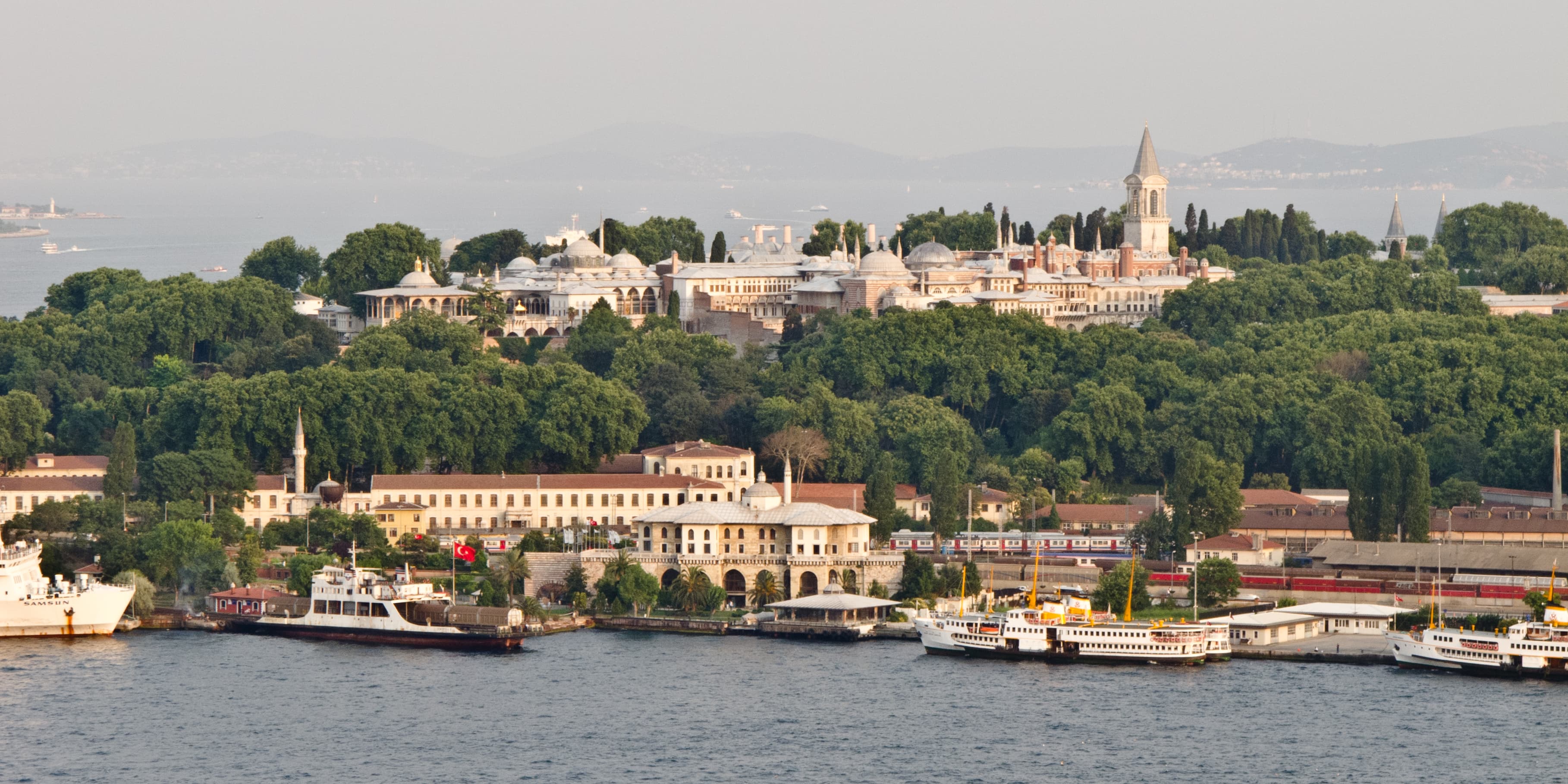
Six years after he shattered the walls of Constantinople, Sultan Mehmed the Conqueror set about reshaping the city’s skyline.
When Sultan Mehmed II, newly hailed as the Conqueror, surveyed the ruins of Constantinople in the years following its fall in 1453, he found the ancient Great Palace of the Byzantine emperors largely uninhabitable. For a short time, the Ottoman court established itself in the center of the city at what became known as the Old Palace. Yet Mehmed required a setting that would physically manifest the shift of world history his conquest had wrought—an arena where his new administrative order could be executed in absolute, silent isolation. In 1459, he selected the high, hilly promontory of Seraglio Point, where the ancient Greek acropolis of Byzantion had once stood overlooking the confluence of the Golden Horn, the Bosphorus, and the Sea of Marmara. Summoning the finest stonemasons, carpenters, and sculptors from across his expanding realms, Mehmed began the construction of the Saray-ı Cedîd-i Âmire, the Imperial New Palace.
For nearly four centuries, this sprawling site—known to the West as the Seraglio and eventually named Topkapı, or "Cannon Gate," after a nearby seaside gateway—was the nerve center of the Ottoman Empire. The design that emerged from the 1460s onward was a striking departure from Western ideals of monumental architecture. To European visitors, Topkapı appeared asymmetric, non-axial, and low-slung, comprised of an almost organic accumulation of single- and double-story pavilions rather than a singular, towering palace. It was designed not to overwhelm the spectator with a colossal facade, but to lead the initiate through a series of increasingly restricted, nested courtyards, where the noise of the outer world was systematically stripped away until only the quiet of the sovereign remained. This layout was the architectural expression of the Kanunname, the imperial code promulgated by Mehmed II in the late fifteenth century, which codified a strict court hierarchy, precise protocol, and, above all, the principle of imperial seclusion. In the inner courtyards, even the highest officials of the state were expected to observe an absolute, heavy silence.
The progression through Topkapı was a journey from the public to the deeply private. One entered the complex through the massive Imperial Gate, a high-domed stone structure adorned with gilded calligraphy and the monograms of the sultans, which led into the vast First Courtyard. Known as the Court of the Janissaries, this outermost precinct functioned as a public park and parade ground, where visitors were greeted by the ancient Byzantine church of Hagia Irene, repurposed by the Ottomans as an imperial armory and storehouse. To proceed further, one had to pass through the crenellated, twin-towered Gate of Salutation. Here, the strictures of Ottoman majesty were instantly felt: all visitors, no matter their rank or foreign stature, were required to dismount from their horses before crossing the threshold. Only the sultan was permitted to ride through the gate on horseback, a deliberate continuation of the ceremonial traditions of the Byzantine emperors.
Behind this gate lay the Second Courtyard, where the administrative machinery of the empire hummed, and further still lay the third and fourth courtyards, which housed the private quarters of the sultan, the imperial treasury, and the school for court pages. However, the spatial and political dynamics of the palace shifted dramatically in the sixteenth century during the reign of Suleyman the Magnificent. The empire had grown to encompass vast territories across three continents, and the palace underwent a massive expansion under the direction of the Persian architect Alaüddin and, later, the legendary Mimar Sinan, who rebuilt the imperial kitchens and private baths after a devastating fire in 1574.
The most profound transformation of Topkapı’s spatial politics was engineered not by an architect, but by Hurrem Sultan, the influential wife of Suleyman. Traditionally, the female members of the royal family resided in the Old Palace, miles away from where state affairs were conducted—a separation explicitly decreed by Mehmed the Conqueror. But after a catastrophic fire ravaged the Old Palace in 1541, Hurrem successfully lobbied to permanently relocate the Imperial Harem to Topkapı. This physical consolidation of the private family and the public divan forever altered the power dynamics of the Ottoman court. The Harem grew into a massive labyrinth of more than four hundred rooms, complete with guarded apartments, private courtyards, and secret passageways protected by grilled windows. From this sprawling domestic stronghold, the queen mothers and royal consorts began to exert unprecedented influence over statecraft, diplomacy, and the succession of the throne.
By the close of the sixteenth century, Topkapı had achieved the physical form that survived into the modern era: an intricate, terraced compound of stone, marble, and brilliant Iznik tiles, surrounded by high defensive walls and flanked by the lush imperial gardens of Gülhane Park. Along the shorelines of the Bosphorus stood various pavilions, summer kiosks, and pleasure palaces, most of which have since been lost to time, fire, and nineteenth-century railway construction, leaving only the late sixteenth-century Basketmakers’ Kiosk as a solitary witness to the palace’s old maritime face.
The decline of Topkapı was gradual but inevitable. By the seventeenth and eighteenth centuries, the sultans grew weary of the medieval palace’s rigid, inward-looking architecture and began spending more of their time in airy, European-style villas built along the shores of the Bosphorus. In 1856, Sultan Abdülmecid I officially abandoned Topkapı, moving his court to the newly constructed Dolmabahçe Palace, a monument of Westernized luxury and contemporary comfort that stood in stark contrast to the secluded pavilions of Seraglio Point. Though the old complex retained the imperial treasury, the mint, and the library, its halls fell quiet, preserved as a relic of a bygone age.
Following the dissolution of the Ottoman Empire, the newly declared Republic of Turkey transformed Topkapı into a museum by government decree on April 3, 1924. Today, its courtyards are filled not with silent janissaries and petitioning viziers, but with millions of global visitors. The spaces that once demanded absolute silence now echo with the languages of the modern world. In its guarded treasury, the Spoonmaker’s Diamond and the jewel-encrusted Topkapı Dagger catch the light, while the quiet chambers of the inner palace hold illuminated manuscripts, weapons, and sacred relics. Recognized as a cornerstone of the UNESCO World Heritage Site of Istanbul, Topkapı Palace remains on its high promontory, a physical map of a vanished empire’s mind—an architecture designed not to show power, but to shelter it.
Connected to
- founded byMehmed II1432 CE
+ 12 further connections to entries not yet ingested