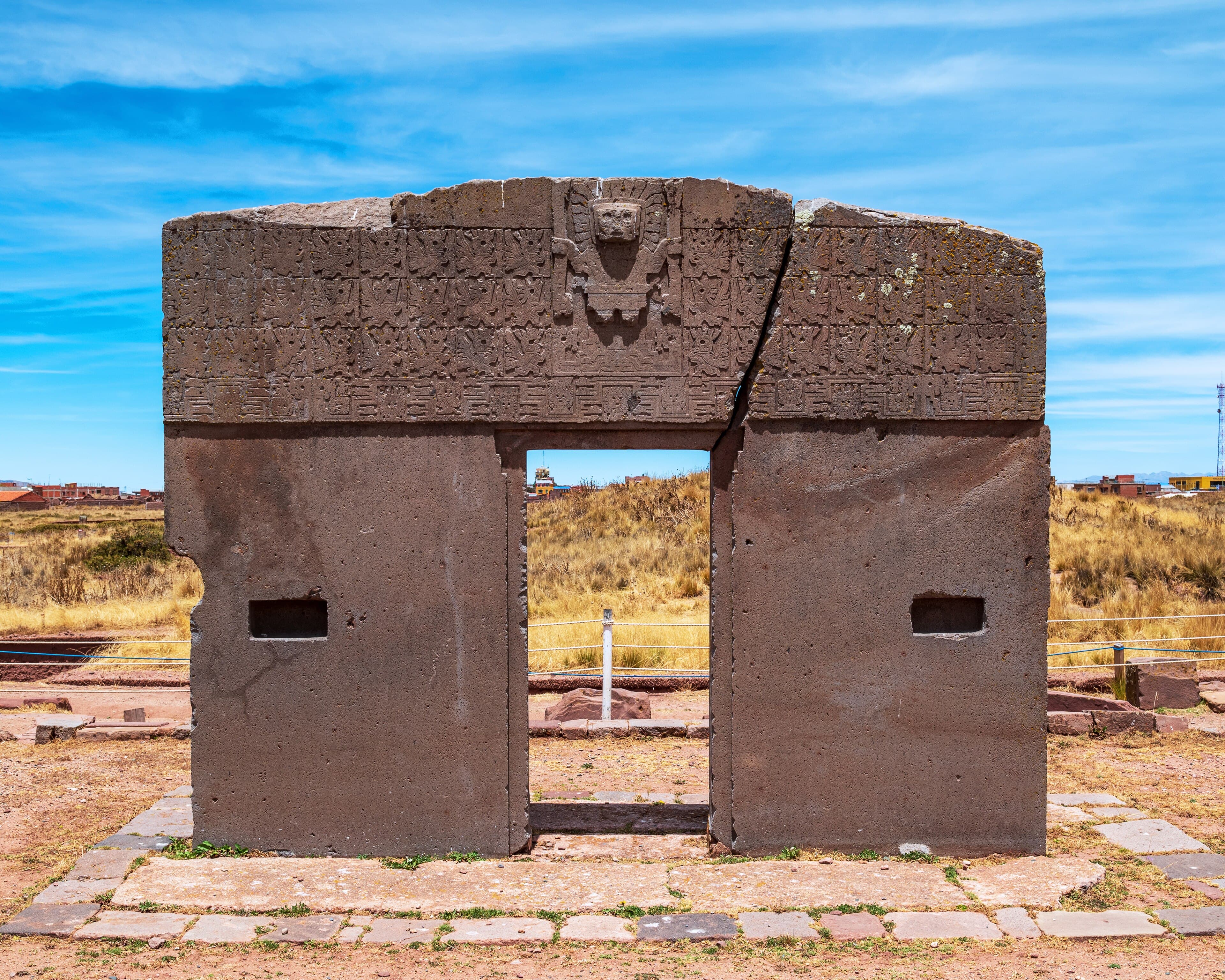
High in the Andean altiplano of western Bolivia, near the shores of Lake Titicaca, lie the megalithic blocks and monumental structures of an ancient city that once considered itself the literal midpoint of existence.
High in the Andean basin, where the thin air of the altiplano meets the vast, reflective expanse of Lake Titicaca, lies a collection of shattered stone that was once believed to be the navel of the universe. To the Jesuit chronicler Bernabé Cobo, writing in the century after the Spanish conquest, the ruins were known by their Aymara name: taypiqala, meaning "the stone in the center." Long before the Inca carved their empire across the spine of South America, this barren, wind-swept valley in western Bolivia was home to Tiwanaku, a metropolis of monumental scale and baffling architectural precision. For half a millennium, between approximately 400 CE and 900 CE, it operated not merely as a city, but as a cosmic anchor—a place where the movements of the stars were carved into heavy andesite, and where the human and divine were brought into violent, ecstatic alignment.
When the Spanish conquistador Pedro Cieza de León first encountered the site in 1549 while searching for the southern Inca capital of Qullasuyu, the city had already been empty for centuries. What he found was a ghost landscape of colossal earthen mounds and megalithic blocks so finely cut and joined that they defied the imagination of sixteenth-century Europeans. The scale of the engineering was so immense that twentieth-century romanticists, desperate for an explanation, spun wild chronologies. The explorer Arthur Posnansky spent decades arguing that the site was up to 17,000 years old, while mid-century archaeologists claimed a foundation date of 1580 BCE. Modern science has since anchored Tiwanaku to a more modest, yet no less extraordinary, reality. The city began its steady rise in the early centuries of the first millennium, coalescing into a major urban and ceremonial power around 375 CE. At its zenith in 800 CE, it housed a concentrated population of 10,000 to 20,000 people, sustained by a complex agropastoral economy and trade networks that stretched across the Andes.
The heart of Tiwanaku was designed as a physical manifestation of the cosmos, flanked by the sacred peaks of Pukara and Chuqi Q’awa. The city’s elite lived within a monumental core surrounded by a massive, water-filled moat—a deliberate design choice meant to transform the sacred precinct into a metaphorical island, isolated from the profane world of the commoners. Within this sacred island stood the Akapana, a colossal, terraced platform mound shaped like a half-Andean cross, rising sixteen and a half meters above the plain. The Akapana was a place of transformation and terror. Excavations of the mound have revealed the remains of human and camelid sacrifices, offering a grim glimpse into the rituals that sustained the state. Among the artifacts of the Tiwanaku hinterlands, scholars have identified a recurring motif: the "Camelid Sacrificer," a figure combining human and alpaca-like traits, clutching an axe or a severed trophy head. In the Andean worldview, humans and camelids shared , a vital life essence, and the act of sacrifice was part of —the profound, necessary process of becoming and cosmic transformation.
9 links to entries not yet ingested in the Library.
To the north of the Akapana lies the Kalasasaya, a massive walled courtyard containing the famous Gateway of the Sun. Nearby, the Semi-Subterranean Temple sinks into the earth, its sandstone walls studded with dozens of stone tenon heads, each carved in a different style, as if representing the diverse peoples and ancestors pulled into Tiwanaku’s spiritual orbit. These structures were not merely stages for ritual; they were massive astronomical instruments. The Kalasasaya was precisely aligned to mark the sunrise on the equinoxes and both solstices, while the Akapana aligned with the peak of the Quimsachata mountain, offering an uninterrupted view of the rotation of the Milky Way.
Yet, for all its spiritual gravity, the true wonder of Tiwanaku lies in its masonry. At the neighboring complex of Pumapunku, a T-shaped, terraced earthen platform faced with megalithic blocks, the stone-cutting reaches a level of sophistication unmatched in the pre-Columbian Americas. Here, builders worked with blocks of astonishing size. The largest, part of a paved stone terrace known as the "Plataforma Lítica," is estimated to weigh 131 metric tonnes; a second block weighs eighty-five tonnes. The precision with which these blocks were cut, using a complex system of proportions and descriptive geometry, has baffled observers for generations. The gateways of Pumapunku and the Akapana feature recessed frames with socket joints for metal clamps, demonstrating a highly organized, modular system of construction where individual stone elements were shifted and adjusted to fit together. Though modern fringe theorists have tried to attribute this craft to external forces, reconstruction work based on three-dimensional modeling shows that it was the result of human ingenuity, patience, and a deep understanding of structural form.
This monumental architecture was supported by an economy that was equally structured. The people of Tiwanaku had no market institutions or commercial currency. Instead, they operated under a system of elite redistribution. The ruling class controlled virtually all agricultural and economic output, but they were bound by a reciprocal obligation to provide commoners—whether they were farmers, herders, or potters—with the resources required to fulfill their specific roles. As the city grew, occupational niches became highly specialized. Artisans produced beautifully decorated ceramics, intricate textiles, and portable prestige items like carved bone tubes and snuff trays, used in the ritual consumption of psychotropic substances.
Through these portable goods, the influence of Tiwanaku radiated outward, establishing a profound cultural relationship with the Wari civilization to the north. Together, the Wari and Tiwanaku shared a common religious vocabulary known as the "Southern Andean Iconographic Series," which featured front-facing deities in the "Staff God" pose, surrounded by winged attendants. It was a relationship based on trade, ritual, and perhaps military alliance, which bound the southern Andes together in a shared spiritual geography.
By 900 CE, however, the cosmic order began to fracture. The complex systems that had fed and housed tens of thousands of people in the high-altitude valley began to fail. Recent geological studies of the region indicate a prolonged period of severe aridity that settled over the altiplano toward the end of the first millennium. The drought devastated the local agriculture, drying up the raised fields that had long insulated crops from the brutal highland frosts. Without the agricultural surplus to redistribute, the social contract between the elites and the commoners dissolved. By 1000 CE, the state had collapsed, and the "stone in the center" was abandoned to the elements.
Yet Tiwanaku’s story did not end with its abandonment. Centuries later, the rising Inca Empire would look upon the megalithic ruins of the altiplano not as a dead city, but as a sacred origin point. They incorporated Tiwanaku’s architectural styles, its stone-working techniques, and its celestial iconography into their own imperial ideology, claiming the site as the place where their creator god, Viracocha, first brought the sun and moon into being. In this way, Tiwanaku survived its own collapse. Though its original name and the language of its builders—perhaps Puquina—were lost to time, the memory of its stone towers lingered, serving as the blueprint for the great empires that would follow in its shadow.