Timurid Empire
- Also known as
- Amir Temur imperiyasi
- An Impireacht Thiomuirideach
- Böyük Teymur İmperiyası
- Büyük Timur İmparatorluğu
- Dawlada Tiimuuriyiinta
- Dewleta Tîmûrî
To climb the Ulu Tagh mountainside in modern Kazakhstan is to encounter a boulder carved with a stark declaration: Timur, the "Sultan of Turan," had marched north with three hundred thousand men.
In the summer of 1391, on a high, wind-scoured ridge of the Ulu Tagh mountains in what is now central Kazakhstan, a column of three hundred thousand soldiers halted. At their head was Timur—known to the West as Tamerlane—the formidable warlord of the Central Asian steppe. He ordered his men to find a suitable slab of rock, and upon its face, stonecutters carved an inscription in the elegant Chagataid script of the north. It proclaimed that the "Sultan of Turan, Timur bey," had marched into the northern wastes with his massive army to bring war to his rival, Tokhtamysh Khan of the Golden Horde. The inscription was a monument of raw, nomadic ambition, yet it was written in a style that was already deeply literary. It perfectly captured the paradox of the empire Timur built: a state conceived in the saddle, driven by the brutal calculus of the Mongol conquests, yet one that would ultimately become the grandest patron of Persian culture, astronomy, and architecture in the medieval Islamic world.
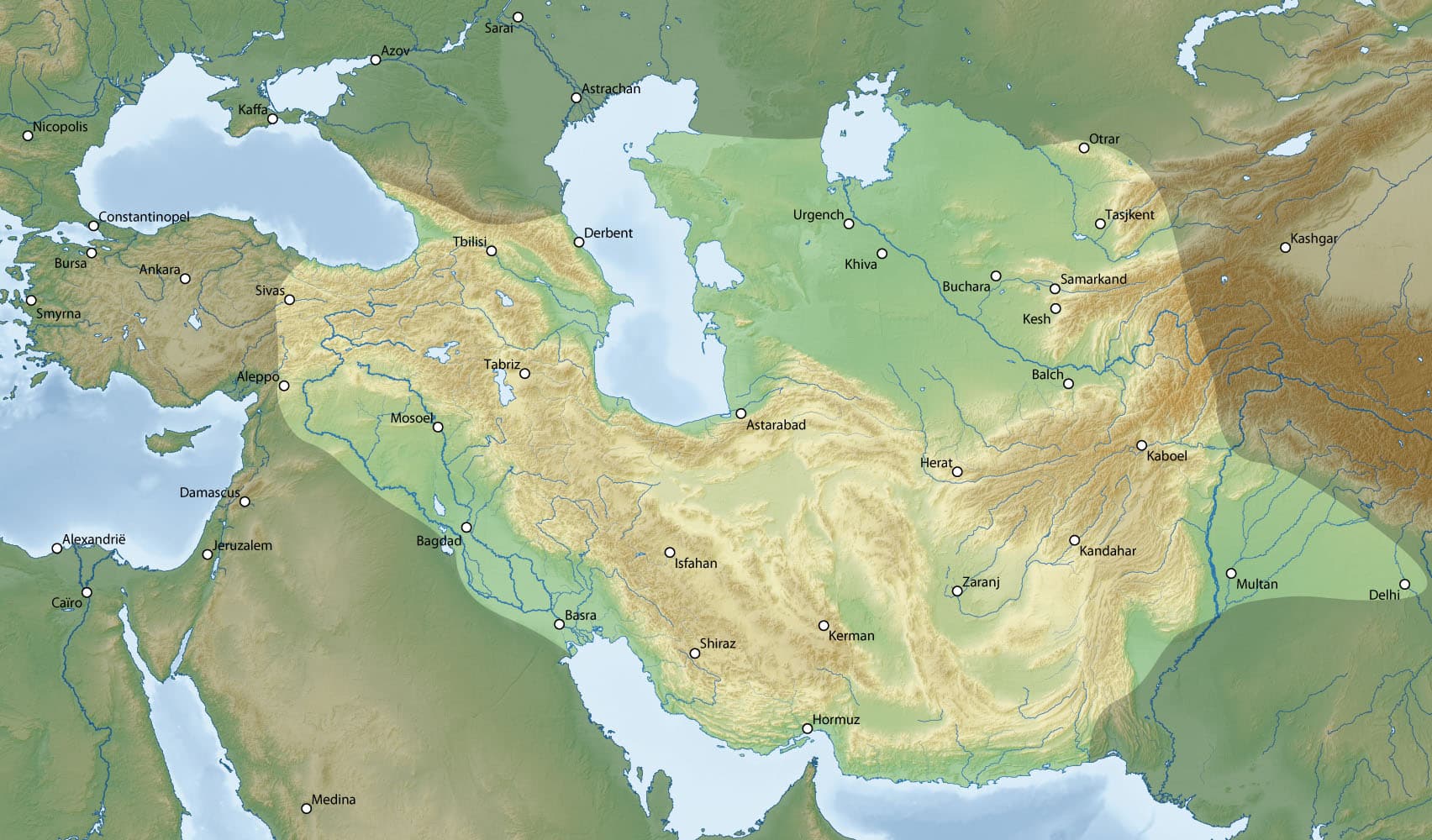
The state Timur established in 1370 was a sprawling geopolitical construct that spanned modern-day Iran, Iraq, Afghanistan, Central Asia, the South Caucasus, and parts of Pakistan, northern India, and Turkey. Born into the Barlas tribe—a Mongol group that had settled in Transoxiana, converted to Islam, and adopted the Turkic tongue—Timur was a product of the complex frontier world of the post-Chagatai Khanate. He was acutely aware of his lack of direct paternal descent from Genghis Khan, the only lineage that carried the legitimate right to the title of khan in the Inner Asian steppe. To navigate this political vulnerability, Timur ruled nominally through puppet Chagatai khans, whom he chose and discarded at will, while adopting the title of Gurkani, meaning "son-in-law," after marrying the Genghisid princess Saray Mulk Khanum. In the eyes of his contemporaries, his identity was a fluid, formidable composite. To the Syrian historian Ibn Khaldun, who met him outside the besieged walls of Damascus in 1401, Timur was "the sultan of the Mongols and Tatars," a warlord who spoke "the Mongol language" (al-lisān al-Mughūlī). To the Castilian envoy Ruy González de Clavijo, who traveled to Samarkand in 1404, the realm was simply Mugalia. Within his own court, however, the state was increasingly referred to as Iran-o-Turan—a poetic pairing that bridged the ancient, sedentary Persian world south of the Oxus River with the vast, nomadic steppe to the north.
Timur’s conquests were staggering in their speed and terrifying in their cost, leaving an estimated seventeen million people dead. Beginning in 1363, he secured Transoxiana and Khorasan, taking Samarkand in 1366 and Balkh in 1369. By 1380, he turned his armies westward, methodically dismantling the successor states of the Mongol Ilkhanate. He extinguished the Kartids of Herat, purged the Muzaffarids from Shiraz after the bloody Battle of Shiraz in 1393, and drove the Jalayirids from Baghdad. When the Delhi Sultanate fell into internal chaos, Timur crossed the Indus in 1398, routing the armies of Sultan Mahmud Shah and orchestrating a devastating massacre in Delhi. Yet, even amidst the slaughter, Timur’s distinct imperial vision was at work: he systematically spared the city’s finest stonecarvers and craftsmen, sending them back across the Hindu Kush to rebuild his imperial capital at Samarkand. He then marched west to confront the rising power of the West Asian empires, seizing Aleppo and Damascus, destroying Baghdad once more in 1401, and utterly shattering the Ottoman army at the Battle of Ankara in 1402. The Ottoman Empire was plunged into a decade-long civil war, and Timur stood unchallenged as the preeminent ruler of the Islamic world, maintaining vast diplomatic and trade networks that stretched all the way to Ming China, whose envoys regularly trekked to Samarkand.
Connected to
- had as citizenHafez1325 CE
- containsSamarkand8th c. BCE
+ 4 further connections to entries not yet ingested