Person · 1336 CE – 1405 CE · Mongol Empire and Successors
Timur
- Also known as
- Aksak Timur
- Amir Temur
- Amir Temur
- Amir Temur
- Amir Timur
- Amir timur
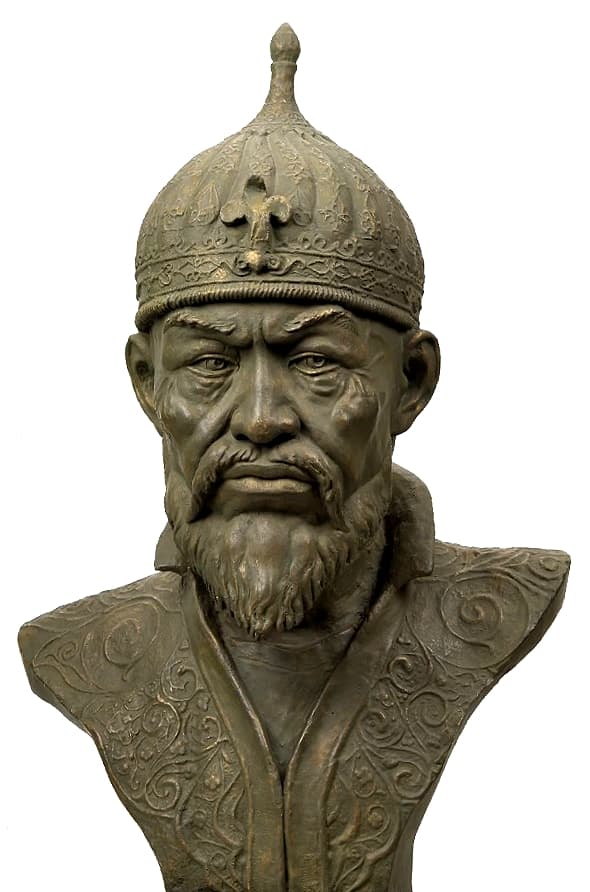
By the late fourteenth century, a single man had reconstructed the terrifying shadow of the Mongol Empire across the plains of Eurasia, establishing himself as an undefeated force of sheer military devastation.
In the mid-fourteenth century, a young man of the Barlas tribe rode across the harsh, wind-scoured grasslands of Transoxiana, leading a small band of opportunists. They survived on the margins of a splintering world, raiding travelers and rustling sheep, horses, and cattle. During one of these minor skirmishes around 1363—some say while he was attempting to steal a sheep from a local shepherd, others that he was serving as a mercenary for the khan of Sistan in the dry wastes of the Dasht-e Margo—two arrows found him. One tore into his right hand, cost him two fingers, and permanently stiffened his arm; the other shattered his right leg. He survived, but for the rest of his life, he walked with a pronounced limp. To his Persian-speaking rivals, he became known as Temūr-i Lang, "Timur the Lame," a derogatory epithet that Western tongues would later smooth into Tamerlane. Yet the name his parents gave him in his native Chagatai tongue meant "iron," and it was this unyielding quality that would define his trajectory from a crippled bandit of the steppes to the most feared conqueror of his age.
The world Timur inherited was one of profound political fragmentation. The grand Mongol consensus forged by Genghis Khan a century earlier had fractured into rival khanates, each slipping into internal decay. Born in the late 1320s near the city of Kesh, Timur belonged to the Barlas, a Mongol tribe that had migrated west, adopted the Karluk Turkic language, and converted to Islam. Though later court histories manufactured a prestigious birth date of April 8, 1336, to align his birth with the death of the last Ilkhanate ruler, Abu Sa'id Bahadur Khan, Timur’s early reality was far more modest. His father, Taraghai, was a minor noble—wealthy enough to command respect and influence in the local court, but far from a kingmaker. To rule this fractured landscape, Timur had to navigate a complex web of dual identities. He was a creature of the Eurasian steppe, steeped in the nomadic military traditions of the Mongols, but he was also a Muslim ruler operating in an increasingly settled, Persianized world.
This dual identity presented a fundamental crisis of legitimacy. According to the unwritten code of the steppe, only direct, male-line descendants of Genghis Khan could claim the title of Khan. Timur, despite later court genealogies that strained to connect his lineage to Genghis Khan’s ancestors, lacked this divine bloodline. To circumvent this, Timur operated with a brilliant, pragmatic cynicism. He elevated a succession of puppet Chaghatayid Khans, starting with Suyurghatmish, to rule nominally while he governed as their "protector" under the title of Amir, or general. He further secured his position by marrying Saray Mulk Khanum, a genuine Chinggisid princess and the widow of his former ally-turned-rival, Amir Husayn. This marriage earned Timur the coveted title of , or royal son-in-law, legally tethering him to the house of Genghis Khan. Yet the Islamic world posed a different challenge; he could not claim the title of Caliph, which was strictly reserved for the Quraysh tribe of the Prophet Muhammad. Timur solved this by casting himself in cosmic and messianic terms. He adopted the title , the "Lord of Conjunction," referencing the rare astrological alignment of Saturn and Jupiter that signaled the dawn of a new, epochal era. He styled himself the "Sword of Islam" and a —a holy warrior—while simultaneously claiming spiritual descent from the Prophet's son-in-law, Ali, effectively positioning himself as the ultimate defender of both the steppe and the faith.
Connected to
12 links to entries not yet ingested in the Library.