Place · Trans Saharan Trade
Timbuktu
- Also known as
- Timbeactú
- Timboctó
- Timboektoe
- Timboektoe
- Timboektoe
- Timbuctoo
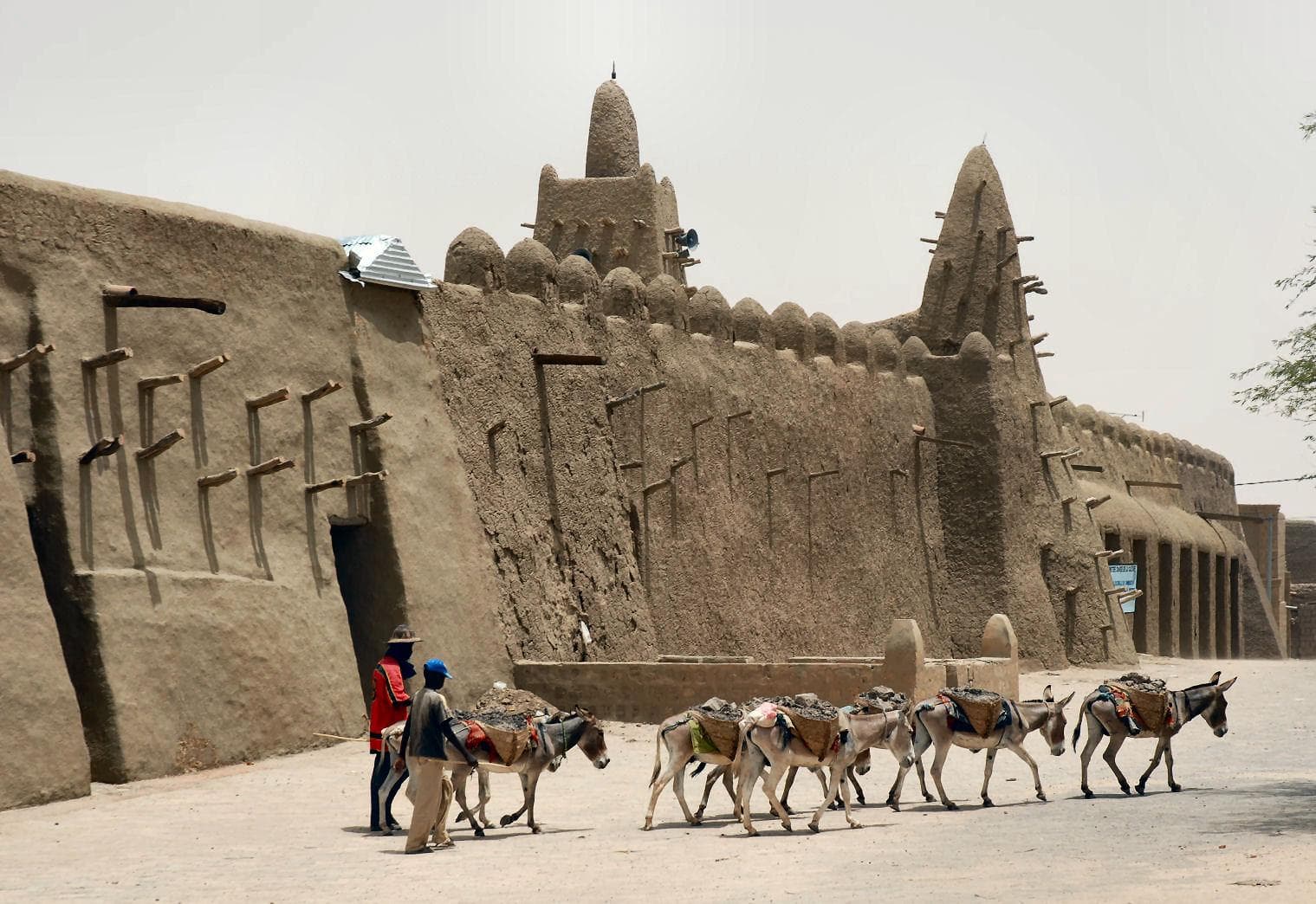
Long before its name became, in distant corners of the world, a synonym for the impossibly remote, Timbuktu existed as a seasonal camp situated just north of the Niger River.
In the closing decades of the nineteenth century, when French marines disobeyed orders and floated down the Niger River to seize Timbuktu, they found a city that had been slowly retreating into the earth. For centuries, the Western imagination had conjured it as a golden mirage—a metropolis of unfathomable wealth and forbidden geography, isolated by oceans of sand. What Lieutenant Boiteux and his handful of men actually encountered in December 1893 was a vast, wind-scoured ruin. The great mosque of Sankoré, once the intellectual heartbeat of West Africa, sat precariously near the western outskirts, its towering mud minaret standing as a lonely sentinel against the encroaching dunes. The short, eight-kilometer road between the city and its river port at Kabara was so thoroughly infested by desert raiders that the locals called it Ur-immandess—"He, God, hears not." It was a place of deep exhaustion, where the inhabitants had spent generations paying tribute to whichever nomadic army or empire had most recently swept over their horizons.
This oscillation between legendary splendor and dusty isolation is the central paradox of Timbuktu. It is a city built on the southern scarp of the Sahara, some fifteen kilometers north of the Niger River's main channel, existing precisely where the dry expanse of the desert meets the wet bounty of the river system. It has been described as the meeting point of the camel and the canoe, a natural inland harbor where the salt mines of the high desert met the gold, grain, and ivory of the African interior. The very name of the city is shrouded in this liminal geography. To some, it derives from the Songhay word Tùmbutu, meaning a depression or hollow in the sand dunes. To others, it comes from the Berber tin and bouctou, meaning the place covered by small dunes. In the seventeenth-century chronicle Tarikh al-Sudan, the historian Abd al-Sadi preserved a more intimate legend: that the city began as a seasonal camp for Tuareg nomads, who left their provisions under the care of a slave woman named Tinbuktu—meaning "the one with a lump"—whose blessed encampment grew into a global crossroads.
Long before it became a Muslim intellectual capital, the region was alive with human activity. Archaeological surveys have revealed that Iron Age settlements thrived along the ancient, now-dry wadi systems just southeast of the modern city as early as the fifth century BCE. These early communities flourished throughout the first millennium CE before collapsing around the eleventh century, just as the Maghsharan Tuareg began establishing a more permanent seasonal settlement. The true transformation of Timbuktu from a nomad depot into a global emporium, however, was ignited by water, gold, and faith. In the twelfth and thirteenth centuries, merchants from the wealthy trading city of Djenné recognized Timbuktu’s strategic position and established operations there. When the expansionist Mali Empire absorbed the city in the early fourteenth century, its fortunes became tied to the Mediterranean world.
The turning point arrived with the legendary pilgrimage of Mansa Musa around 1325. Traveling to Mecca with an entourage that dazzled the Middle East with Malian gold, the emperor returned determined to transform Timbuktu into an intellectual beacon. He recruited architects and scholars from across the Islamic world, laying the foundations for the city’s golden age. Under the Mali Empire, and later under the Songhai Empire which conquered the city in 1468, Timbuktu became a metropolis of books. Its intellectual life was anchored by the university system of the Sankoré Madrasah. Here, thousands of students and scholars did not merely study the Quran; they produced original treatises on medicine, rhetoric, law, astronomy, and history. The book trade became the most lucrative business in the city, supported by a wealthy class of local merchants and scholars like Ahmad Baba, whose erudition was celebrated throughout the Islamic world. At its peak, medieval Timbuktu housed an estimated 100,000 people, its streets bustling with North African merchants trading Mediterranean fabrics, Venetian beads, and European hardware for Saharan salt, southern gold, and intellectual manuscripts.
The wealth that built this desert university eventually proved to be its undoing. In 1590, El-Mansur, the Sultan of Morocco, cast his eyes across the desert toward the legendary gold fields of the Niger. He dispatched an invasion force across the Sahara led by an Andalusian commander. Armed with muskets, this army shattered the Songhai Empire at the Battle of Tondibi in 1591 and occupied Timbuktu. The invasion was a catastrophe from which the city’s intellectual culture never fully recovered. In 1593, suspicion of disloyalty led the Moroccan rulers to execute or exile many of Timbuktu's leading scholars, including Ahmad Baba, who was dragged in chains to Marrakesh. The occupiers established a new ruling class known as the Arma—descendants of the Moroccan musketeers—who quickly broke ties with the Moroccan Sultan and ruled as a fractured, predatory military caste.
As the Arma administration decayed into internecine strife, global trade routes were shifting. The rise of European maritime trade along the Atlantic coast of West Africa slowly bypassed the ancient trans-Saharan caravan routes. High-value goods that once crawled across the desert on the backs of thousands of camels were now loaded onto European sailing ships. Starved of its trade and drained of its scholarly class, Timbuktu fell into a long, agonizing decline. By the late eighteenth century, it was a shadow of its former self, repeatedly plundered by the Tuareg, the Fula, and the Tukulor. When European explorers finally reached the city in the nineteenth century, expecting the golden metropolis of medieval myth, they found a impoverished town of mud-brick houses slowly being buried by the desert winds.
The French colonial era, beginning in 1893, sought to freeze this decline, establishing a stable administration under a local hereditary mayor, or kahia, descended from the old Arma families. The French cleared the roads, opened European schools, and even used forced labor to dig a canal in an attempt to reconnect the silted city with the port of Kabara. Yet the modern era brought new vulnerabilities. Following Mali’s independence in 1960, Timbuktu found itself on the margins of a modern nation-state, battling both severe economic isolation and the physical threat of desertification. The Niger River's annual floods, which once spilled into the western outskirts of the city, receded, leaving Timbuktu increasingly high and dry on the southern lip of the Sahara.
In the twenty-first century, the precarity of Timbuktu has taken on a modern, geopolitical edge. The city has become a battleground in the conflict between the Malian state and insurgent forces. Following a series of military coups in Bamako, the withdrawal of United Nations peacekeepers in 2023 left a security vacuum that was quickly exploited. In August 2023, the al-Qaeda-aligned group Jama'at Nasr al-Islam wal Muslimin (JNIM) imposed a total blockade on the city. This ongoing siege has strangled the local economy, driving up food prices, causing severe shortages, and forcing tens of thousands of residents to flee across the desert toward Mauritania. Today, the population of Timbuktu has dwindled to a fraction of its medieval peak. It remains a place of profound historical resonance, containing some of the world's most precious Arabic manuscripts and earth-built architecture, yet it exists in a state of perpetual siege—contending with both the political instability of the Sahel and the relentless, silent advance of the Saharan dunes.
Connected to
6 links to entries not yet ingested in the Library.