Place · Mesoamerican Civilizations
Tikal
- Also known as
- Mutal
- Mutal
- Mutal
- Mutul
- Mutul
- Parco nazionale di Tikal
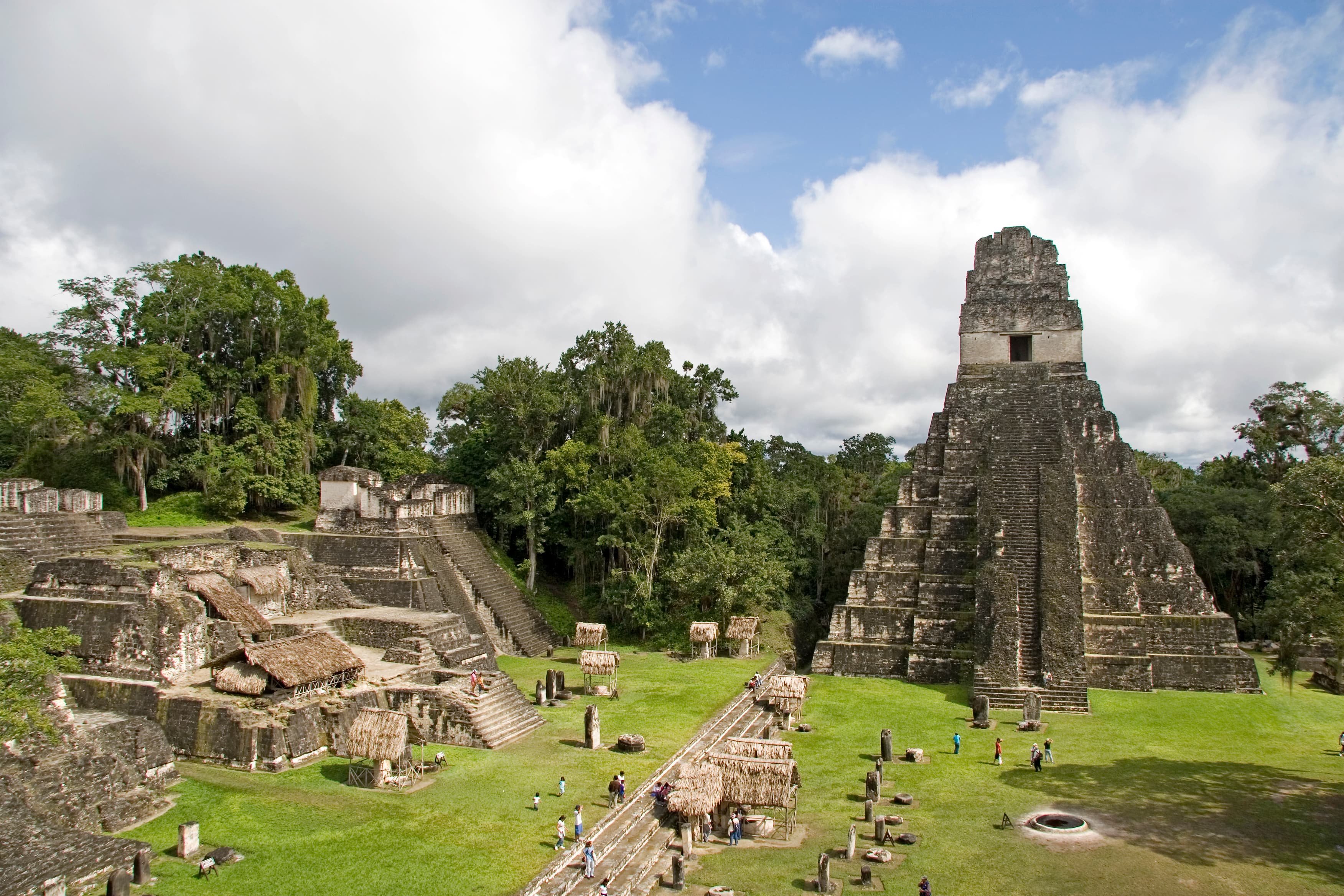
Deep within the rainforests of northern Guatemala’s Petén Basin, the towering ruins of Yax Mutal—known today as Tikal—rise above the jungle canopy.
Deep beneath the emerald canopy of the Petén Basin, where the humid air is thick with the calls of howler monkeys and the dry rustle of leafcutter ants, the stone giants of Yax Mutal rise above the forest. Today we call this place Tikal—a name meaning "at the waterhole" or "the place of the voices," bestowed by nineteenth-century travelers upon discovering its long-abandoned reservoirs. But to the classic Maya, this was the First Mutal, the supreme seat of a dynasty that shaped the geopolitics of Mesoamerica for nearly a millennium. It is a city defined by a paradox of vertical ambition and subterranean survival. Lacking any natural water source other than the tropical rains that fall unpredictably between long droughts, its rulers engineered a sprawling, paved metropolis designed to catch every drop of moisture, funneling the sky into ten massive stone reservoirs to sustain a population that may have reached ninety thousand at its peak.
To understand the sheer scale of Tikal is to look upon a landscape of calculated ascension. The city’s core covers more than sixteen square kilometers, structured around limestone ridges that rise above seasonal swamplands. High on these natural crests, the Maya built their sacred heart, connecting temple complexes and elite palaces with wide, raised causeways that arched over the low bayos. Before the great temples dominated the horizon, Tikal was a modest agrarian settlement. Traces of Middle Preclassic agriculture date as far back as 1000 BCE, evidenced by caches of simple ceramics buried deep in subterranean, bottle-shaped chambers. By the fourth century BCE, the site had begun its architectural transformation, constructing its first major pyramids and participating in the widespread Chikanel culture that linked the Yucatán Peninsula. Yet, in these early centuries, Tikal was still dwarfed by the colossal northern cities of El Mirador and Nakbe. It was only when these northern giants collapsed in the first century CE that Tikal underwent a rapid political and cultural florescence, inheriting the mantle of lowland Maya civilization.
The deep roots of Tikal's dynastic rule are traditionally traced to Yax Ehb Xook, a foundational figure who established the ruling line in the first century CE. For centuries, this dynasty consolidated its grip on the surrounding trade routes, navigating rivalries with neighboring centers like Uaxactun. But the trajectory of the city was permanently altered on a single, winter day in the late fourth century. On January 14, 378 CE, the reigning fourteenth king of Tikal, Chak Tok Ichʼaak—known to history as Great Jaguar Paw—was killed. His death coincided precisely with the arrival of a mysterious figure from the west named Siyaj Kʼakʼ, or "Fire Is Born." Hieroglyphs depict Siyaj Kʼakʼ as a general representing "Spearthrower Owl," a ruler associated with the distant, massive metropolis of Teotihuacan in the Valley of Mexico.
This was no ordinary diplomatic mission; it was a military coup. Backed by a Teotihuacan faction already living near Tikal’s Lost World complex, Siyaj Kʼakʼ overthrew the native dynasty and installed Spearthrower Owl’s young son, Yax Nuun Ahiin I, on the throne. Though this new ruling elite arrived with foreign weapons and foreign gods, they did not erase the local culture. Instead, they Mayanized. Yax Nuun Ahiin I married into the defeated Tikal royal lineage, legitimizing his descendants and blending Teotihuacan influence into the very fabric of the city's art and architecture. With the military might and prestige of the Mexican highlands behind it, Tikal expanded aggressively. It conquered Río Azul to the northeast, turning it into a militarized outpost against northern rivals and securing a vital trade link to the Caribbean. By the middle of the fifth century, Tikal controlled a core territory extending at least twenty-five kilometers in every direction, establishing a network of vassal states that included Motul de San José and Bejucal.
The brilliance of Tikal was not merely in its conquests, but in its capacity to endure. The city survived centuries of shifting alliances, devastating defeats by rivals like Caracol, and periods of profound silence when no monuments were carved. When it recovered, it did so on a scale that redefined the Mesoamerican horizon, erecting towering, steep-sided temple-pyramids that functioned as artificial mountains, bringing the elite closer to the heavens while their ancestral tombs lay sealed in the bedrock below. Yet, the end of this great metropolis was as dramatic as its rise. By the late Classic Period, the monumental construction that had defined the city for centuries came to an abrupt halt. Elite palaces were burned, and the royal court fell silent. A gradual, devastating population decline took hold, and by the end of the tenth century, the tropical forest began its long, slow reclamation of the plazas.
For nearly a thousand years, the city belonged only to the jaguars, the ocelots, and the roots of the giant, sacred Kapok trees that split the limestone steps of the temples. When modern explorers first broke through the dense jungle canopy in 1848, they found a silent stone labyrinth. Tikal is now protected within a vast national park, a sanctuary where ancient human engineering is inextricably bound to the Guatemalan rainforest. It stands not merely as a collection of impressive ruins, but as a monument to human adaptability and power—a city that conquered the dry seasons of the lowlands, commanded empires, and ultimately dissolved back into the wild landscape that had nurtured its birth.
Connected to
- birthplace ofK'inich Yax K'uk' Mo'
+ 4 further connections to entries not yet ingested