Event · 618 CE – 842 CE · Silk Roads
Tibetan Empire
- Also known as
- Bod
- bod chen po
- Bod Tè-kok
- Danh sách các vua Tây Tạng
- Det tibetanske imperium
- Empire du Tibet
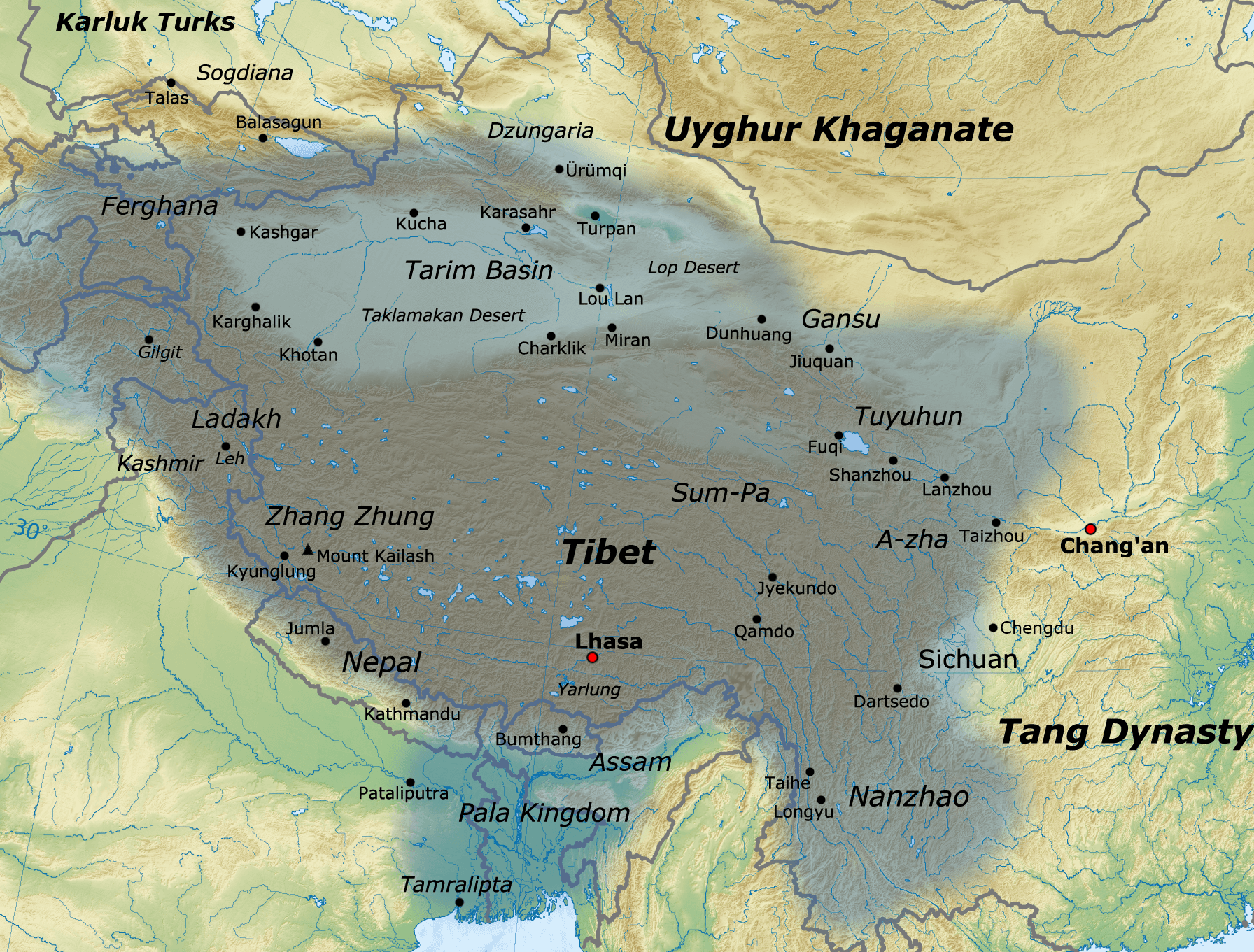
The high, windswept plains of the Tibetan Plateau seem an unlikely cradle for one of Asia’s most formidable conquering powers, yet in the seventh century, the Yarlung dynasty erupted from its southern valley to forge an empire of astonishing scale.
In the early seventh century, a regional power emerged from the rugged stronghold of Taktsé Castle in the Chingba district of Chonggyä, south of Lhasa. Under the leadership of Namri Songtsen, a local clan chief, this nascent state overthrew neighboring rivals, subdued the Kingdom of Sumpa, and consolidated control over the lands surrounding Lhasa. In 608 and 609, Namri Songtsen dispatched the first Tibetan embassies to the Chinese Sui dynasty, announcing the arrival of a new power on the high plateau. The name Bod, which would long designate Tibet in native histories, originally referred to just a conquered fragment of this territory, but it soon became synonymous with a rapidly expanding empire. When Namri Songtsen was poisoned around 618, his son Songtsen Gampo inherited a volatile realm. He immediately suppressed a domestic rebellion and initiated a relentless expansion that transformed the Yarlung dynasty from a regional principality into a formidable imperial power, known to the contemporary Tang dynasty as Tufan or Tubo.
Songtsen Gampo was a sovereign of remarkable diplomatic acumen and military ruthlessness. He stabilized his court through calculated violence, permitting the execution of his treasonous minister Myang Mangpoje—who had conquered the Sumpa people—and replacing him with Gar Tongtsen, whose clan would dominate Tibetan administration for decades. When a dispute arose with his younger brother Tsänsong, the prince was burned to death by his own minister, likely on the emperor's orders. To the west, the emperor sent his sister Sämakar to marry Lig-myi-rhya, the king of Zhangzhung. When the king refused to consummate the union, she assisted her brother in orchestrating his defeat, allowing Songtsen Gampo to overrun and absorb the western kingdom by 645. On his eastern frontier, the emperor turned his sights toward China. After a request for a Chinese princess was denied in 634, the Tibetans smashed the Tuyuhun buffer state near Lake Koko Nur and launched a massive military campaign against the Tang dynasty. Threatening the Chinese border region of Songzhou with an army that Tibetan records numbered at 100,000, Songtsen Gampo forced the hand of the Tang court. In 640, Princess Wencheng departed China to marry the Tibetan emperor. Though her arrival is traditionally celebrated as the spark that introduced Buddhism to the plateau, the new religion remained confined largely to foreign courtiers, while the emperor occupied himself with developing the Tibetan script and translating sacred texts.
Following Songtsen Gampo’s death in 650, the Tang dynasty launched a retaliatory strike that briefly captured Lhasa, but the Chinese occupiers were unable to withstand the hostile, oxygen-deprived environment of the Tibetan Plateau and quickly retreated. Actual power fell to the minister Gar Tongtsen, who guided the empire through the subjugation and gradual cultural assimilation of the Tuyuhun kingdom by 663. In the decades that followed, the high-altitude armies of Tibet proved nearly unstoppable in the lowlands of Central Asia. Between 665 and 670, the Tibetans seized Khotan and crushed the Tang forces at the Battle of Dafeichuan. This victory allowed them to seize the crucial Four Garrisons of Anxi in the western Tarim Basin, stripping China of its dominance over the lucrative Silk Road trade routes for over twenty years. This era of military triumph was financed and directed by a complex domestic hierarchy. When the emperor Tridu Songtsen took the throne as an infant in 676, his mother, the formidable Empress Thrimalö, ruled alongside the influential Gar clan. Believed to be descended from the Indo-European Lesser Yuezhi, the Gar clan’s power eventually rivaled that of the emperor himself. In 698, Tridu Songtsen reasserted imperial authority through a bloody purge, inviting over two thousand members of the Gar clan to a royal hunting party and slaughtering them. The clan's leading general committed suicide, and his surviving troops fled to China, ending the family's stranglehold on the state.
Connected to
- founded bySongtsän Gampo604 CE
+ 4 further connections to entries not yet ingested