Place · Mesoamerican Civilizations
Teotihuacan
- Also known as
- archeological site of Teotihuacan
- Cidade Pré-Hispânica de Teotihuacan
- City of the Gods
- City of the Sun
- Civilització teotihuacana
- Piramida Księżyca
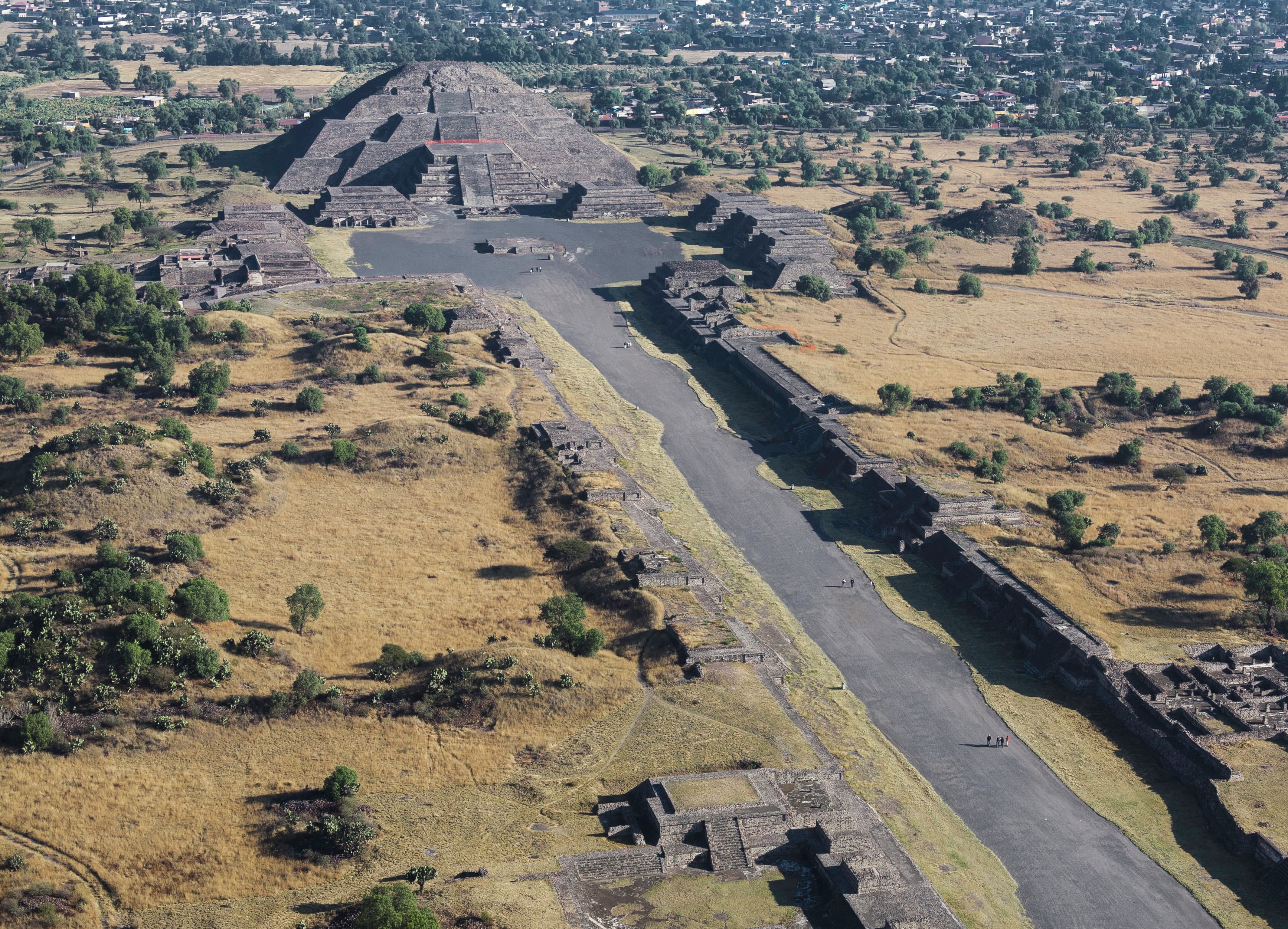
Long before the rise of the Aztec Empire, a colossal metropolis dominated the Valley of Mexico, concentrated so densely that up to ninety percent of the surrounding valley's population lived within its eight-square-mile limits.
Long before the Aztecs constructed their lake-bound empire, and centuries before the first Spanish horses kicked up the dust of the Mexican plateau, there existed a city of such colossal scale that those who stumbled upon its ruins could only assume it was built by hands other than human. When the Nahuatl-speaking Aztecs migrated into the Valley of Mexico in the fourteenth century, they found a silent, mammoth metropolis of stone, already abandoned and reclaimed by the scrub and cactus for nearly eight hundred years. Awed by the sheer height of its artificial mountains and the mathematical precision of its broad avenues, the Aztecs named the place Teotihuacan—the "place where gods were born," or, as some scholars interpret it, "the place of those who have the road of the gods." To the Maya of the lowlands, who recorded its existence in their hieroglyphs, it was known simply as Puh, the "Place of Reeds," a metaphorical term for a place where humanity gathered in thick, rustling, infinite crowds.
The origins of this metropolis are shrouded in a geography of fire and ash. Around 100 BCE, the southern Basin of Mexico was dominated by the urban center of Cuicuilco. But when the Xitle volcano erupted, burying Cuicuilco and much of the southern valley under a suffocating layer of lava and basalt, a massive displacement of survivors occurred. Seeking refuge and a new beginning, these refugees, along with local farmers drawn to the abundant natural springs of the northern sub-valley, coalesced in a dry, flat basin forty kilometers northeast of modern-day Mexico City. Here, the early Teotihuacanos harnessed their landscape with astonishing ingenuity. From the swampy margins of the valley floor, they engineered chinampas—raised agricultural beds of rich organic mud—which yielded unprecedented crop surpluses. They carved out a network of canals that allowed fleets of canoes to transport food and goods directly into the heart of the emerging city.
By the first century CE, this agricultural engine fueled a period of explosive, organized growth. The builders of Teotihuacan did not merely let their city expand organically; they planned it on a cosmic grid. The spine of the city was the Avenue of the Dead, a grand, wide thoroughfare that oriented the entire urban space. Along this axis rose monuments of staggering proportions. The Pyramid of the Sun, completed around 100 CE, was constructed from millions of basket-loads of earth and stone, standing as one of the largest pre-Columbian structures in the Americas. Nearby, the Pyramid of the Moon anchored the northern end of the avenue, while the intricately carved Temple of the Feathered Serpent dominated the southern sector. At its zenith in the first half of the first millennium, between 350 and 650 CE, Teotihuacan expanded to cover eight square miles. It housed between 100,000 and perhaps even more residents, accounting for eighty to ninety percent of the entire valley’s population. It was, for its time, the largest city in the Americas and likely the sixth-largest city in the world.
Yet, for all its size and regional dominance, Teotihuacan presents a profound historical paradox: it was a metropolis without a face. In an era of Mesoamerican history where neighboring Maya and Zapotec city-states erected massive stone stelae detailing the births, conquests, and lineages of individual, absolute kings, Teotihuacan left behind no royal tombs, no depictions of dynastic rulers, and no monuments celebrating the triumphs of a sovereign. Instead, around 300 CE, the city underwent a remarkable transformation. The Temple of the Feathered Serpent was desecrated and covered over, and the political center of gravity shifted away from this grand palace complex toward the more bureaucratic Avenue of the Dead Complex. Construction efforts shifted away from royal self-aggrandizement and toward the collective. The state invested in building hundreds of standardized, multi-family residential compounds. Built of stone and plaster, these multi-floor apartment complexes housed the city’s vast population in relative comfort, featuring private courtyards, drainage systems, and vibrant, colorful murals depicting religious iconography, animals, and agricultural abundance.
This collective, highly organized society was also deeply cosmopolitan. Rather than a homogenous enclave, Teotihuacan was a multi-ethnic magnet that drew migrants from across Mesoamerica. Archaeologists have identified distinct neighborhoods within the city limits where foreign communities settled, preserving their own cultural traditions while integrating into the Teotihuacano economy. There were districts inhabited by people from the Gulf Coast, Oaxaca, and the Maya lowlands. The city’s economic reach was vast, fueled primarily by its monopoly on green obsidian, a volcanic glass highly prized for its sharp edges. Teotihuacan exported fine obsidian tools, weapons, and beautifully uniform green stone funeral masks—often covered in delicate mosaics of turquoise, shell, and obsidian—across the Mesoamerican world. Its political and military shadow was equally long; in January 378 CE, a warlord from Teotihuacan named Sihyaj K'ahk'—"Born of Fire"—arrived in the classic Maya city of Tikal, initiating a dramatic intervention that reshaped the geopolitics of the Mayan lowlands for generations.
The end of the city was as dramatic as its rise, and written in ash. Sometime around 550 CE, the grand public buildings, temples, and elite palaces lining the Avenue of the Dead were systematically sacked, looted, and burned. Because this destruction was highly localized, targeting only the structures associated with the ruling class while leaving the common residential compounds untouched, historians hypothesize that Teotihuacan fell not to a foreign invasion, but to internal collapse. The sixth century was marked by severe global climate disruptions, including the extreme weather events of 535–536 CE, which likely triggered prolonged droughts, crop failures, and widespread famine in the valley. As tributary relations fractured and resources dwindled, the stark social divisions between the ruling elites and the intermediary classes likely ignited a violent, domestic uprising.
Though the city was never entirely abandoned, its central authority was shattered forever. The regional power vacuum left by Teotihuacan’s fall allowed other centers, such as Xochicalco and Tula, to rise in the centuries that followed. But the physical presence of Teotihuacan remained, a silent mountain range of plaster and stone that continued to haunt the imagination of Central Mexico. To the later Aztecs, who claimed a symbolic ancestry with the ancient builders, the ruins were a sacred landscape where the current age of the world had been set in motion by the self-sacrifice of the gods. Today, as visitors walk the sun-bleached expanse of the Avenue of the Dead, the ancient city continues to project its silent, geometric authority—a monument to a civilization that achieved global scale, built on a vision of collective order, before vanishing into the realm of myth.
Connected to
11 links to entries not yet ingested in the Library.