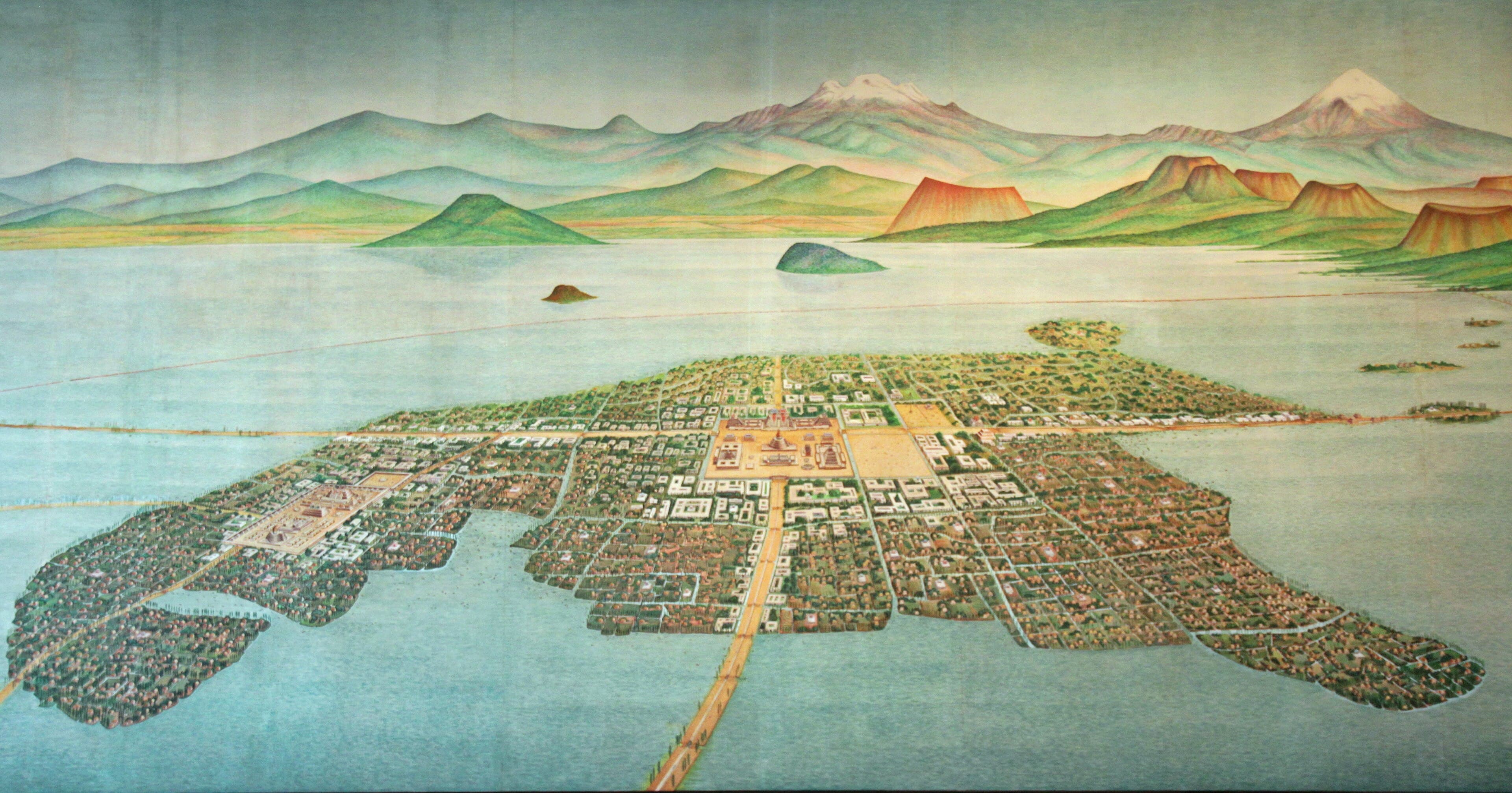
On a shallow, brackish lake in the Valley of Mexico, an extraordinary metropolis rose from the waters, constructed upon an island where the Mexica people established their home.
In November of 1519, a small band of Spanish soldiers marched along a narrow earthen causeway spanning the salt waters of Lake Texcoco and saw what they believed to be an illusion. Rising from the center of the lake was a metropolis of white stone, its vast towers, temples, and palaces seeming to float directly upon the water. To Bernal Díaz del Castillo, one of the Spanish chroniclers, it felt like the enchantments recounted in old chivalric romances. Some of his comrades whispered to one another, asking if what they were seeing was not a dream. They were looking at Tenochtitlan, the capital of the Mexica Empire, a city that was then five times the size of Henry VIII’s London and larger than any urban center in Europe save, perhaps, Paris, Venice, or Constantinople. Linked to the mainland by three massive causeways wide enough for ten horses to ride abreast, this island city of more than two hundred thousand souls was a triumph of engineering over an environment that should have rendered human habitation impossible.
The foundation of Tenochtitlan, traditionally celebrated on March 13, 1325, was born of necessity and guided by prophecy. The wandering Mexica, looking for a homeland in the crowded Valley of Mexico, had been told by their patron deity, Huitzilopochtli, to seek a sign: an eagle perched on a prickly pear cactus, growing from a rock, clutching a serpent in its beak. They found this improbable omen on a small, swampy island in the western shallows of Lake Texcoco. Rather than retreat from the inhospitable marshes, the Mexica set about reshaping the water itself. To expand their narrow foothold, they utilized the chinampa system, constructing artificial agricultural islands by layering mud, reeds, and decomposing organic matter within wooden palisades anchored to the lakebed by willow trees. These highly fertile gardens not only fed the growing population but gradually dried and expanded the island, transforming a scattering of muddy islets into a highly organized, grid-like metropolis of eight to thirteen square kilometers.
As the city expanded, so did its mastery of hydraulic engineering. Lake Texcoco was the lowest and largest of five interconnected lakes in an endorheic basin, meaning its waters were brackish and prone to catastrophic flooding. To protect their capital, the Mexica engineered the great Levee of Nezahualcoyotl around 1453—a massive barrier stretching twelve to sixteen kilometers across the lake. This dike served a dual purpose: it held back the seasonal floodwaters from the east and partitioned the lake, trapping fresh spring water around Tenochtitlan while keeping the brackish, salty waters at bay. To supply the population with sweet water for washing and bathing, the Mexica constructed two double-channel aqueducts of terracotta, each over four kilometers long, winding from the mountain springs of Chapultepec directly into the city center. This water fueled a culture obsessed with cleanliness. While ordinary citizens bathed twice daily, the emperor Moctezuma II was said to bathe four times a day, utilizing the root of the plant as soap and the root of the agave to wash clothes, while the elite frequented the , dome-shaped steam baths that served as sanatoriums and social retreats.
+ 5 further connections to entries not yet ingested
At the heart of Tenochtitlan lay a walled ceremonial precinct, a sacred precinct five hundred meters on each side that acted as the axis mundi of the Mexica universe. Here stood the Templo Mayor, a colossal twin-pyramid dedicated to Huitzilopochtli, the god of war and the sun, and Tlaloc, the rain god. Nearby stood the temple of the feathered serpent Quetzalcoatl, the Sun Temple of Tonatiuh, a ball court for the ritual game of tlachtli, and the tzompantli, a massive wooden rack displaying the skulls of sacrificial victims. Just beyond the sacred walls lay the sprawling, hundred-room palace of Moctezuma II. This was not merely a royal residence but an administrative city-in-miniature, featuring specialized quarters for foreign ambassadors, a botanical garden, and an extensive royal menagerie. The emperor’s zoo employed three hundred keepers to tend to birds of prey, reptiles, and mammals, while an elaborate aquarium featured twenty distinct ponds—ten of fresh water and ten of salt—to house diverse aquatic birds and fish.
Every aspect of this landscape was governed by a rigorous symmetry. All new construction had to be approved by a public official known as the calmimilocatl, who enforced a master urban plan. The city was divided into four grand quarters, each subdivided into twenty calpullis, or districts. These calpullis were organized around shared kinship or proximity, grouping together noblemen (pipiltin) and commoners (macehualtin) in a complex web of mutual obligation where elites provided land and commoners returned tribute and labor. The physical structure of the city reflected these rigid social hierarchies. The poorest lived in modest houses of mud-plastered reeds and thatch, while the middle classes lived in adobe brick homes with flat roofs. The nobility inhabited sprawling stone masonry complexes arranged around private inner courtyards. Crisscrossing these neighborhoods was an intricate network of canals and stone-paved streets, allowing the entire city to be traversed either on foot or by canoe. Wooden bridges spanned the canals, designed to be drawn up at night to isolate districts and secure the city from internal unrest or external invasion.
The economic engine of this empire was Tlatelolco, Tenochtitlan’s sister city on the northern half of the island, which housed the grandest marketplace in Mesoamerica. Here, the hereditary merchant class known as the pochteca traded goods brought from the shores of the Gulf of Mexico, the Pacific Ocean, and potentially beyond. The conquistador Hernán Cortés estimated that sixty thousand people gathered daily at the Tlatelolco market, a bustling forum where judges sat in booths to resolve disputes on the spot, and where everything from exotic jaguar pelts and cacao beans to turkeys, obsidian blades, and gold dust was bartered. The pochteca occupied a unique position in this hierarchy; though commoners by birth, their wealth rivaled that of the nobility, and they were exempt from taxes, though they were obligated to fund lavish public feasts to maintain their social standing.
This extraordinary metropolis, which had been rebuilt in spectacular fashion under the ruler Ahuitzotl following a late fifteenth-century flood, met its sudden end through a combination of diplomatic miscalculation and military siege. When Cortés and his Spanish force entered the city in late 1519, Moctezuma II chose to receive them as ambassadors, hoping to avoid a war that could easily be exploited by the empire’s many indigenous enemies, particularly the Tlaxcaltecs. The fragile peace shattered during the festival of Toxcatl, when Spanish forces under Pedro de Alvarado, fearing a trap, sealed the exits of the sacred courtyard and slaughtered the unarmed Mexica nobility dancing in honor of Huitzilopochtli. The resulting uprising forced the Spaniards to retreat, but they returned in 1521 with a massive army of native allies. By launching a fleet of brigantines to control the lake, cutting off the aqueducts, and systematically demolishing the stone houses to fill the canals as they advanced, the Spanish and Tlaxcaltec forces strangled the island city. When Tenochtitlan finally fell in August of 1521, its grand palaces were in ruins, its canals were choked with debris, and the waters of Lake Texcoco were stained with the collapse of the greatest empire in Mesoamerica. On its ruins, the conquerors began to construct the cabecera of the Viceroyalty of New Spain, laying the foundations of modern Mexico City directly over the buried temples of the Mexica.