Person · 1768 CE – 1813 CE · Post Colonial Americas
Tecumseh
- Also known as
- Estrella fugaz
- Etoile filante
- Harold Blanca
- Jaguar céleste
- Padajoča zvezda
- Shooting Star
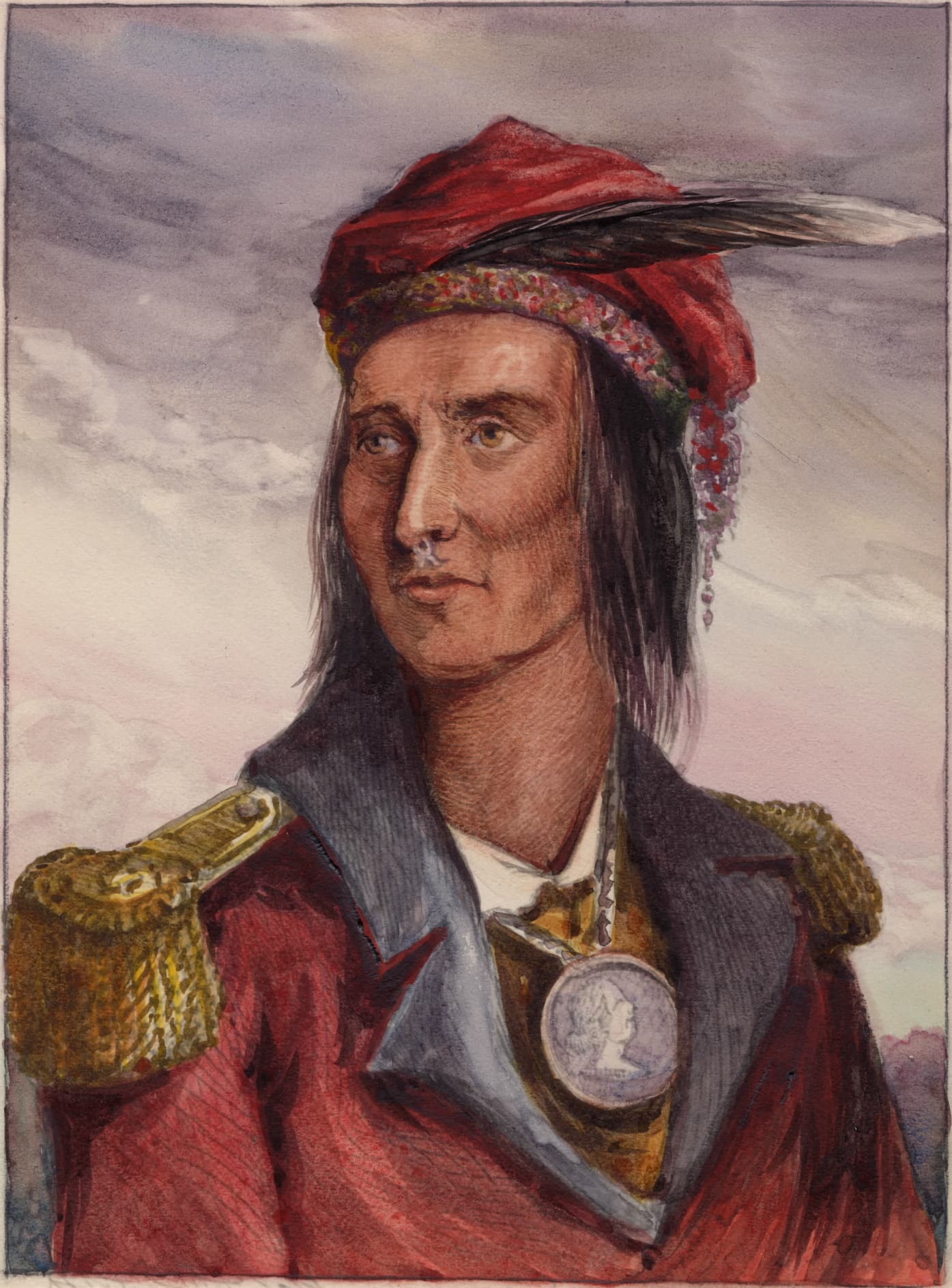
To watch a world shrink is to be forced into a choice between quiet accommodation or a defiance so absolute it borders on the mythic.
In the summer of 1783, a fifteen-year-old Shawnee boy sat among a great gathering of indigenous nations at Lower Sandusky. The American Revolutionary War had just ended, and the newly minted United States was asserting a right of conquest over all lands north of the Ohio River, ignoring the sovereign peoples who lived there. At this intertribal conference, Joseph Brant, the Mohawk leader, rose to speak. He articulated a radical, elegant doctrine: Native American lands were held in common by all tribes. Therefore, no single tribe could cede a single acre to the United States without the consent of every nation. The idea struck the young teenager with the force of revelation. His name was Tecumseh—derived from his clan’s association with a meteor, often translated as "I Cross the Way" or "Shooting Star"—and though he did not invent this doctrine of common ownership, he would become its most formidable, poetic, and tragic champion.
To grow up Shawnee in the late eighteenth century was to live in a state of perpetual displacement. Born around March 1768 in the Ohio Country, Tecumseh was the son of Puckeshinwau, a war chief of the Kispoko division, and Methoataaskee. His parents had met and married in the south, in what is now Alabama, where many Shawnees had fled decades earlier to escape the devastating 17th-century Beaver Wars. By 1759, they returned to Ohio in an attempt to reunite their scattered people in their historic homeland. But peace was fleeting. British claims yielded to American expansion, and the borderlands erupted into violence. In 1774, Tecumseh’s father was killed at the Battle of Point Pleasant, forcing the Shawnees to cede their hunting grounds in Kentucky. During the Revolutionary War, American militia expeditions repeatedly invaded Shawnee territory. Tecumseh, still a child, watched his world burn; in 1780 and again in 1782, expeditions led by George Rogers Clark destroyed Shawnee towns and crops, forcing Tecumseh’s family to flee further north and west.
Out of these ashes, Tecumseh emerged as a warrior under the tutelage of his older brother, Cheeseekau. In his late teens, Tecumseh participated in raids against the flatboats carrying waves of American settlers down the Ohio River. Even then, observers noted a distinct quality in the young warrior: a profound aversion to torture and the cruel treatment of prisoners, a characteristic that would define his later military career. He was a man of deep, quiet discipline. While his personal life saw several short-lived marriages—including a long relationship with a Cherokee woman and later unions with Mamate and White Wing—his focus remained inexorably bound to the defense of his people. In the early 1790s, he fought alongside the Chickamauga Cherokees in Tennessee, where Cheeseekau was killed in battle. Returning to Ohio, Tecumseh fought in the Northwest Indian War under the Shawnee chief Blue Jacket. He survived the catastrophic Native defeat at the Battle of Fallen Timbers in 1794, but he refused to attend the signing of the Treaty of Greenville in 1795, which surrendered two-thirds of Ohio to the United States. He knew that separate treaties were a slow, piecemeal surrender.
By the turn of the nineteenth century, the Native communities of the Ohio Valley were decaying from within, ravaged by epidemic disease, poverty, and the spiritually corrosive effects of white settlement and alcoholism. It was during this dark period that Tecumseh’s younger brother, Lalawéthika—previously regarded as a misfit of little consequence—experienced a profound religious awakening. Reborn in 1805 as Tenskwatawa, "the Shawnee Prophet," he preached a gospel of total cultural purification. He urged Native Americans to cast off European clothing, reject American trade goods, discard their traditional medicine bags, and completely renounce alcohol. Tecumseh recognized the immense political potential of his brother’s religious revival. He adopted the Prophet’s tenets, wearing only traditional Shawnee clothing and eating only native foods. Together, in 1808, the brothers established Prophetstown at the confluence of the Wabash and Tippecanoe rivers in present-day Indiana. It quickly grew into a vibrant, multi-tribal metropolis, a physical manifestation of a pan-Indian confederacy.
Tecumseh’s strategy was as simple as it was revolutionary. He traveled tirelessly from the Great Lakes to the Gulf of Mexico, using his formidable eloquence to recruit warriors and unite historically hostile tribes into a single democratic alliance. He argued that individual chiefs who signed treaties with the United States were selling land they did not own. "The Way," he argued, belonged to everyone. This message deeply alarmed the American authorities, particularly William Henry Harrison, the ambitious governor of the Indiana Territory. In 1809, Harrison negotiated the Treaty of Fort Wayne, securing three million acres of central Indiana from a few desperate, compliant chiefs. For Tecumseh, this was an existential challenge. During a tense meeting with Harrison at Vincennes in 1810, the two leaders narrowly avoided a violent clash. Tecumseh warned Harrison that the treaty was illegitimate and that any attempt to settle the ceded land would be met with armed resistance.
The crisis peaked in the autumn of 1811. While Tecumseh was away in the South recruiting allies among the Creeks and Cherokees, Harrison marched a hostile force toward Prophetstown. Despite Tecumseh’s explicit instructions to avoid conflict during his absence, Tenskwatawa was provoked into action. On November 7, 1811, the Battle of Tippecanoe ended in a devastating defeat for the Native forces. Prophetstown was burned, and the Prophet’s spiritual authority was shattered. When Tecumseh returned, he found his confederacy fractured, though not entirely destroyed. The onset of the War of 1812 between the United States and Great Britain offered him a final, desperate leverage. Allying his remaining forces with the British, Tecumseh was commissioned as a brigadier-general. His tactical brilliance and recruitment of warriors were instrumental in the stunning capture of Detroit in August 1812. Yet his British allies proved unreliable. Following the American naval victory on Lake Erie in 1813, the British commander, Colonel Henry Proctor, ordered a retreat into Upper Canada. Tecumseh, furious, bitterly reproached Proctor for his cowardice, but he had no choice but to retreat with him.
On October 5, 1813, Harrison’s pursuing army caught up with the combined British and Native forces at the Battle of the Thames. Proctor and his troops broke early in the fighting, leaving Tecumseh and his warriors to face the American charge alone. In the thick of the woods, Tecumseh was killed, traditionally reported to have fallen at the hands of Colonel Richard Mentor Johnson of Kentucky. With his death, the confederacy dissolved instantly. The dreams of an independent, united Native nation in the heart of North America died on the banks of the Thames, and the lands Tecumseh had spent his life defending were rapidly carved up by the advancing American republic. Yet, in defeat, Tecumseh achieved a singular immortality. He became a legendary figure of tragic heroism, admired by the very people who had fought so relentlessly to displace him—a shooting star that flared brilliantly across the American frontier, leaving an indelible mark on the memory of the continent.
Connected to
8 links to entries not yet ingested in the Library.