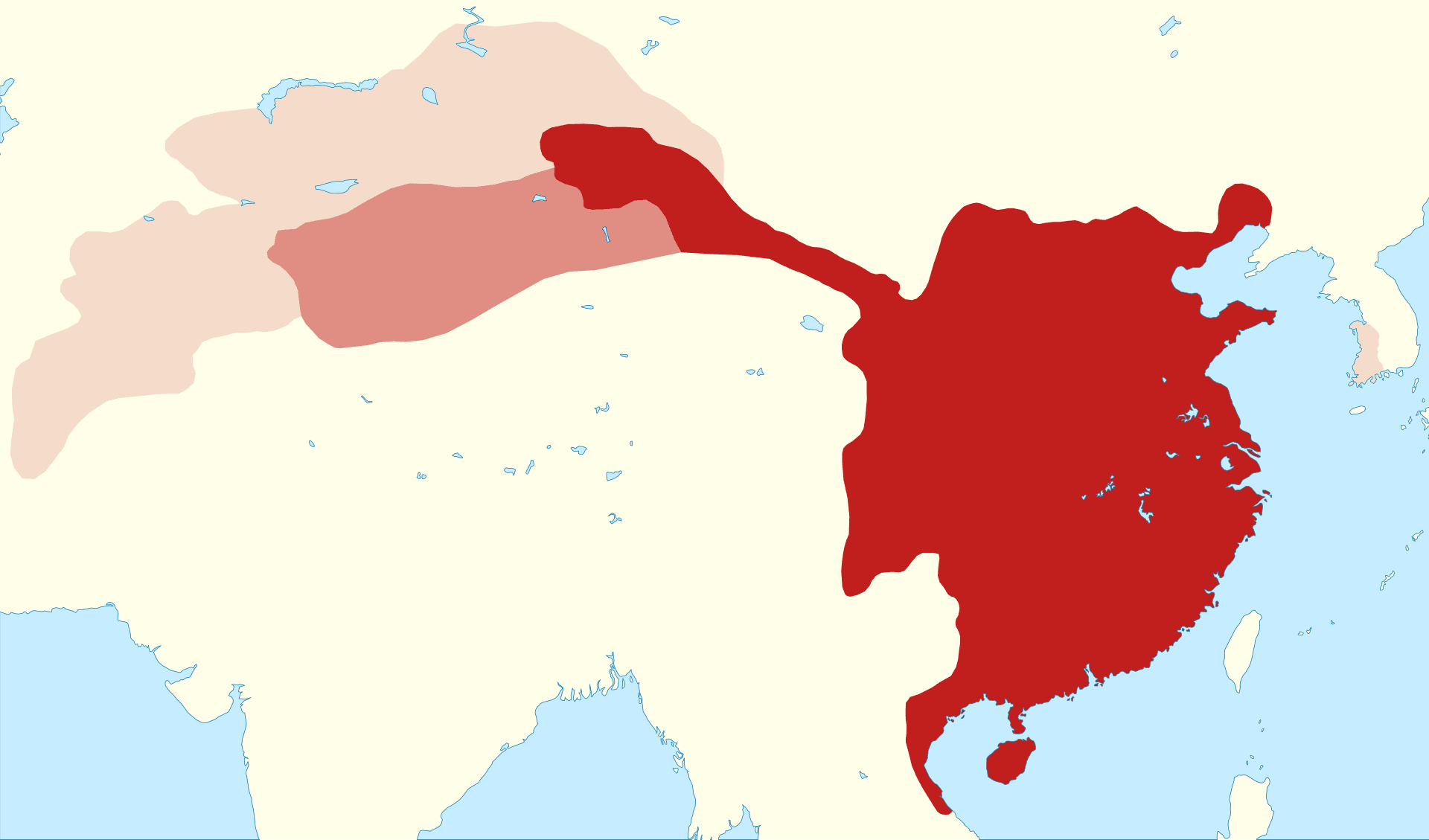
When the Li family seized power from the declining Sui dynasty in 618 CE, they initiated three centuries of imperial rule that transformed China into a sprawling, cosmopolitan empire.
In the winter of 617 CE, a veteran military commander named Li Yuan rode through the gates of Chang’an. The Sui dynasty, built on grand designs and ruinous wars, was fracturing into violent chaos, and Li—the Duke of Tang and governor of Taiyuan—had chosen to seize the moment rather than be crushed by it. He was not alone. Beside him rode his son, Li Shimin, a brilliant horseman and archer who had been commanding troops since he was eighteen, and his daughter, Princess Pingyang, who had raised and led her own army of thousands to secure her father’s path to the capital. Within months of entering Chang’an, news arrived that the last Sui emperor had been murdered. Li Yuan promptly declared himself the sovereign of a new order: the Tang.
Though born of the northwestern military aristocracy, whose bloodlines were heavily intertwined with the nomadic Xianbei of the steppes, the House of Li claimed a pedigree that stretched back to the legendary philosopher Laozi and the great generals of the ancient Han dynasty. This dual inheritance—the martial vigor of the frontier and the administrative depth of the classical Chinese state—became the defining engine of the early Tang. It was a dynasty forged in blood and family betrayal. In 626 CE, fearing his own assassination, Li Shimin ambushed and killed two of his brothers at the Xuanwu Gate of the imperial palace. Shortly thereafter, he forced his father to abdicate. Ascending the throne as Emperor Taizong, he proved to be a leader of astonishing capability, possessing both the ruthlessness to seize power and the wisdom to govern through consensus. To heal the wounds of the civil war that brought him to power, Taizong built Buddhist monasteries on the battlefields where he had once fought, ordering monks to pray for the souls of the dead on both sides.
Under Taizong and his successors, the Tang state expanded with a speed and confidence that eclipsed the historical reach of the Han. Engaging in sophisticated diplomatic maneuvers and brutal military campaigns, the Tang played nomadic rivals against one another, effectively dismantling the Eastern and Western Turkic Khaganates. When the Eastern Turks surrendered, they accepted Taizong not merely as the Son of Heaven, but as their Tian Kehan—the Heavenly Khagan—making him the first Chinese ruler to simultaneously hold supreme authority over both the sedentary farming populations of the Central Plains and the nomadic horsemen of the northern steppes. Tang protectorates stretched along the Silk Road deep into Central Asia, securing the lucrative trade routes that brought a flood of foreign merchants, diplomats, and monks to the capital. Chang’an grew into the most populous city on earth, a sprawling metropolis where Persian merchants, Nestorian Christian priests, and Japanese scholars mingled in markets filled with Central Asian music and exotic goods.
+ 10 further connections to entries not yet ingested
This cosmopolitan golden age was briefly but spectacularly interrupted by the rise of a woman who defied every Confucian convention of governance. Wu Zetian had entered the imperial court as a low-ranking consort to Emperor Gaozong, Taizong’s successor. When Gaozong suffered a debilitating stroke in 655 CE, Wu quietly stepped into the void, listening to ministerial debates from behind a silk screen and dictating state policy. Her rise to absolute power was marked by ruthless survival; when her eldest son, the crown prince, began to oppose her influence, he died suddenly under circumstances pointing to poison. In 690 CE, she took the ultimate step, declaring the establishment of her own Wu Zhou dynasty and ruling as the only legitimate female emperor in Chinese history. To legitimize her rule, Wu circulated the Great Cloud Sutra, a Buddhist text predicting that a reincarnation of the Maitreya Buddha would return as a female monarch to banish disease and disaster. Although her court was a place of high tension and sudden downfalls, her administrative reforms were profound. By expanding the civil service examinations and recruiting officials from outside the traditional northwestern military aristocracy, she broke the monopoly of the old ruling clans, opening the halls of power to talented scholars from across China.
Though her dynasty vanished when a palace coup restored the Tang in 705 CE, the administrative opening she championed laid the groundwork for the reign of her grandson, Emperor Xuanzong. For much of his forty-four-year rule, Xuanzong’s court represented the peak of Tang civilization. It was a period characterized by remarkable economic prosperity, low inflation, and a humanitarian spirit; in 747 CE, Xuanzong abolished the death penalty, and in one year of his reign, only twenty-four executions were recorded across the entire empire. In this atmosphere of stable wealth, Chinese culture reached its absolute zenith. This was the great age of Chinese poetry, dominated by the wandering, Daoist-infused brilliance of Li Bai—a member of the same Longxi Li clan as the emperors—and the deeply humane, melancholic verses of Du Fu. Together with the poet-painter Wang Wei, they captured a world of exquisite fleeting beauty, recorded on paper using the newly developing technology of woodblock printing.
Yet the very cosmopolitanism that enriched the Tang court ultimately sowed the seeds of its undoing. In his later years, Xuanzong grew increasingly withdrawn, relying heavily on his long-serving chancellor, Li Linfu. Favouring an aggressive foreign policy, Li Linfu championed the appointment of non-Chinese generals to command the empire’s massive border armies. Among these generals was An Lushan, a commander of mixed Sogdian and Turkic descent who had spent years fighting on the northeastern frontier. In 755 CE, possessing the loyalty of over one hundred thousand battle-hardened troops, An Lushan turned his armies southward toward the capital.
The ensuing An Lushan rebellion shattered the Tang world. Though the rebellion was eventually suppressed after eight years of catastrophic fighting, the central authority of the Tang emperors was permanently broken. To survive, the court was forced to cede immense power to regional military governors known as jiedushi, who collected their own taxes and passed their commands hereditarily to their sons, rendering the civil-service examination system increasingly obsolete. The cosmopolitanism of the early Tang turned inward; in the ninth century, amid growing economic distress and a search for scapegoats, the state turned on foreign influences. In the 840s, Emperor Wuzong launched a systematic suppression of Buddhism, destroying thousands of monasteries and forcing hundreds of thousands of monks and nuns back into secular life, a blow from which Chinese Buddhism never fully recovered.
By the late ninth century, the empire was a shadow of its former self. Agrarian rebellions, sparked by widespread poverty and government dysfunction, swept through the countryside, displacing entire populations and draining the last drops of treasury wealth. When the Tang finally collapsed in 907 CE, giving way to the splintered chaos of the Five Dynasties and Ten Kingdoms period, it left behind a cultural blueprint that would define East Asia for a millennium. Its bureaucratic systems, its poetic forms, and its architectural styles had already crossed the seas to shape the emerging states of Japan and Korea. The Tang had shown the world how an empire could be both fiercely martial and deeply literary, creating a cosmopolitan ideal of a global civilization that future generations would spend centuries trying to recreate.