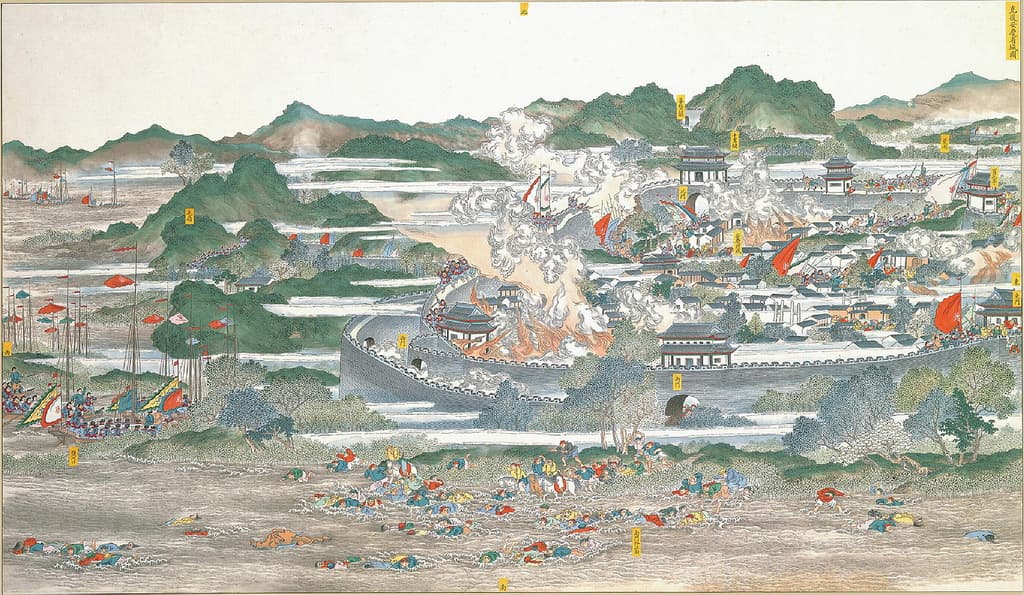
In the middle of the nineteenth century, a failed imperial candidate named Hong Xiuquan awoke from a series of feverish visions convinced he was the younger brother of Jesus Christ.
In the spring of 1837, a young Hakka man named Hong Huoxiu walked out of the imperial examination halls in Guangzhou having failed the grueling civil service tests for the third time. The disappointment shattered him. Returning to his poor village in Guangdong, he collapsed into a state of delirium, seized by vivid, terrifying visions that lasted for days. In his fever, Hong ascended to a luminous heaven where he met a celestial family. A majestic father figure lamented that humanity had forsaken him to worship demons, and instructed Hong to change his name to Hong Xiuquan to avoid a sacred naming taboo. Alongside this father stood an elder brother, who gave Hong a sword and a seal to slay the dark forces corrupting the earth. Hong even witnessed Confucius being soundly chastised by the heavenly father for leading the people of China astray. Upon waking, Hong returned to his quiet, frustrated life as a village schoolteacher, the visions compartmentalized but not forgotten. It was only in 1843, after failing the imperial examinations for a fourth and final time, that a cousin prompted him to look closely at a set of Protestant Christian pamphlets he had been handed by a missionary years prior. In those translated pages, the fever dream of his youth resolved into a terrifying, singular clarity. The father was God; the elder brother was Jesus Christ. Hong Xiuquan was not merely a failed scholar; he was the younger brother of Jesus, sent by heaven to purge China of its demonic rulers and establish paradise on earth.
This bizarre theology, which soon coalesced into a dynamic new religion known as Taiping Christianity, struck a match to a country that was already dry timber. By the mid-nineteenth century, the Qing dynasty was buckling under unprecedented strain. The population of China had nearly doubled between 1766 and 1833, yet the amount of cultivated land remained static, driving rents high and leaving millions of overtaxed peasants landless. Defeat in the First Opium War had exposed the military impotence of the ruling ethnic minority Manchus, while a massive trade imbalance fueled by the illicit importation of opium drained the state treasury and crippled the local economy. In the mountainous southern provinces like Guangxi, where central authority was weak and local clans ruled through violence, banditry, piracy, and secret societies flourished. Here, among the marginalized Hakka minority, anti-Manchu sentiment ran deepest. Hong's message of a holy war against the demonic Qing rulers found a ferociously receptive audience. In 1844, his dedicated follower Feng Yunshan organized the God Worshipping Society, fusing Hong’s vision of Christian salvation with Taoist, Confucian, and indigenous millenarian traditions, presenting it as a restoration of the ancient Chinese faith in Shangdi.
+ 3 further connections to entries not yet ingested
The spark that ignited the civil war was struck in the southern hills of Guangxi, where local Qing officials, alarmed by the growing power of the God Worshipers, launched a campaign of religious persecution against them. In late December 1850, small-scale skirmishes escalated into open warfare. By early January 1851, a disciplined ten-thousand-strong rebel army organized by Feng Yunshan and Wei Changhui routed the imperial Green Standard Army at the village of Jintian. On January 11, his triumph secured, Hong Xiuquan declared the birth of the Taiping Tianguo—the Heavenly Kingdom of Peace—with himself as its Heavenly King. Pursued by imperial forces, the Taiping army began a relentless march northward in September 1851, leaving Guangxi behind. They swept through Hunan along the Xiang River, besieging Changsha, seizing Yuezhou, and capturing the strategic city of Wuchang on the Yangtze River by December 1852. Along the way, their ranks swelled with peasants, desperate refugees, and members of Triad secret societies, drawn to a movement that promised to completely upend the old social order rather than merely replace one corrupt emperor with another.
By the spring of 1853, the Taiping host had turned east, pouring down the Yangtze River. In February they seized Anqing, and on March 19, 1853, they breached the massive walls of Nanjing, the ancient southern capital of China. For Hong and his followers, this was the arrival of the New Jerusalem, which they renamed Tianjing, the "Heavenly Capital." The victory was immediately christened with blood. Viewing the ruling Manchus not as human adversaries but as literal demons, the Taipings systematically slaughtered every Manchu man in the city. The Manchu women were then driven outside the city gates and burned to death. From this new capital, the Taiping leadership launched concurrent Northern and Western military expeditions, attempting to press toward the imperial seat in Beijing and secure their hold over the fertile Yangtze valley. But as the war expanded, the internal cohesion of the Heavenly Kingdom began to fracture under the weight of its own success. Powerful figures within the movement, such as Yang Xiuqing, claimed their own direct lines to the divine, asserting that they could speak with the voice of God the Father himself, bypassing Hong’s authority and steering the rebellion toward a catastrophic internal power struggle.
For fourteen years, the Taiping civil war tore through the heart of China, escalating into what would become the bloodiest conflict of the nineteenth century and perhaps the deadliest civil war in human history. Estimates of the dead range from twenty million to thirty million people—comparable to the losses of World War I—with some higher projections suggesting that up to seventy-three to one hundred million people, nearly a third of the Chinese population at the time, perished in the chaos. Whole provinces were depopulated as thirty million refugees fled the fighting, seeking safety in foreign treaty ports or remote mountainous regions. The war was fought with merciless savagery on both sides. While the Taipings sought a total social revolution, ordering their male followers to grow their hair long in open defiance of the shaved foreheads and braided queues mandated by Qing law, the imperial forces responded with equal brutality, culminating in horrific massacres of civilian populations in captured rebel territories.
Ultimately, the messianic dream of the Heavenly Kingdom collapsed under the weight of internal rot and decentralized resistance. A failed campaign against Beijing between 1853 and 1855, followed by a bloody internal coup in the autumn of 1856, permanently broke the unity of the Taiping leadership. Rather than relying on the weakened central imperial armies, the Qing state increasingly turned to decentralized provincial forces, most notably the Xiang Army organized and commanded by the scholar-general Zeng Guofan. Moving methodically down the Yangtze, Zeng’s forces recaptured Anqing and, in May 1862, laid siege to the Heavenly Capital of Nanjing. Inside the starving city, the end was slow and agonizing. On June 1, 1864, with the imperial forces at the gates, Hong Xiuquan died, his health broken by the consumption of weeds gathered from the palace grounds during the famine of the siege, amid persistent rumors of poison. A month later, Nanjing fell, and by August 1871, the last scattered remnants of the rebel armies were hunted down and destroyed.
The Qing dynasty survived the onslaught, but the cost of victory proved fatal. To defeat the Taiping, the imperial court had been forced to cede immense fiscal and military authority to provincial leaders, sowing the seeds of regional warlordism that would tear China apart in the early twentieth century. Though the dynasty attempted a "Self-Strengthening Movement" to modernize its military in the wake of the rebellion, the fundamental social, ethnic, and economic fractures exposed by the long war remained unhealed. The fall of Nanjing did not bring peace, but rather a prolonged twilight for the imperial system, setting in motion the collapse that would culminate in the birth of the Republic of China in 1912.