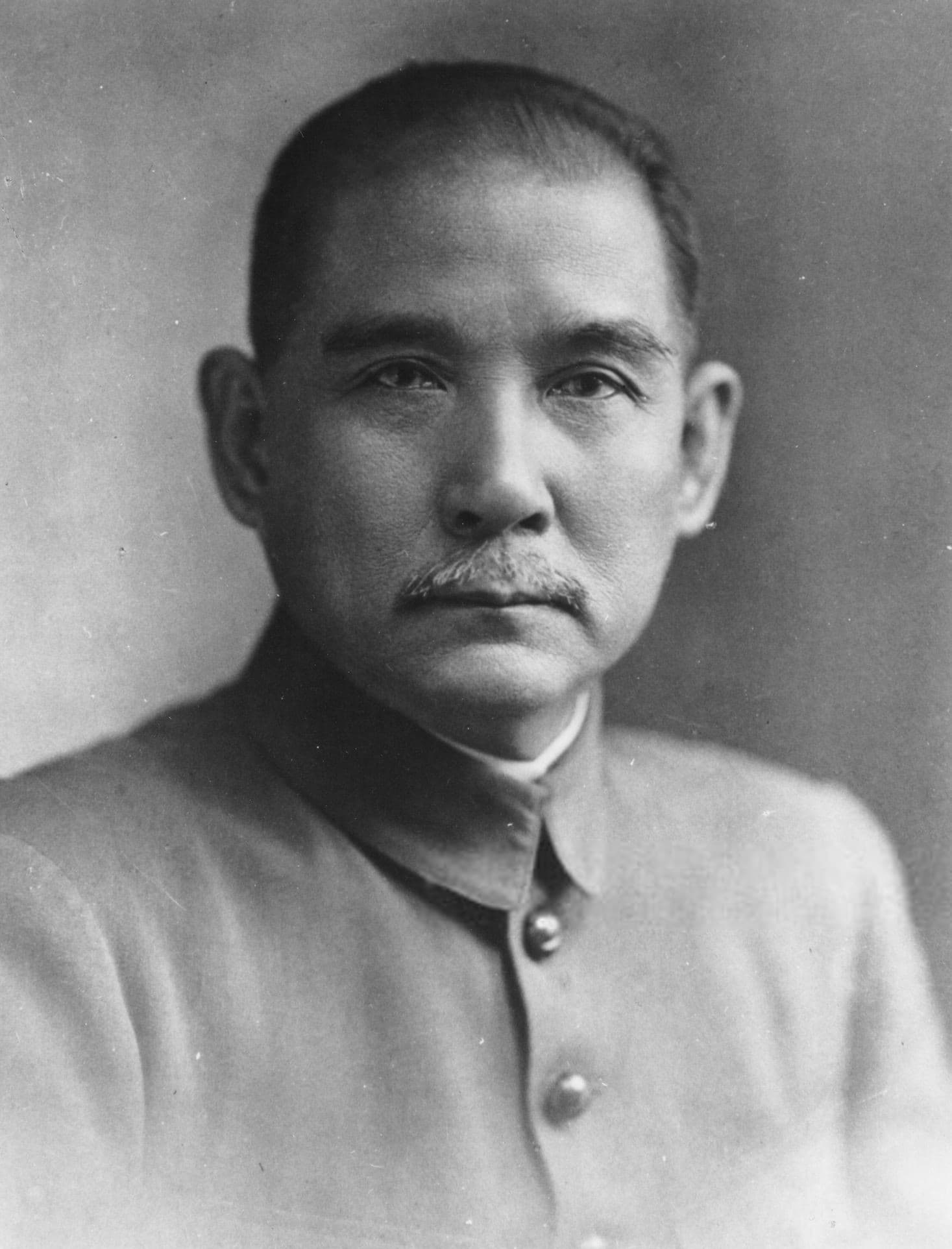
The collapse of a dynasty that had ruled for nearly three centuries began not in the grand palaces of Beijing, but in the mind of a peasant’s son from Guangdong who trained as a physician in British Hong Kong.
In the autumn of 1893, a twenty-seven-year-old physician named Sun Wen stood on the margins of a dying empire, preparing a document he believed might save it. Born to Hakka peasant farmers in the southern province of Guangdong, he had spent his youth straddling worlds: educated under the Hawaiian monarchy in Honolulu, baptized by an American Congregationalist missionary in British Hong Kong, and trained in Western surgery at the Hong Kong College of Medicine for Chinese. He was a man of the borderlands, fluent in the languages of modernity but deeply agonizing over the decay of his homeland. He spent months drafting an eight-thousand-character petition to Li Hongzhang, the powerful Qing Dynasty viceroy who championed the self-strengthening of China. Sun’s petition was a blueprint for peaceful modernization, arguing that a nation’s strength lay not merely in its warships, but in the education of its people, the development of its agriculture, and the free flow of commerce. In 1894, he traveled to the northern treaty port of Tianjin to present it. He was denied an audience.
That rejection was the quiet turning point from which there was no retreat. The young doctor, realizing the Manchu court was too ossified to reform itself, resolved to amputate the diseased limb of the imperial dynasty. Traveling to Hawaii, he gathered a small group of expatriate Chinese, mostly from the lower social classes, and founded the Revive China Society. It was the first Chinese nationalist revolutionary organization, and its members were made to swear a dangerous, treasonous oath: "Expel the Tartar barbarians, restore China." To fund his ambitions, Sun turned to his elder brother, Sun Mei, a wealthy rancher in Maui who would ultimately sell off most of his twelve-thousand-acre estate and cattle to finance his younger sibling’s dangerous dream.
By 1895, China’s humiliating defeat in the First Sino-Japanese War laid bare the utter inadequacy of the Qing state, prompting two rival intellectual currents. One faction, led by scholars like Kang Youwei and Liang Qichao, argued that the Manchu court could regain legitimacy through a constitutional monarchy—a hope that briefly flickered during the failed Hundred Days’ Reform of 1898. Sun, however, belonged to the radical camp that saw no future in the old dynastic system. For him, only a republic would suffice. In October 1895, his Revive China Society, now merged with the Hong Kong-based Furen Literary Society under the presidency of Yeung Ku-wan, plotted its first armed insurrection in Guangzhou. They disguised their revolutionary headquarters as a business called the Kuen Hang Club. But the plot leaked. Qing authorities intercepted the conspirators, capturing and executing over seventy members, including Sun’s childhood friend Lu Haodong—the man who had once helped him vandalize a village deity in a youthful, defiant protest against local superstition.
+ 12 further connections to entries not yet ingested
Sun fled into a long, wandering exile that would span fifteen years and transform him into an international symbol of Chinese resistance. In 1896, while living in London to raise funds and recruit allies, he was lured into the Chinese Legation and imprisoned. The Qing secret service planned to drug him and smuggle him back to China for execution. For twelve days, Sun’s life hung in the balance until he managed to get word to James Cantlie, his former medical school teacher. Through the combined pressure of Cantlie, British newspapers like The Globe and The Times, and the British Foreign Office, Sun was released. He emerged from the legation not just a survivor, but a global celebrity. He quickened his fame by publishing Kidnapped in London in 1897, turning his near-death experience into a powerful narrative of republican martyrdom.
From London, Sun traveled through Canada to Japan, arriving in Yokohama in August 1897. In Japan, he adopted the pseudonym Kikori Nakayama, a name given to him by the Japanese philosopher Tōten Miyazaki. It was from this alias that his most famous Chinese moniker, Sun Zhongshan, would later derive. Japan was a fertile ground for Sun’s network; many Japanese intellectuals and activists, motivated by a pan-Asian opposition to Western imperialism, supported his cause. During his exile, Sun also forged connections with other regional revolutionaries, such as the Philippine diplomat Mariano Ponce, and utilized the networks of the ancient Tiandihui—the Heaven and Earth Society, or triads—to navigate the Chinese diaspora and secure financial backing.
To unify his disparate, often fractious supporters, Sun articulated a political philosophy that would become his flagship legacy: the Three Principles of the People. Drawing heavily from his Western education, his admiration for American historical figures like Abraham Lincoln and Alexander Hamilton, and his own Christian beliefs, Sun envisioned a modern China built upon nationalism, democracy, and the people’s livelihood. He sought an ethnically harmonious conception of the Chinese nation that would replace dynastic loyalty with republican citizenship. For Sun, the revolutionary struggle was not merely a political coup but a moral crusade, which he frequently compared to the salvation mission of the Christian church.
The spark Sun had spent decades tending finally caught fire in the autumn of 1911. While Sun was traveling in the United States, a mutiny in Wuchang escalated into a nationwide revolution, bringing down the nearly three-century-old Qing Dynasty. Sun rushed back to China, where he was proclaimed the first provisional president of the newly declared Republic of China in January 1912. Yet, the young republic possessed no army capable of defying the remnants of the imperial military. To secure the peaceful abdication of the Qing court and prevent a catastrophic civil war, Sun made a painful compromise, relinquishing the presidency to Yuan Shikai, the powerful commander of the northern Beiyang Army.
The compromise quickly proved fatal to Sun’s democratic vision. In 1913, following the assassination of Song Jiaoren—the brilliant organizer of Sun’s newly formed political party, the Kuomintang, an act widely attributed to Yuan’s machinations—Sun launched a failed "Second Revolution" to oust the aspiring dictator. Once more, Sun was forced to flee to Japan. When he returned to China in 1917, the country had fractured into a patchwork of competing warlords. Sun established a Constitutional Protection junta in Guangzhou to defend the original republican constitution, but his plans for a Northern Expedition to reunify the country were repeatedly derailed by internal betrayal and warlord infighting, including a devastating revolt by his former ally Chen Jiongming.
In his final years, frustrated by the reluctance of Western democracies to support his cash-strapped government, Sun turned to the newly established Soviet Union and the young Chinese Communist Party. He forged the First United Front, restructuring the Kuomintang along disciplined, Leninist lines while retaining his own Three Principles as the state ideology. In late 1924, despite failing health, Sun made one final journey north from his southern base in Guangdong. He sought to negotiate a peaceful reunification of the country with the northern warlords Duan Qirui and Zhang Zuolin, calling for a national assembly and the abolition of the unequal treaties that had humiliated China for nearly a century.
Sun Yat-sen never lived to see the unified republic he spent his life building. He died of liver cancer in Beijing on March 12, 1925, at the age of fifty-eight. His death triggered an outpouring of grief across a fractured land, and his birthplace of Xiangshan County was renamed Zhongshan in his honor. In death, Sun achieved a unique status in modern Chinese history: he remains deeply revered on both sides of the Taiwan Strait. To the Republic of China on Taiwan, he is the "Father of the Nation"; to the People's Republic of China on the mainland, he is the "Forerunner of the Revolution." Beyond the monuments and the changing regimes, Sun’s true legacy lay in the shattering of the dynastic cycle, convincing a civilization that had been ruled by emperors for millennia that its future belonged to a republic of citizens.