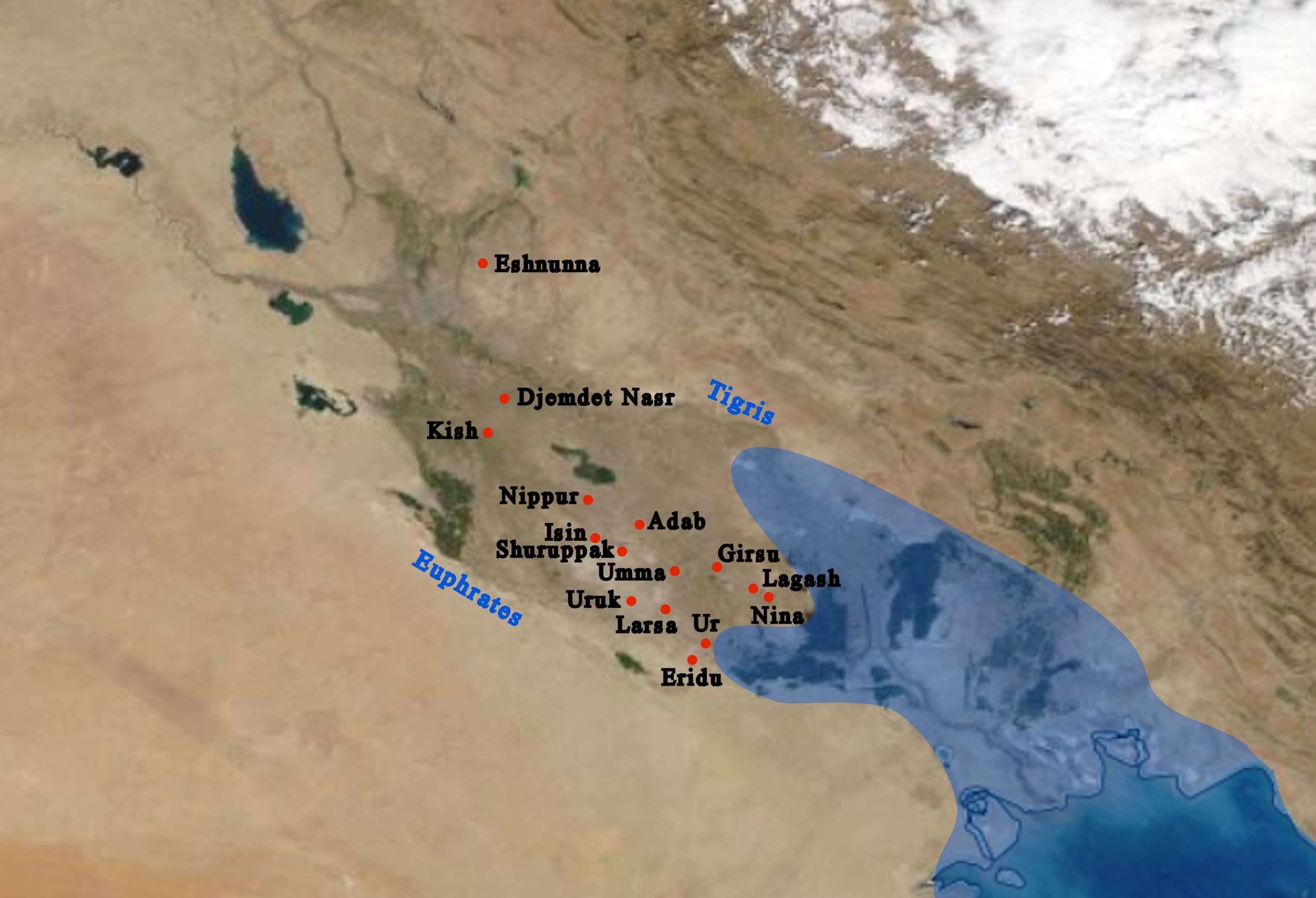
Long before the rise of the Mediterranean empires, the marshy floodplains between the Tigris and Euphrates rivers gave rise to a transformation in how humans lived together.
Before it was a map of cities, the southern reach of the Tigris and Euphrates was a shifting world of reeds and water. In the fifth millennium BCE, the Persian Gulf reached farther inland than it does today, and the land that would become Sumer—known to its later conquerors as šumeru and to its own people as Kengir, the "country of the noble lords"—was a labyrinth of tidal marshes, mudflats, and seasonal lagoons. Here, three distinct lives converged: nomadic Semitic pastoralists who pitched black tents and tracked herds of sheep and goats along the dry fringes; marsh-dwelling fisher folk who built arched dwellings from bundled reeds; and peasant farmers of the Ubaid culture who coaxed grain from the silty soil using rudimentary irrigation canals. From the fusion of these disparate cultures, amidst a landscape defined by the constant, unpredictable pulse of two great rivers, emerged the earliest known civilization on Earth.
To modern eyes, this world was lost for millennia. Unlike the monumental stone ruins of Egypt, the mud-brick architecture of Sumer crumbled back into the alluvial clay from which it was baked, leaving behind only wind-scoured mounds known as tells. When modern archaeology began its first serious sweeps of southern Mesopotamia in the nineteenth century, the Sumerians were entirely unrecognized. It was only on January 17, 1869, that the French scholar Jules Oppert first proposed the name "Sumer" in a lecture, identifying a non-Semitic tongue in the bilingual clay tablets then emerging from the sands. Soon after, in 1877, Ernest de Sarzec began excavating the ancient city of Girsu, followed by American digs at Nippur and German investigations at Shuruppak. What these excavators uncovered was not merely an empire, but a sprawling, highly competitive ecosystem of independent city-states—Eridu, Ur, Larsa, Uruk, Bad-tibira, Lagash, Umma, Shuruppak, and Nippur—each separated by canals and boundary stones, and each oriented around a towering temple dedicated to a patron deity.
At the heart of the Sumerian experiment was a profound ecological paradox. The alluvial plain of southern Iraq is incredibly fertile when watered, but it receives almost no rain. To cultivate wheat and barley, the early settlers had to master the rivers. This required a level of collective organization never before seen in human history. The Ubaidians, and later their Uruk-period successors, drained the marshes, dug extensive networks of canals, and constructed massive dikes to protect their fields from catastrophic spring floods. The resulting agricultural surpluses did not merely feed families; they funded a massive social specialization. For the first time, society split into those who produced food and those who managed it. Priestly governors, known as , and later secular kings, or , ruled from monumental complexes. Under their administration, specialists spun wool into textiles, hammered imported copper into tools, and shaped clay on fast-turning wheels to mass-produce unpainted pottery for a rapidly expanding population.
8 links to entries not yet ingested in the Library.
This transition from the Ubaid to the Uruk period, beginning around 4100 BCE, transformed the modest riverine settlements into the world’s first true cities. Uruk, the greatest of them, became a metropolis of over ten thousand people, its reach extending far beyond the Mesopotamian plain. Sumerian merchants and colonists pushed north and west, establishing trading outposts as far as the Taurus Mountains in modern Turkey, the Mediterranean coast, and eastward into the highlands of Iran. Along with copper, timber, and precious stones, these trade networks brought back captives from the surrounding hill country. The earliest written records of Sumer leave no doubt that this first urban revolution was fueled in part by slave labor, with captured hill people put to work in the fields and workshops of the temple estates.
To manage this complex flow of goods, labor, and tribute, the administrators of Uruk developed a system of notation that would alter the course of human consciousness. What began as proto-writing—token markings on clay to keep count of sheep, oil jars, and grain deliveries—slowly evolved between 3350 and 2500 BCE into the world’s earliest written texts. Written in an agglutinative language isolate with no known relative—neither Semitic nor Indo-European—this script was pressed with a reed stylus into wet clay tablets, creating wedge-shaped impressions. This was cuneiform. The language, which the Sumerians called Emegir, was a highly structured tongue where grammatical concepts were glued together in long compound words. Because it was the language of the first scribes, it became the foundational operating system of Mesopotamian culture.
For decades, scholars debated the origin of this unique language and the people who spoke it. Some pointed to Sumerian legends that spoke of Dilmun—the modern island of Bahrain in the Persian Gulf, where Mesopotamian-style round disks have been unearthed—as the ancestral "home city of the land of Sumer." Others suggested migrations from the Caucasus or even North Africa. Yet the archaeological evidence points to a more organic, localized genesis within the Fertile Crescent itself. The Sumerians’ own mythology seemed to remember this long, internal synthesis of cultures. In the ancient literary cycle, the sacred gifts of civilization, the me—which included the arts of woodcarving, metalwork, writing, and kingship—were held by Enki, the god of wisdom, in his primeval temple at Eridu, the oldest of the southern cities. In the myth, these gifts were eventually transferred to Inanna, the goddess of love and war, who brought them to her temple at Uruk, mirroring the historical shift of regional power toward the great urban centers of the fourth millennium BCE.
By the early third millennium BCE, the Sumerian world had entered its Early Dynastic period, an era of intense rivalry and brilliant material culture. The city-states were no longer isolated pioneers but peer-polities locked in a constant struggle for hegemony, land, and water rights. The historical record, which becomes legible and reliable with kings like Enmebaragesi, reveals a landscape of shifting alliances, where a ruler might claim the title of king of Kish to assert a symbolic overlordship over the entire valley. In these centuries, the temples remained the spiritual anchors of the cities, but political power increasingly resided in the military palaces.
This native dynastic era was shattered around 2270 BCE when Sargon of Akkad, a Semitic-speaking ruler from the north, conquered the southern city-states and forged the Akkadian Empire. For the first time, the independent cities of Sumer were integrated into a centralized, regional state. Although native Sumerian rule re-emerged centuries later under the brilliant, highly bureaucratic Third Dynasty of Ur around 2100 BCE, the geopolitical landscape had permanently shifted. Incursions by Amorite tribes from the west steadily eroded the authority of the kings of Ur, and by 1900 BCE, the distinct political identity of Sumer had dissolved, eventually absorbed into the rising power of Babylon.
Yet the end of Sumerian political independence was not the end of Sumerian civilization. Long after the last native speaker of Emegir had died, replaced by the East Semitic Akkadian tongue, the Sumerian language endured. It was preserved by Semitic priests and scribes who copied, translated, and studied Sumerian hymns, incantations, and legal texts. In the temples of Babylon and Assyria, Sumerian became a sacred, classical language, occupying a position analogous to Latin in medieval Europe.
So profound was the influence of this dead language that late nineteenth-century scholars, led by the French Assyriologist Joseph Halévy, initially refused to believe it was a real tongue at all. Perplexed by the bizarre multi-layered meanings of the cuneiform signs, Halévy argued that Sumerian was a highly sophisticated, secret priestly cryptography invented by Semitic scribes to keep their rituals hidden from the masses. It took decades of rigorous philological work by scholars like Paul Haupt, Peter Jensen, and Arno Poebel to prove that Sumerian was indeed an organic, spoken language of the ancient world. The very complexity that looked like cryptography was actually the result of centuries of popular etymologies, sound-associations, and translation work by ancient bilingual scribes who had played with the signs, gradually transforming a prehistoric regional speech into a universal medium of liturgy and law.
Sumer’s legacy to the ancient world, and ultimately to the modern one, was not defined by the borders of its short-lived empires, but by the intellectual infrastructure it left behind. The scribes of Uruk and Ur did not just invent writing to record transactions; they created a system of categorization that allowed humanity to organize reality. In their lists of birds, fish, metals, and stars, and in their legal codes and architectural designs, they established the template for urban life. When the waters of the Tigris and Euphrates finally reclaimed the mud-brick walls of Eridu and Nippur, the clay tablets buried beneath them preserved a world-view that had already traveled across the Near East, shaping the literatures, laws, and mythologies of every civilization that followed them in the fertile valley.