Person · 1494 CE – 1566 CE · Ottoman Empire
Suleiman the Magnificent
- Also known as
- 1. Süleyman
- Birinci Süleyman
- I Sulejman
- I Süleyman
- I Süleyman
- I Сулейман
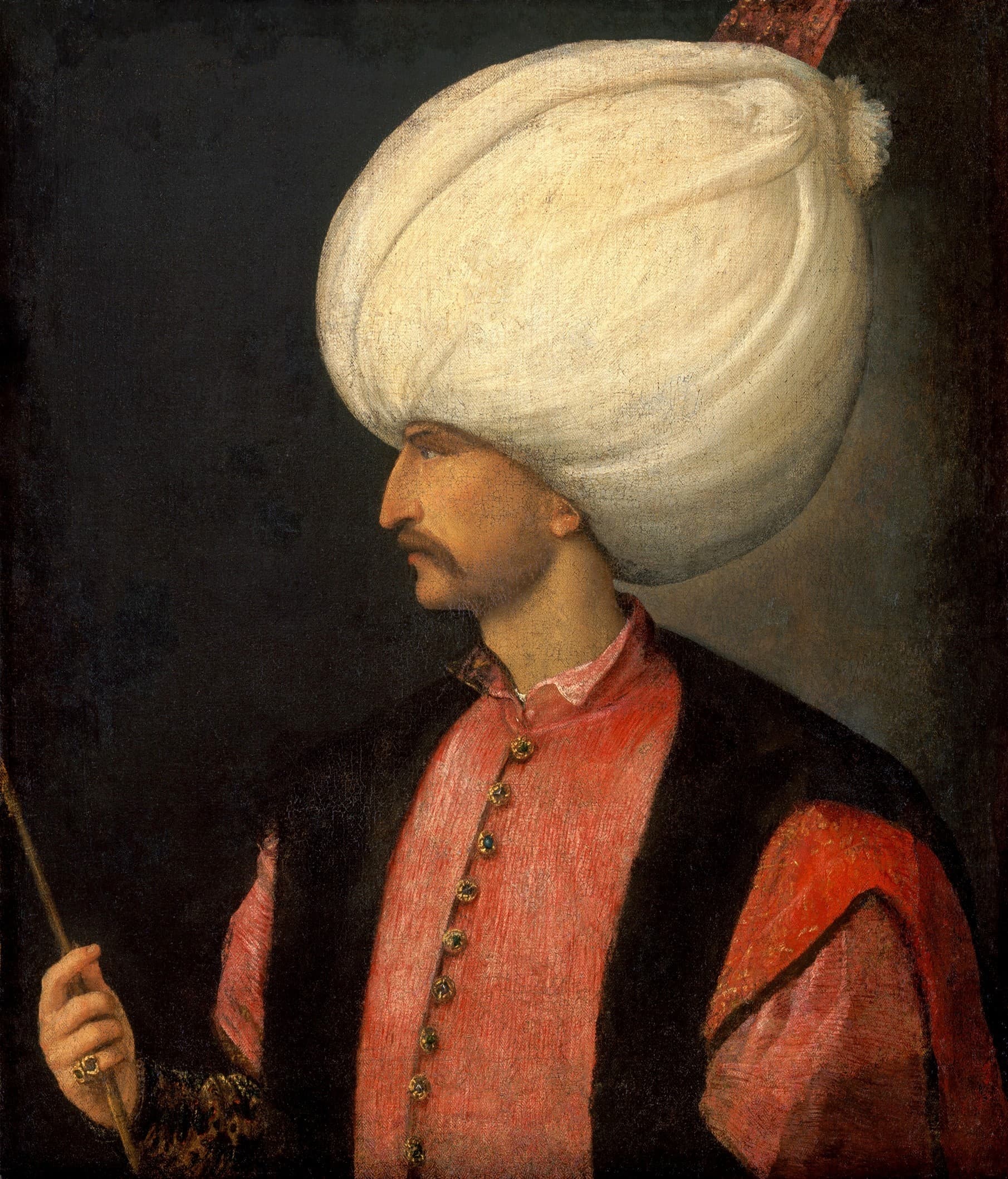
The reach of the Ottoman Empire during the sixteenth century was shaped largely by the hand of a single man who ruled for nearly forty-six years.
In the autumn of 1520, a Venetian diplomat named Bartolomeo Contarini caught his first glimpse of the newly crowned tenth sultan of the Ottoman Empire. The young ruler, just twenty-six years old, was tall, slender, and tough-faced, with a thin, bony frame and a sparse, barely visible beard. To Western observers, he seemed an intellectual, a quiet young man of friendly humor who spent his hours reading, studying history, and practicing the intricate art of the goldsmith. Yet behind this refined facade lay an ambition that would reshape the boundaries of the early modern world. For the next forty-six years, this young man—known to his subjects as Kanunî, the Lawgiver, and to a terrified, fascinated Europe as Suleiman the Magnificent—would preside over the absolute zenith of Ottoman economic, military, and political power. By the time of his death, he would rule over twenty-five million souls, stretching his dominion from the gates of Vienna to the shores of the Persian Gulf, transforming his empire into a global superpower that forced the monarchs of Europe to redefine their own claims to sovereignty.
Suleiman’s path to global preeminence began with a calculated correction of his ancestors' failures. Where his great-grandfather Mehmed the Conqueror had met defeat at the walls of Belgrade, Suleiman succeeded. In the summer of 1521, he encircled the Hungarian-held fortress with a massive force of 250,000 soldiers and more than one hundred ships on the Danube, subjecting the garrison to a devastating bombardment until the city fell on August 28. Belgrade quickly transformed under his rule, swelling to a metropolis of over one hundred thousand people, second only to Constantinople. Having broken the outer shield of Central Europe, Suleiman turned his gaze to the Mediterranean. The Knights Hospitaller, operating from their heavily fortified island stronghold of Rhodes, had long harassed Ottoman shipping. In 1522, after constructing the massive Marmaris Castle as a naval base, Suleiman launched a brutal five-month siege of the island. Though the victory cost the Ottomans between fifty thousand and sixty thousand lives to combat and disease, the Knights capitulated, and Suleiman, showing a characteristic mixture of mercy and pragmatism, allowed them to depart in peace.
These early conquests paved the way for Suleiman’s most devastating European triumph. On August 29, 1526, he met the young King Louis II of Hungary at the Battle of Mohács. Encouraged by impatient nobles, the Hungarian chivalry launched a premature frontal assault that collapsed catastrophically into coordinated Ottoman counterattacks. King Louis and the bulk of the Hungarian aristocracy perished on the field, bringing an abrupt end to the Jagiellonian dynasty. Walking the corpse-strewn field, Suleiman reportedly lamented the young king’s fate, mourning that Louis had been cut off before tasting the "sweets of life and royalty." The victory broke the Kingdom of Hungary, partitioning it into a permanent battleground between the Ottomans, the Habsburgs, and the Ottoman-supported Prince John Zápolya. When the Habsburg Archduke Ferdinand reoccupied the Hungarian capital of Buda, Suleiman responded with fury. In 1529, his forces marched up the Danube valley, reclaimed Buda, and pushed onward to lay siege to Vienna.
The siege of Vienna in the autumn of 1529 represented the absolute high-water mark of Ottoman expansion into the West. It was an extraordinarily ambitious expedition, but it stretched the logic of sixteenth-century logistics to its breaking point. Late summer rains and miserable weather plagued the march, forcing the Ottoman army to leave behind their heaviest siege artillery and severely hampering their supply lines. Against a reinforced garrison of sixteen thousand defenders, the weather-beaten Ottoman forces could not breach the walls, marking Suleiman’s first major military defeat. A second attempt in 1532 was similarly frustrated when the stubborn defense of the small fortress of Güns delayed the army too long for an assault on Vienna. Despite these setbacks, the campaigns cemented a bitter, centuries-long rivalry with the Habsburgs. By 1533, Ferdinand was forced to sign the Treaty of Constantinople, acknowledging Suleiman as his "father and suzerain," agreeing to pay an annual tribute, and accepting the Ottoman grand vizier as his equal in rank. When hostilities resumed in the 1540s, Suleiman secured further Hungarian territories, including Esztergom, Siklós, and Székesfehérvár, forcing the Holy Roman Emperor Charles V to sign a humiliating treaty where he was addressed merely as the "King of Spain"—allowing Suleiman to claim that he alone was the true Caesar.
While Suleiman’s armies battered the Christian West, his eastern borders demanded equal vigilance. The Shia Safavid Empire of Iran, ruled by Shah Tahmasp, remained a persistent ideological and territorial threat. The conflict erupted after Tahmasp executed the pro-Ottoman governor of Baghdad and replaced him with a Safavid loyalist. In 1533, Suleiman dispatched his brilliant grand vizier and close companion, the Greek-born former slave Pargalı Ibrahim Pasha, to reclaim eastern Asia Minor. Suleiman joined Ibrahim the following year, marching his forces deep into the harsh, arid Persian interior. Rather than risk a pitched battle, the Shah retreated, burning the countryside and relying on scorched-earth tactics. Despite these hardships, Suleiman entered Baghdad in triumph in 1535. To legitimize his rule over the newly conquered Arab and Shia territories, he ordered the restoration of the tomb of Abu Hanifa, the founder of the Hanafi school of Sunni Islamic law, signaling his role as the supreme protector of orthodox Islam.
Yet Suleiman’s historical legacy rests as much on his internal transformations of the state as it does on his military conquests. Working alongside his chief judicial official, Ebussuud Efendi, Suleiman achieved a monumental synthesis of Ottoman governance, harmonizing the state’s secular administrative decrees (Kanun) with sacred Islamic law (Sharia). This legal architecture standardized taxation, overhauled criminal law, and streamlined education, earning him the enduring title of Kanunî among his subjects. Beneath this orderly legal framework, the empire blossomed into an artistic golden age. Suleiman was a generous patron of literature, architecture, and the arts, funding grand mosques, public works, and intellectual institutions that came to define the visual identity of the empire.
This era of grand institutional reform was mirrored by a revolutionary shift within the walls of the imperial palace. In 1534, Suleiman shattered centuries of Ottoman royal tradition by legally marrying his concubine, Hürrem Sultan. A woman of immense intelligence and political acumen, Hürrem rose from the ranks of the imperial harem to become the Sultan’s chief advisor and confidante, initiating a decades-long historical era known as the "Sultanate of Women," where female members of the dynasty wielded unprecedented political influence over the affairs of state. This domestic revolution, however, occurred alongside profound personal tragedies. In 1536, Suleiman ordered the execution of his lifelong friend and grand vizier, Ibrahim Pasha, whose growing power and ambition had begun to threaten the throne, demonstrating that even the most intimate bonds of Suleiman's youth were subservient to the absolute preservation of imperial authority.
By 1566, the aging Sultan was seventy-two years old, frail, and had not led an army in thirteen years. Yet, determined to strike one final blow against the Habsburgs, he set out on his thirteenth military expedition, targeting the Hungarian fortress of Szigetvár. He arrived at the siege on August 5, watching the slow, bloody bombardment from a tent pitched on a nearby hill. On September 6, 1566, just one day before the fortress finally fell to his troops, Suleiman died quietly in his tent. Fearing that the army would mutiny or lose its will to fight if they discovered their leader had perished, Suleiman's innermost circle kept his death an absolute secret for forty-eight days. While a secret courier raced to Constantinople to summon his successor, Selim II, the grand vizier maintained the illusion that the Sultan was still alive, directing the army’s movements in the dead ruler's name.
Suleiman’s death marked the end of an era of unstoppable Ottoman expansion, serving as a watershed moment in global history. He left behind an empire that had expanded to its natural geographic limits, forcing his successors to transition from an era of continuous conquest to one of administrative consolidation and institutional adaptation. For the European powers who had trembled at his name, his passing brought a cautious relief, yet the administrative, judicial, and cultural structures he forged would sustain the Ottoman state for centuries to come, long after the great Lawgiver was laid to rest.
Connected to
- religionIslam631 CE
- father · child ofSelim I1470 CE
+ 12 further connections to entries not yet ingested