Person · 604 CE – 650 CE · Silk Roads
Songtsän Gampo
- Also known as
- Gampo
- Soncen Gampo
- Song Tsen Gam Po
- Song Tsen Gampo
- Songcen Gampo
- Songcen Gampo
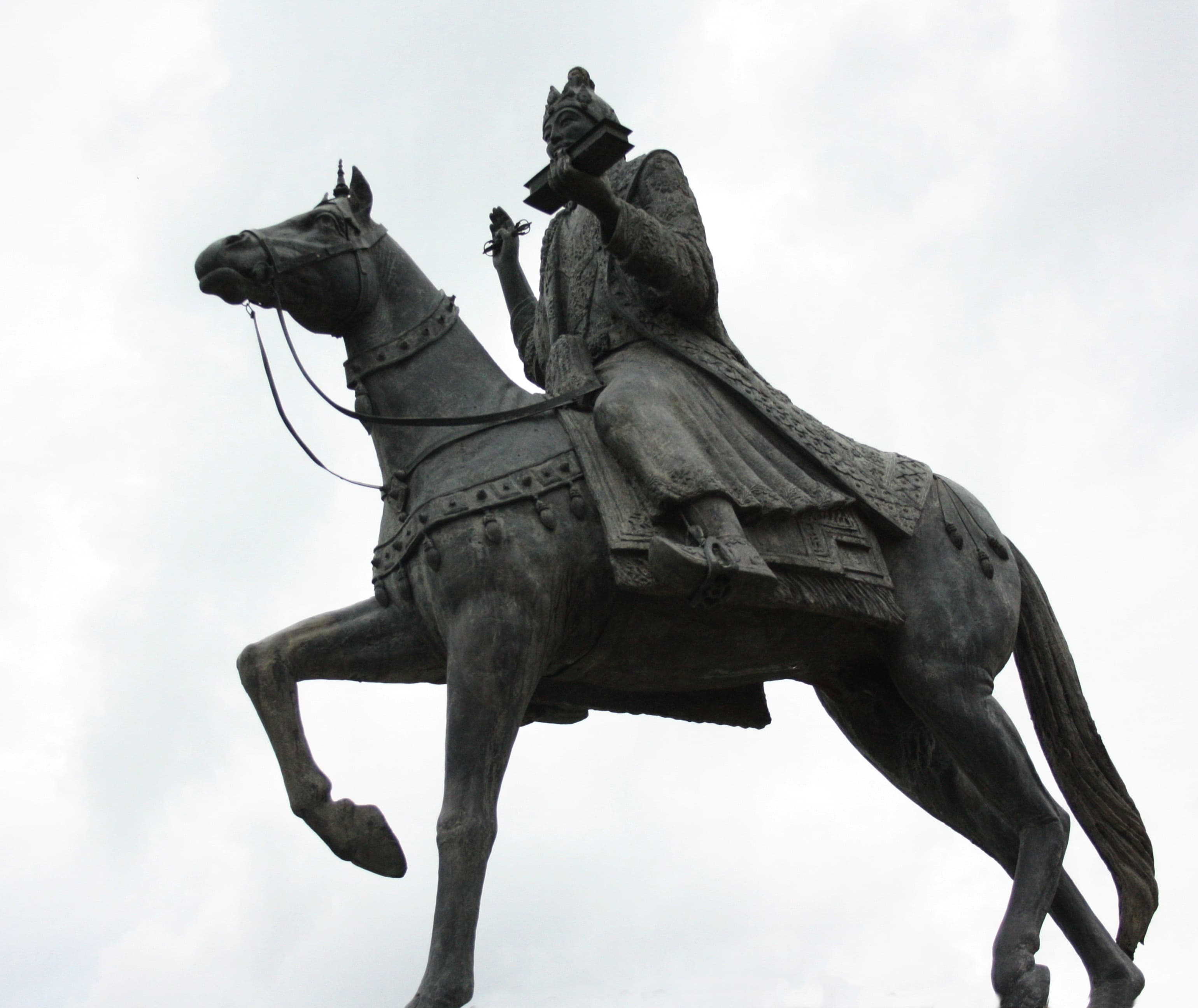
Before the seventh century, the Tibetan Plateau was a fractured landscape of rival clans and regional chieftains.
In the early seventh century CE, the Tibetan Plateau was not a nation but a fractured high-altitude wilderness, a shifting jigsaw of feuding clans, sacred peaks, and ancient, pre-Buddhist martial dynasties. The transition from this volatile world of local chieftains to a unified empire—one capable of staring down the Tang Dynasty of China and the kingdoms of Northern India—crystallized around a single, mythologized figure: Songtsän Gampo. To later generations of Tibetan historians, he was an emanation of Avalokiteshvara, the bodhisattva of infinite compassion, a divine king who brought the light of the Buddhist Dharma to a barbarous land. Yet the contemporary records painted on the silk scrolls of Chang'an and recovered from the dry caves of Dunhuang reveal a more complex, pragmatic figure. He was a brilliant, iron-willed sovereign who forged an empire through tactical marriages, ruthless military campaigns, and a profound understanding of how cultural technology could serve as the ultimate instrument of statecraft.
He was born in the Ox year of the Tibetan calendar, likely corresponding to 605 CE, at Gyama in Meldro, just northeast of modern Lhasa. His father, Namri Songtsen, was the ruler of the Yarlung dynasty, a lineage that had begun to assert its dominance over the southern valleys of the plateau. But Namri Songtsen’s ambitions were cut short; around 618 CE, he was poisoned by rival factions. Songtsän Gampo, still a minor of perhaps twelve or thirteen, was thrust onto the throne. According to Yarlung tradition, a king was deemed ready to rule when he was old enough to ride a horse, and the young monarch quickly proved he could handle both his mount and the treacherous politics of his court. He began by consolidating his hold on the Yarlung Valley, leaning heavily on the military and diplomatic talents of his ministers, most notably Nyang Mangpoje Shangnang. Together, they turned their eyes toward the Sumpa tribe in the northeast, crushing them around 627 CE with the aid of troops from the western kingdom of Zhangzhung.
But courtly loyalty was a fleeting commodity. By 632 or 633 CE, Nyang Mangpoje, the architect of these early victories, was accused of treason and executed. He was replaced by Gar-Tongtsen, a brilliant minister who would help guide Tibet’s expansion for decades. With internal rivals silenced, Songtsän Gampo systematically expanded his borders. To the west lay Zhangzhung, a powerful, culturally distinct kingdom that dominated the high plateau. The unification of the two realms was initially sealed with a double marriage: Songtsän Gampo took a princess of Zhangzhung as one of his consorts, while his own sister, Sad-mar-kar, was sent west to marry the Zhangzhung king, Ligmikya. The alliance, however, soured. Sad-mar-kar sent secret, poetic complaints back to Lhasa, detailing her poor treatment at the hands of Ligmikya’s principal wife. Utilizing his sister’s strategic placement and inside intelligence, Songtsän Gampo orchestrated a betrayal. While traveling to the Amdo region, King Ligmikya was ambushed and killed by Tibetan soldiers. With his death, Zhangzhung was annexed into the central Tibetan state, creating a unified polity known as Bod rGyal-khab.
With the plateau increasingly under his control, Songtsän Gampo turned his attention outward, recognizing that his expanding empire required recognition from the great powers on its periphery. In 634 CE, the first Tibetan embassy arrived at the Tang court of Emperor Taizong in Chang'an. To the Chinese, accustomed to subservient barbarian tribes, the mission was recorded as a tribute-bearer. In reality, it was an ultimatum: Songtsän Gampo demanded a imperial marriage alliance, a princess of the Tang to cement his status as an equal sovereign. When Taizong refused, the Tibetan king unleashed his armies. He attacked the Tangut people, who would centuries later form the Western Xia, as well as the Bailang and various Qiang tribes along the Sino-Tibetan frontier. By 637 and 638 CE, Tibetan forces numbering over one hundred thousand had marched into the frontier province of Songzhou. Though Chinese chronicles claim the Tibetans ultimately retreated and apologized, the historical reality is clear: Emperor Taizong, recognizing the formidable military threat on his western flank, capitulated. He agreed to send a royal bride.
This diplomatic triumph yielded Princess Wencheng, who arrived in Tibet in the early 640s CE. She was not Songtsän Gampo’s only foreign bride; he had also wed Princess Bhrikuti, the daughter of the king of the Licchavi dynasty of Nepal. These foreign queens are celebrated in Buddhist hagiography as the twin catalysts of Tibet's spiritual awakening, bringing with them sacred images of the Buddha. To house these foreign treasures, Songtsän Gampo ordered the construction of the first grand Buddhist temples in Tibet, most notably the Jokhang in Lhasa—a city he established as his capital, moving the seat of power from the Yarlung Valley to the Kyichu Valley. Originally a pastureland known as Rasa, "the place of goats," the site was renamed Lhasa, "the place of gods," to reflect its new sacred character.
Yet for all his patronage of these foreign princesses and their shrines, Songtsän Gampo’s personal relationship with Buddhism was likely more political than spiritual. He remained a king of his times, deeply rooted in the indigenous, pre-Buddhist rituals of the Yarlung dynasty. When he died, he was not cremated in the Buddhist fashion but buried in the royal tombs of Yarlung, surrounded by the traditional animal sacrifices and ancestral protocols of his forebears. Buddhism, during his reign, was an elite import, a courtly prestige project rather than a mass religion.
The true stroke of genius in Songtsän Gampo’s state-building was his realization that a great empire could not be governed by oral traditions and local customs alone. It required literacy and a unified legal framework. To solve this, he dispatched his minister Thonmi Sambhota and a contingent of young scholars to India. Their mission was to study Sanskrit grammar and phonetic systems to devise a written script capable of capturing the nuances of the Tibetan spoken tongue. Upon his return, Thonmi Sambhota went into retreat at the Kukhamaru Palace in Lhasa to finalize the script. Songtsän Gampo himself reportedly retired from public life for four years to master this new written language.
The creation of the Tibetan script unlocked a wave of administrative and cultural transformation. For the first time, court records could be kept, a formal constitution could be written, and laws could be codified. This newfound literacy allowed Tibet to absorb and adapt the administrative sciences of its neighbors. Traditional accounts note that while the dharma and writing came from India, the Tibetans imported handicrafts, astrological systems, and paper-making technology from China, and model laws and administrative structures from the Uyghurs of the Second Turkic Khaganate to the north. By adapting these diverse foreign technologies to the unique geography of the plateau, Songtsän Gampo created a robust, centralized state.
His later years were marked by both tragedy and continued geopolitical maneuvering. His eldest son and chosen heir, Gungsong Gungtsen, reached the traditional age of thirteen and was briefly given the throne while his father retired, possibly to focus on the drafting of the new Tibetan constitution. But the young king died after only five years of rule, forcing the aging Songtsän Gampo to resume the mantle of power. Family strife also plagued the dynasty; his younger brother, Tsensong, was betrayed and burned to death by his own minister, Khasek, in 639 CE, amid whispers of imperial intrigue.
When Songtsän Gampo died in 650 CE, he left behind an empire that had permanently altered the geopolitics of Inner Asia. Because his son had predeceased him, the crown passed to his young grandson, Mangsong Mangtsen, under the regency of the capable minister Gar-Tongtsen. The Yarlung dynasty would rule for another two centuries, but its foundations were entirely the work of the first Dharma King. By moving his capital to the Potala Palace in Lhasa, commissioning a written script, and balancing the giant empires of Tang China and India, Songtsän Gampo did not merely conquer the Tibetan Plateau; he invented Tibet as a distinct, unified civilization. The script created in his court remains the vehicle for Tibetan literature and sacred texts to this day, and the temples he founded survive as the spiritual heart of a culture that, despite centuries of foreign invasion and political upheaval, has never forgotten the king who first taught it how to write its own name.
Connected to
- foundedTibetan Empire618 CE
+ 12 further connections to entries not yet ingested