Place · 1464 CE – 1591 CE · Trans Saharan TradeTier 3 · Curated
Songhai Empire
- Also known as
- Ìjọba Songhai
- إمبراطورية سونغاي
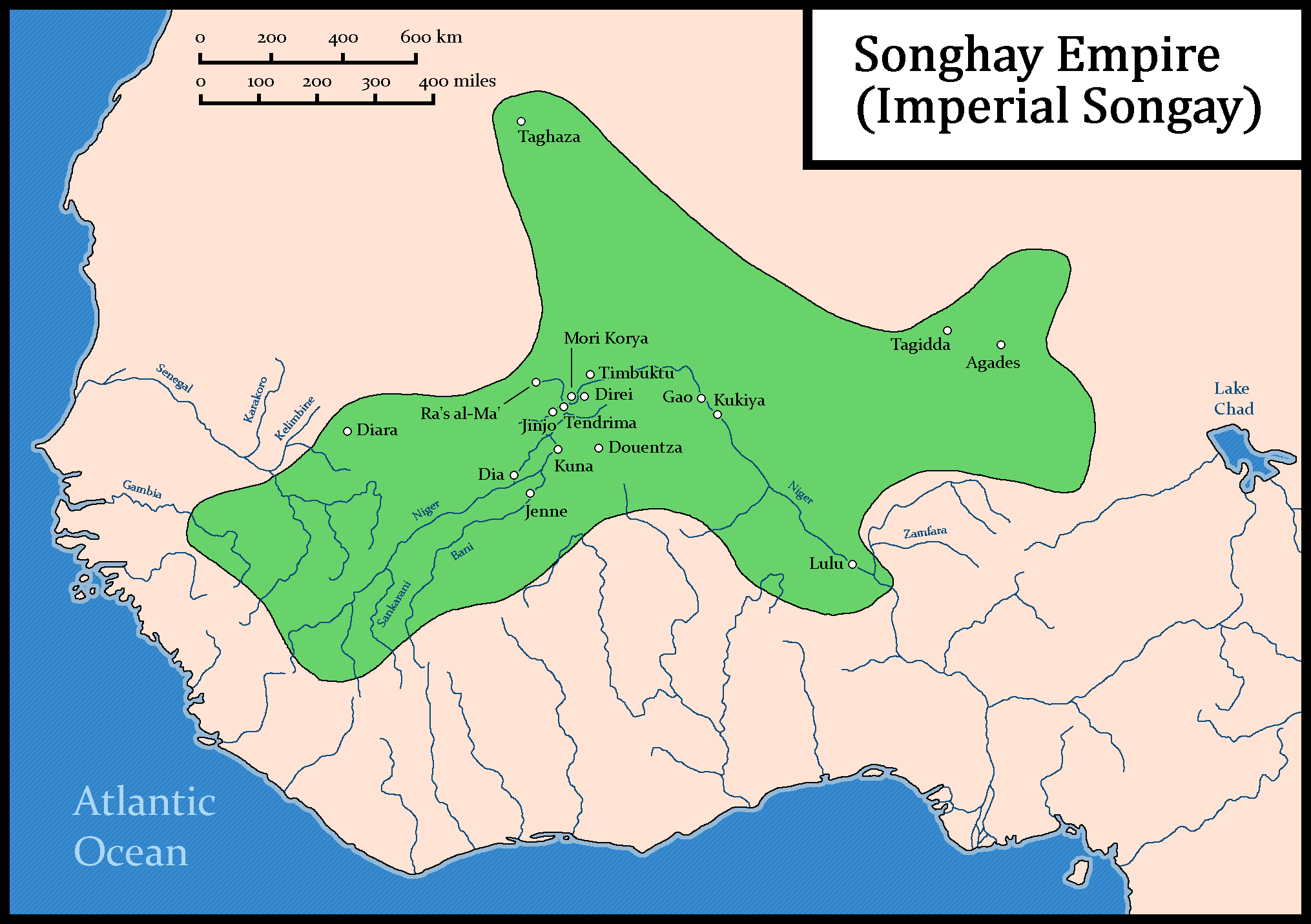
The rise and fall of the Songhai Empire hinged on the control of the great river highways and desert trade routes of the western Sahel.
On a spring morning in 1591, near the dusty banks of the Niger River at a place called Tondibi, two worlds collided in a cloud of gunpowder, dust, and terrified beasts. On one side stood the grand host of the Songhai Empire: ten thousand armored horsemen and thirty thousand infantry, a sprawling mass of warriors drawn from the Sahel, the savannahs, and the riverlands. They carried iron-tipped spears, bows, and broadswords, their elite cavalry outfitted in heavy chain mail and gleaming helmets, a spectacle of medieval military splendor that had long terrorized the West African interior. Facing them was an invading force barely an eighth their size—some four thousand men sent by the Saadi Sultan of Morocco, Ahmad al-Mansur. Yet this smaller army, commanded by a Spanish-born eunuch named Judar Pasha, carried a terrifying novelty that would rewrite the terms of West African history: the arquebus and the cannon. Desperate to break the Moroccan line without exposing his men to the strange, roaring weapons of the invaders, the Songhai emperor, Askia Ishaq II, ordered his commanders to drive a massive herd of one thousand long-horned bulls directly into the enemy ranks. It was an ancient, proven stratagem, designed to trample the opposing infantry and shield the advancing Songhai cavalry behind a wall of thundering flesh. But as the bulls charged, Judar Pasha’s soldiers unleashed a volley from their firearms. The sudden, deafening explosions and the acrid stench of sulfur did not break the Moroccan line; instead, they panicked the beasts. The massive herd of bulls wheeled around in terror, charging backward into the dense ranks of the Songhai infantry. In the ensuing chaos, the Moroccan arquebusiers advanced, their disciplined fire cutting down the scattered, struggling defenders. Within hours, the largest empire in African history was shattered, its army routed, and its centuries-old dominance over the trans-Saharan world brought to a sudden, violent end.
The catastrophe at Tondibi was the spectacular finale of a state that had, over the course of more than a century, raised itself to the zenith of early modern imperial power. To understand how the Songhai reached this pinnacle of wealth and territorial vastness, one must look not to the fire of Moroccan guns, but to the slow, ancient alchemy of the Niger River. Long before it was an empire, Songhai was a mosaic of ecological niches and human adaptations centered around the ancient hub of Kukiya and the rising river-port of Gao. Between the ninth and third centuries BCE, several distinct groups began to coalesce along the Niger Bend. Among the earliest were the Sorko people, master boatbuilders who fashioned sturdy canoes from the wood of the cailcedrat tree. They dominated the river, fishing, hunting its waters, and providing vital water-borne transport for goods and people. Alongside them were the Gao people, specialized hunters of river megafauna like crocodiles and hippopotamuses, and the Do, who farmed the rich, silty soils deposited by the river’s seasonal floods. Before the tenth century, these disparate groups were subjugated by horse-riding, Songhai-speaking elites who established political dominance over the region. Over generations, these communities integrated, adopting a common tongue and a shared identity. By the tenth century, their chiefs had established Gao as a prosperous small kingdom, ideally positioned to control the burgeoning trade routes that linked the West African forest zones to the Mediterranean world.
Gao’s wealth soon attracted the predatory attention of the expanding Mali Empire, which annexed the city around the end of the thirteenth century. For over a century, Mali profited from Gao’s vibrant trade and levied heavy taxes on its rulers. When the famed Moroccan traveler Ibn Battuta visited Gao in 1353, he found a bustling, highly productive metropolis, describing it as "one of the finest, biggest, and most fertile cities of the Sudan," rich in rice, milk, fish, and incomparable cucumbers, where merchants conducted their transactions using cowrie shells as currency. Yet, the seeds of Mali’s decline were already sown. Following the death of Mansa Sulayman in 1360, bitter dynastic disputes and financial mismanagement crippled the Malian state. Though Malian regents attempted to suppress rebellions in Gao, they could not hold the eastern frontier forever. By the late fourteenth century, as Mali fractured, the Songhai reasserted their independence under rulers like Sunni Muhammad Dao. By the 1460s, the Songhai were no longer merely defending their ancestral river-lands; they were actively expanding westward, swallowing the fragmenting territories of their former masters.
The true architect of the Songhai Empire was Sonni Ali, who reigned from 1464 to 1492. A military commander of relentless energy and tactical genius, Ali transformed a regional river-kingdom into an aggressive, expansionist empire. Unlike the urban, orthodox Muslim elites who would later dominate the empire's historical record, Sonni Ali remained deeply attached to the traditional religious practices of his mother’s people from the Dendi region. This syncretism, combined with his ruthless treatment of recalcitrant cities, earned him the enduring enmity of Islamic scholars. His military campaigns were relentless: he repelled the Mossi to the south, conquered the Dogon in the north, and set his sights on the great urban trading hubs of the Middle Niger. In 1468, he annexed Timbuktu, which had fallen under the control of the Tuareg after the decline of Mali. Sunni Ali’s entry into Timbuktu was marked by violence and pillaging. The chronicler Al-Sa'di, writing in the seventeenth-century historical work Tarikh al-Sudan, recorded the horror of the town’s Muslim intelligentsia, stating that the "Godless tyrant" committed gross iniquities, burning and destroying the town, and brutally torturing those who remained, while many of the city’s esteemed scholars fled on camels to Walata. Five years later, in 1473, after a grueling seven-year siege that starved the inhabitants into submission, Ali conquered the wealthy market city of Djenné. By securing Gao, Timbuktu, and Djenné, Sonni Ali united the three great commercial jewels of the Niger Bend under a single authority, vastly increasing the wealth of the state and surpassing the former glory of Mali.
Upon Sonni Ali’s death in 1492, a brief dynastic struggle ensued. His son and successor, Sonni Baru, attempted to continue his father’s policy of balancing traditional religion with Islam, but this sparked a rebellion among the orthodox Muslim military elites. Muhammad Ture, one of Sonni Ali’s leading generals, overthrew Baru in 1493, establishing the Askia dynasty and taking the name Askia Muhammad I, later known as Askia the Great. Recognizing that Islam could serve as a powerful unifying ideology for his vast, multi-ethnic empire, Askia the Great embarked on a systematic campaign of Islamic revival and political centralization. In 1496, he undertook a magnificent pilgrimage to Mecca, matching the legendary opulence of Mali’s Mansa Musa. Traveling with an escort of five hundred cavalry and one thousand infantry, he carried three hundred thousand pieces of gold, which he distributed generously to charities and spent on lavish gifts to demonstrate the power and wealth of the Songhai state. Upon his return, he was recognized as the Caliph of the Sudan, a title that bolstered his legitimacy across the Islamic world.
Askia the Great transformed the administrative structure of the empire. He replaced the loose, tributary feudalism of the Sonni dynasty with a highly centralized bureaucracy. He divided the empire’s vast territories into three primary military zones, each governed by high-ranking officials. In the west lay the kurma, supervised by the Balama (the minister of defense and commander-in-chief of the western garrisons), alongside the Kurma Fari, who governed from the regional capital of Timbuktu. The central province was governed directly from Gao by the emperor himself, assisted by the Tondi Farma in the south and the Surgukoy—the chief of the Saharan Berbers—in the north. In the east, the Dendifari ruled the volatile province of Dendi, keeping watch over the Hausa kingdoms. To run this massive apparatus, Askia created specialized departmental ministries: the Fari Mondzo supervised the state’s extensive agricultural estates; the Kalisa Farma acted as the finance minister, overseeing the treasury; the Korey Farma managed relations with white foreigners; and the Hikoy, the admiral of the empire, commanded a massive river fleet of over one thousand war canoes stationed at the imperial port of Gao.
This administrative machinery supported an economy of unprecedented scale. The backbone of Songhai’s wealth was the trans-Saharan trade, which relied on the delicate coordination of camel caravans, desert-dwelling Berber guides, and the protective umbrella of the Songhai state. Gold from the southern forests was carried north, while salt, mined from the desolate northern deposits of Taghaza, was brought south. This vital gold-for-salt exchange was augmented by a trade in ivory, ostrich feathers, leather, dates, horses, and enslaved captives. To facilitate commerce, Askia the Great introduced a standardized system of weights and measures across all major market towns, appointing inspectors to police the trade centers. The Niger River served as the great domestic highway of the empire; goods transported by desert caravans were transferred onto donkey caravans or large riverboats at Timbuktu, then moved along a five-hundred-mile river corridor upstream to Djenné or downstream to Gao. The largest of these vessels, known as Kanta boats, were constructed by the tributary Sorko fishermen and could carry up to thirty, or in some cases eighty, tons of cargo—the equivalent capacity of hundreds of camels or thousands of men.
Under Askia the Great, the Songhai economy operated on a rigid, caste-like clan system that dictated a person's occupation. At the top of this social pyramid were the noblemen and the direct descendants of the original Songhai people, followed by freemen, artisans, and merchants. Below them were specialized, hereditary craft guilds—resembling medieval European trade unions—composed of metalworkers, fishermen, carpenters, and weavers. At the very bottom of society were prisoners of war and agricultural slaves, whom the Songhai used far more systematically and intensively than their Ghanaian or Malian predecessors to cultivate the imperial estates. Criminal justice within this complex society was heavily reformed under Askia's rule, aligning closely with orthodox Islamic jurisprudence. Local qadis (judges) were appointed in major trading cities like Timbuktu and Djenné to adjudicate common-law misdemeanors and commercial disputes according to Sharia law. While the emperor reserved the right to try cases of high treason, everyday disputes were settled by these jurists, who were drawn from the highly educated academic community. The decisions of the court were enforced by the Assara-munitions, a specialized police force that functioned as the enforcers of judicial sentences.
This devotion to Islamic governance went hand-in-hand with an extraordinary cultural and intellectual renaissance. Timbuktu, once devastated by Sonni Ali, was transformed under Askia the Great into the intellectual capital of West Africa. He patronized the Sankore Mosque and University, offering generous state pensions to its professors and scholars. The city became a magnet for astronomers, jurists, theologians, and poets from across Morocco, Egypt, and the wider Mediterranean. Askia’s own children were educated in these institutions, and his court in Gao became a vibrant center of intellectual debate. This cultural flowering was recorded with admiration by contemporary Maghrebi writers, such as Leo Africanus, who marveled at the abundance of handwritten books imported from North Africa, which sold for higher prices than any other merchandise in the markets of Timbuktu.
Yet, this golden age rested on a fragile political foundation. In 1528, the aging Askia the Great, now blind and feeble, was deposed by his own children in a palace coup that elevated his son, Askia Musa, to the throne. Musa’s reign was short and bloody, ending with his own assassination in 1531, which plunged the empire into a destabilizing cycle of dynastic rivalry, coups, and civil wars. Though the empire experienced a temporary resurgence of stability and military success during the long reign of Askia Daoud (1549–1582), his death reopened the wounds of succession. By the late 1580s, the empire was deeply divided, its ruling family fractured into feuding factions, and its provincial governors increasingly acting as autonomous rulers.
It was during this period of domestic vulnerability that the eyes of the Saadi Sultan of Morocco, Ahmad al-Mansur, turned toward the south. Morocco was reeling from the financial aftershocks of the Battle of Alcácer Quibir in 1578; though the Moroccans had successfully annihilated a Portuguese invasion, the victory had left the state treasury nearly bankrupt. Desperate to find a new source of wealth to fund his ambitious state-building projects and his developing sugar industry, al-Mansur set his sights on the trans-Saharan trade routes, eager to seize direct control of the West African goldfields and the salt mines of Taghaza. To achieve this, he dispatched Judar Pasha with an elite force of four thousand highly disciplined soldiers, many of them European renegades and Andalusian Moriscos equipped with state-of-the-art gunpowder weaponry.
While the Moroccans had modernized their military machine, the Songhai had remained stagnant. Askia the Great had established a professional, standing army, but his successors had failed to adapt to the gunpowder revolution sweeping the Mediterranean. Despite possessing a vast territory and a sophisticated administrative system, the Songhai military in 1591 was essentially the same force that had fought a century earlier: brave, heavily armored, but utterly unprepared for the psychological and physical devastation of firearms. After a grueling, heroic march across the hyper-arid wastes of the Sahara Desert, Judar Pasha’s expeditionary force arrived on the banks of the Niger.
The Battle of Tondibi did more than just shatter the Songhai army; it dismantled the entire political and economic architecture of the Western Sahel. Following their victory, Judar Pasha’s forces marched on the imperial capitals, systematically sacking Gao, Timbuktu, and Djenné. The libraries of Timbuktu were plundered, its intellectual elite scattered or carried away in chains to Morocco, and the administrative institutions that had guaranteed the safety of the trade routes were dismantled. Yet, the Saadi victory proved to be a pyrrhic one. Governing an empire that stretched thousands of miles across the world’s largest desert was an administrative impossibility for the Moroccan court. Finding the occupation too costly and difficult to maintain, the Saadi dynasty gradually withdrew its direct support, leaving their local garrison commanders—who married into the local population and became known as the Arma—to rule as a localized military caste.
Without a strong, centralized state to police the trade routes and maintain the complex networks of dikes and canals along the Niger, the Western Sahel splintered into dozens of small, feuding kingdoms. The remaining Songhai nobility fled south into the Dendi region, where they established smaller successor states, but the grand imperial experiment was over. The trans-Saharan trade, which had for centuries been the economic lifeblood of the great Sudanic empires of Ghana, Mali, and Songhai, began a slow, terminal decline, increasingly bypassed by European maritime traders operating along the West African coast. In the vacuum left by the empire's fall, West African Islam, which had flourished under the universalist patronage of the Askias, retreated into more localized, fractured forms, waiting for new movements and new leaders to rebuild what had been lost. The collapse of the Songhai Empire marked the end of the era of the great desert-edge empires, leaving behind a haunting memory of a time when the cities of the Niger Bend stood as world centers of wealth, learning, and power—and leaving historians to wonder how the history of the African continent might have differed had the bulls of Tondibi not turned back.
From the archives
The Songhai Empire at its furthest reach, late fifteenth and early sixteenth centuries. CC BY-SA · via Wikimedia CommonsThe Tomb of Askia in Gao, Mali — Songhai's capital. Built c. 1495 for Askia Muhammad. CC BY-SA · via Wikimedia CommonsSankoré in Timbuktu under Songhai sovereignty — a centre of Islamic scholarship rivalling Cairo and Fez. CC BY-SA · via Wikimedia Commons
Connected to
1 link to entries not yet ingested in the Library.