Event · 1804 CE – 1903 CE · Trans Saharan Trade
Sokoto Caliphate
- Also known as
- Al Khilafa al Bilad As-Sudan
- Al Khilafa al Bilad As-Sudan
- Al Khilafa al Bilad As-Sudan
- Califado de Sokoto
- Califat de Sokoto
- Califato de Sokoto
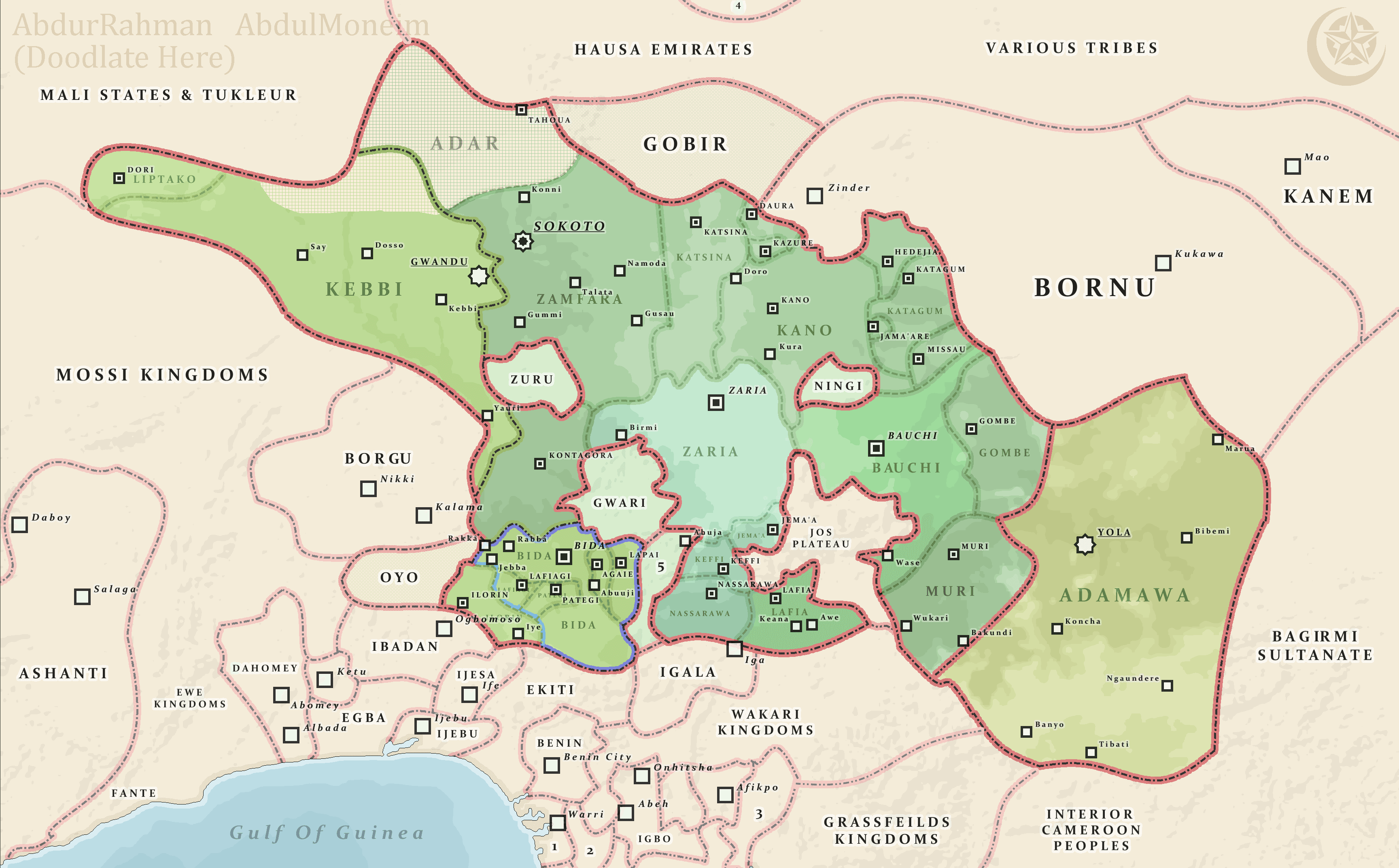
In the winter of 1804, a migration of devout dissidents fled the wrath of the Hausa King Yunfa, who had attempted to assassinate their leader, Usman dan Fodio.
In February 1804, a small band of refugees moved through the arid landscape of the Rima River valley toward the settlement of Gudu, fleeing the wrath of the Sultan of Gobir. At their head was Usman dan Fodio, an urbanized Fulani scholar, writer, and preacher whose reformist theology had grown too popular—and too dangerous—for the Hausa aristocracy. Only two years prior, Yunfa, a former student of dan Fodio who had ascended the throne of Gobir, had attempted to assassinate his old tutor. Now, Yunfa’s soldiers were marching, and the flight to Gudu, deliberately styled after the Prophet Muhammad’s migration (hijra) from Mecca to Medina, marked the point of no return. In Gudu, the exiled dissidents formally pledged their allegiance to dan Fodio, proclaiming him Amir al-Mu'minin—the Commander of the Faithful. When Yunfa officially declared war on February 21, 1804, he did not merely spark a local rebellion; he ignited a revolutionary jihad that would sweep across the Sudanian savanna, dismantle the ancient Hausa city-states, and construct the largest independent political entity in nineteenth-century Africa.
The world that Usman dan Fodio set out to dismantle was one of fragmented, warring kingdoms and deep-seated social friction. For two centuries, the central Bilad as-Sudan—the "Land of the Blacks"—had been in political flux. The great Bornu Empire, which had long dominated the region, was in terminal decline, having lost control of the crucial trans-Saharan trade routes and its salt-rich oasis towns by the late eighteenth century. In the vacuum left by Bornu’s retreat and the much earlier collapse of the Songhai Empire, a patchwork of independent Hausa sultanates, including Gobir, Kebbi, and Zamfara, rose to prominence. These rival states engaged in near-constant warfare. To fund their armies and maintain their courtly luxuries, the Hausa aristocracies imposed heavy, erratic taxes on their subjects and launched relentless slave raids against neighboring populations. Though Islam had been present in the region for centuries, it was often a religion of the elite, synthesized with local traditional beliefs. By the late 1700s, a growing class of itinerant Maliki scholars, influenced by Sufi networks like the Qadiriyya order, began advocating for a strict return to orthodox Islamic law. They found a highly receptive audience among the heavily taxed peasantry and the marginalized Fulani pastoralists, both of whom grew to detest the corruption and despotism of the Hausa kings.
The conflict that followed dan Fodio’s declaration of jihad was brutal and protracted. Despite suffering devastating early losses, such as at the Battle of Tsuntua where many of dan Fodio’s "warrior-scholars" were slain, the reformist forces gradually turned the tide through guerrilla warfare and widespread civilian support. Armed with religious fervor and a network of committed "flag-bearers" who acted as military commanders, dan Fodio’s forces systematically captured the major Hausa states: Katsina and Daura fell first, followed by the wealthy commercial metropolis of Kano in 1807, and finally Gobir in 1809. In that same triumphal year, dan Fodio’s son, Muhammad Bello, founded the walled city of Sokoto, establishing it as the permanent capital of their new order. Rather than a highly centralized empire, the state emerged as a loose confederation of over thirty distinct emirates, each led by a flag-bearer who enjoyed immense local autonomy but recognized the supreme spiritual and political suzerainty of the in Sokoto.
Connected to
5 links to entries not yet ingested in the Library.