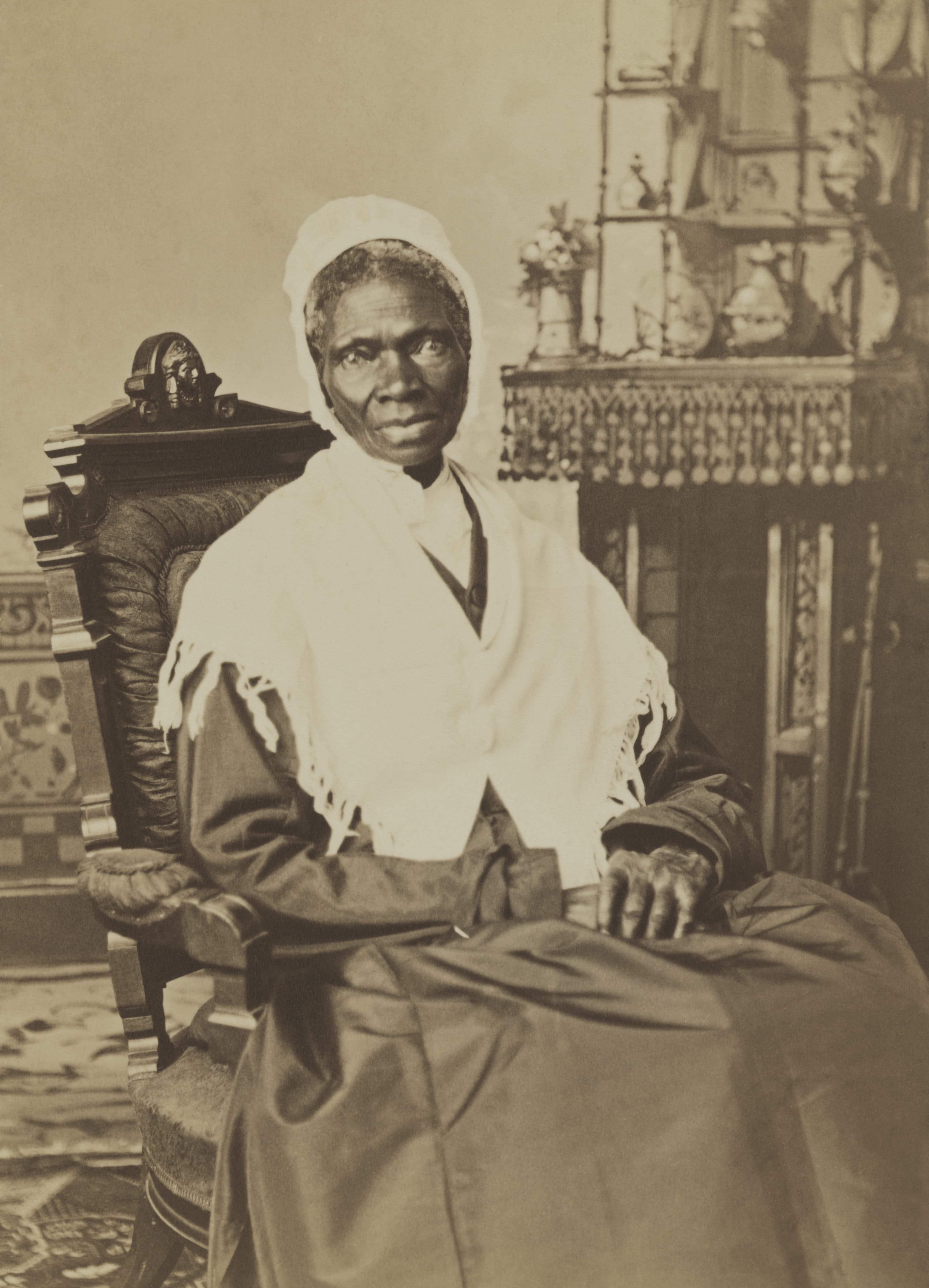
The woman who would call herself Sojourner Truth began her life speaking Dutch in the hilly lowlands of Swartekill, New York.
She spoke with a heavy Low Dutch accent, a linguistic inheritance from the Hudson Valley lowlands where she spent her first thirty years. She never learned to read or write, yet she possessed a rare, commanding authority of voice—deep, resonant, and entirely free of the southern slave dialect that white writers would later retroactively thrust upon her. When she spoke, she drew upon the sheer physical reality of her life: she was a six-foot-tall woman who had spent decades clearing timber, hauling stone, and spinning wool. Decades after her escape, when she stood before audiences of white reformers who often viewed the struggles of Black Americans and the struggles of women as entirely separate spheres, she embodied the physical refutation of their assumptions. As her biographer Nell Irvin Painter would observe, in an era when most Americans reflexively conceptualized slaves as male and women as white, she stood as a towering reminder that among the Black are women, and among the women, there are Black.
She was born Isabella Bomefree around 1797 in Swartekill, a hilly Dutch-speaking enclave in Ulster County, New York, some ninety miles north of New York City. Her parents, James and Elizabeth, were the property of Colonel Hardenbergh. Her father, a tall man captured from the Gold Coast of modern Ghana, was called "Bomefree," the Dutch word for tree; her mother, "Mau-Mau Bet," was the daughter of enslaved people from Guinea. The world of Isabella’s childhood was not the expansive cotton plantation of the American South, but the cold, insular slaveholding culture of rural New York. Her first memories were of a dark cellar where she slept with her parents on damp straw, and of the agonizing stories of her older siblings sold away to distant buyers. When Charles Hardenbergh died in 1806, the nine-year-old Isabella was auctioned off alongside a flock of sheep, sold for one hundred dollars to a cruel tavern keeper named John Neely. Neely beat her daily, once with a bundle of rods, for her inability to understand his English instructions. By 1810, after another brief, harsh ownership under Martinus Schryver, she was purchased by John Dumont of West Park.
For sixteen years, Dumont’s farm was the crucible of her life. He subjected her to repeated sexual abuse, which in turn provoked the relentless, hostile harassment of his wife, Elizabeth Waring Dumont. Isabella sought solace in a brief, doomed romance with Robert, an enslaved man from a neighboring farm. When Robert’s owner discovered the relationship, fearing that any offspring would legally belong to Dumont rather than himself, he and his son savagely beat Robert in front of Isabella until Dumont intervened; she never saw Robert again, and the memory of his battered face haunted her for the rest of her life. She was subsequently married to an older enslaved man named Thomas, bearing five children: James, who died in infancy; Diana, the product of her rape by Dumont; and Peter, Elizabeth, and Sophia.
12 links to entries not yet ingested in the Library.
The promise of freedom in New York was a slow, agonizingly deferred hope. Although the state had begun legislating gradual emancipation in 1799, the final date for total liberation was set for July 4, 1827. Dumont had promised Isabella her freedom a year early if she worked faithfully. But when the time came in 1826, he reneged, claiming a hand injury had diminished her productivity. Infuriated but determined to owe him nothing, she spun one hundred pounds of wool to satisfy her own sense of obligation, and then, in the late autumn of 1826, she simply walked away. Carrying her infant daughter, Sophia, she traveled on foot until she reached the home of Isaac and Maria Van Wagenen in New Paltz. When Dumont pursued her, Isaac Van Wagenen defused the confrontation by purchasing her remaining months of service for twenty dollars.
It was during her stay with the Van Wagenens that Isabella undertook her first great public battle, discovering the power of the law. She learned that Dumont had illegally sold her five-year-old son, Peter, to a slaveholder in Alabama, violating New York’s emancipation laws. Armed with nothing but moral outrage and the financial backing of the Van Wagenens, she secured legal counsel and filed a lawsuit against Peter’s new owner in the New York Supreme Court. In 1828, she won, becoming one of the first Black women in American history to sue a white man and prevail. When Peter was returned to her, his body bore the horrific scars of systemic abuse, a physical testament to the world she had resolved to fight.
Her victory coincided with a profound spiritual transformation. In 1827, she experienced a powerful conversion, joining the Methodist church in Kingston before migrating south to New York City in 1829. There, her spiritual journey took a bizarre detour when she joined the communal sect of Robert Matthews, a self-styled prophet who went by "Matthias." She worked as his housekeeper and lived within his religious commune until 1834, when the sudden death of a wealthy member, Elijah Pierson, led to charges of murder against both Matthews and herself. Though acquitted due to a lack of evidence and letters attesting to her exemplary character as a servant, the scandal soured her on communal religious movements, and she returned to domestic service in New York City. By then, her son Peter had taken a job on a Nantucket whaling ship; though he wrote to her three times, she never saw him again after his ship returned to port in 1842.
On June 1, 1843—Pentecost Sunday—Isabella Bomefree cast off her past entirely. Convinced that the Spirit of God was calling her to "testify to the hope that was in her," she took a new name: Sojourner Truth. Packing her few worldly possessions into a pillowcase, she walked out of New York City and headed north into the Connecticut River Valley. She traveled from town to town, preaching, singing, and lecturing against the sin of slavery. For a time, she aligned with the Millerites, an Adventist group awaiting the imminent second coming of Christ, before gravitating toward the Northampton Association of Education and Industry in Florence, Massachusetts. This utopian, egalitarian community was a gathering ground for intellectual abolitionists, including William Lloyd Garrison, Frederick Douglass, and David Ruggles. Here, Truth oversaw the community’s laundry, supervising both men and women, and delivered her first formal anti-slavery speeches.
When the Northampton Association disbanded in 1846, Truth remained in the reform orbit. She dictated her life story to her friend Olive Gilbert, and in 1850, Garrison privately published it as The Narrative of Sojourner Truth: a Northern Slave. Selling copies of her book along with portrait cards of herself—which she proudly captioned, "I sell the shadow to support the substance"—she secured financial independence, eventually purchasing her own home in Florence.
By the early 1850s, Truth had become a fixture on the reform lecture circuit. In May 1851, she attended the Ohio Women’s Rights Convention in Akron. The meeting was a pivotal moment. Sitting on the steps of the pulpit, she listened as ministers argued that women were too delicate for the rights enjoyed by men. When she rose to speak, she brought her massive physical presence and her history as a laborer to bear on the debate. She pointed to her muscular arms, declaring that she had plowed, planted, and gathered into barns, and no man could head her.
The speech she gave that day would enter American mythology, but in a highly distorted form. The most famous version of the address—the one containing the rhythmic, southern-accented refrain, "Ain't I a Woman?"—was published twelve years later, in 1863, by the white feminist Frances Dana Barker Gage. Gage wrote Truth's dialogue in a heavy, southern plantation dialect that Truth, a native Dutch speaker from New York, never spoke. The earliest recorded transcription, published just weeks after the convention by the abolitionist journalist Marius Robinson in the Anti-Slavery Bugle, contained no mention of the phrase "Ain't I a Woman?". Yet it was Gage's version, born of the heightened emotional atmosphere of the Civil War, that captured the public imagination.
During the Civil War, Truth worked tirelessly, organizing relief supplies for refugees and helping recruit Black soldiers for the Union Army. After the war’s end, she turned her sights toward the economic survival of the newly emancipated. Recognizing that legal freedom was meaningless without economic self-sufficiency, she petitioned the federal government to grant lands in the West to formerly enslaved people—anticipating the unfulfilled promise of "forty acres and a mule"—though her efforts were ultimately rejected by Washington.
Sojourner Truth died in Battle Creek, Michigan, on November 26, 1883. She had spent her life navigating the intersection of two of America’s most volatile social movements, refusing to let either one obscure the other. In 2009, a bronze bust of Truth was unveiled in Emancipation Hall at the U.S. Capitol Visitor Center, making her the first African American woman to be commemorated with a statue in the Capitol building. It stands as a monument to a woman who redefined the boundaries of American reform, utilizing the language of her Dutch childhood and the labor of her enslaved youth to demand a complete and undivided human dignity.