Person · 470 BCE – 399 BCE · Classical Greece
Socrates
- Also known as
- jan Sokasi
- jan Sokate
- jan Sokrates
- Sakratiiz
- Socrat
- Socrat
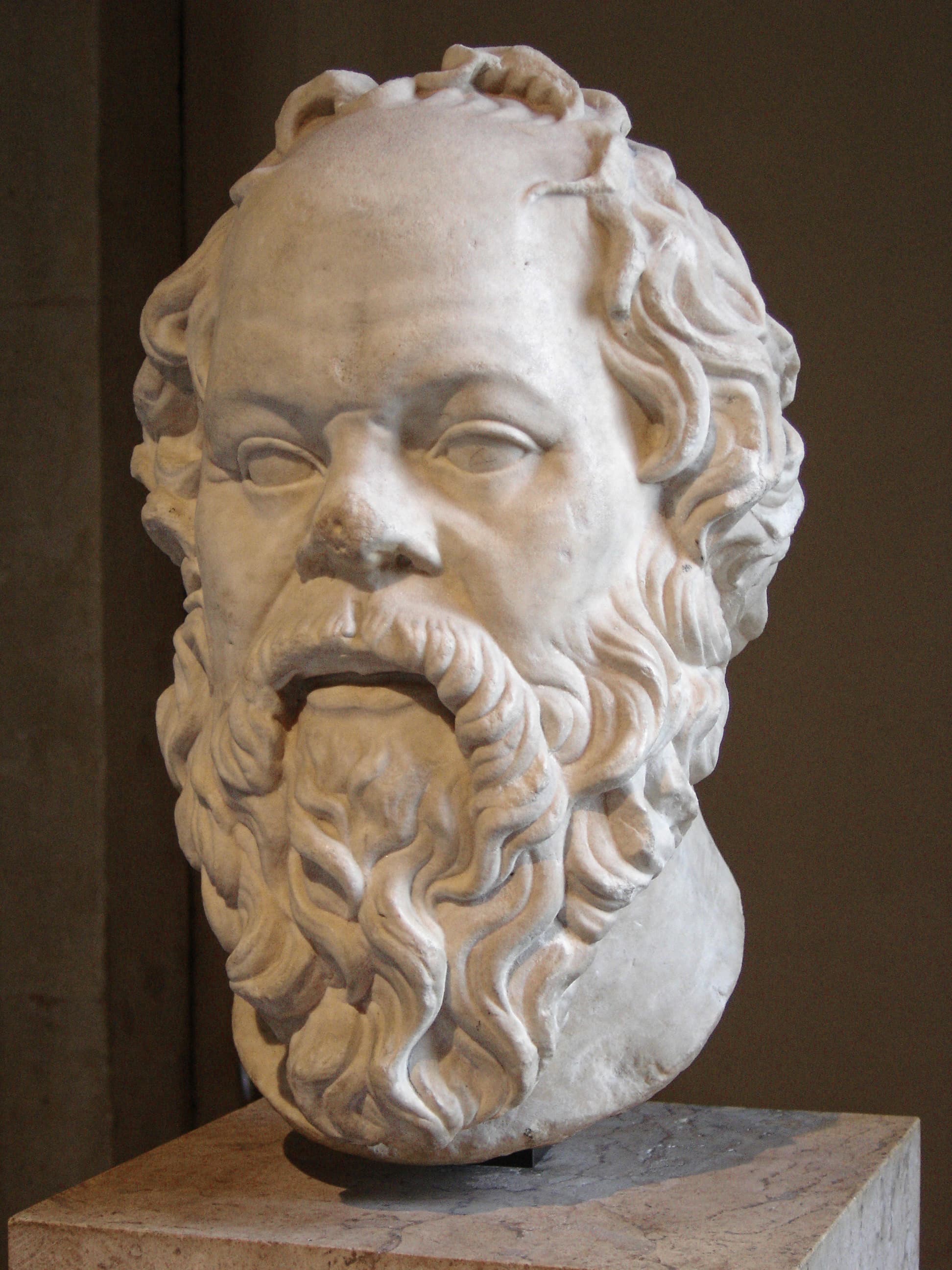
In ancient Athens, a man who wrote absolutely nothing managed to permanently reshape the trajectory of human thought.
To walk through the Agora of Athens in the late fifth century BCE was to run the risk of being intellectually dismantled by a man who looked like a satyr. He was notoriously ugly—short of stature, thick-necked, and somewhat corpulent, with bulging eyes, a flat, upturned nose, and thick lips that suggested, to the superficial observer, a temperament of stupidity or coarse sensuality. He wore a single ragged coat in all seasons, went barefoot even in the winter mud, rarely bathed, and lived on the barest margins of sustenance. Yet this grotesque figure, the son of a stoneworker and a midwife, possessed a magnetism that drew the most brilliant, wealthy, and ambitious youths of Athens into his orbit. He did not lecture, he did not write, and he claimed to know nothing at all. Instead, he asked questions—short, deceptively simple queries about justice, courage, or piety—that inevitably led his interlocutors into a state of aporia, a profound intellectual impasse where they realized that the concepts they had built their lives upon were entirely unexamined.
This was Socrates of Alopece, a man who transformed philosophy by bringing it down from the heavens to the human marketplace. Before him, the thinkers of the Greek world had preoccupied themselves with the cosmos, speculating on the primal elements of nature or the movements of the stars. Socrates turned his gaze inward, becoming perhaps the first Western philosopher to dedicate himself entirely to ethics and the health of the human soul. He conceived of his life's work not as a profession—he took no fees, unlike the mercenary Sophists of his day—but as a divine commission. This calling, he believed, was witnessed by oracles, dreams, and a mysterious inner "divine voice" that warned him away from actions, particularly political involvement, that would compromise his principles. His mission was not to teach positive doctrines, but to convict men of their own ignorance in the hope of provoking their moral and intellectual improvement. "To want nothing," he remarked, "is divine; to want as little as possible is the nearest possible approach to the divine life."
For all his detachment from material luxury, Socrates was no hermit. He was a thoroughly Athenian citizen who performed his civic and military duties with conspicuous courage. During the Peloponnesian War, he served as a heavily armed infantryman, a hoplite, distinguishing himself for his bravery and legendary physical endurance at the siege of Potidaea—where he saved the life of the brilliant young aristocrat Alcibiades—as well as at the battles of Delium and Amphipolis. When forced into the political arena by the luck of the draw, he showed an iron adherence to the law that transcended partisan politics. In 406 BCE, while serving as president of the senate, he stood alone in resisting the illegal, emotional demand of the Athenian assembly to try the eight generals of the battle of Arginusae en masse rather than individually. Two years later, during the brief, bloody reign of terror under the oligarchy known as the Thirty Tyrants, Socrates was ordered along with four others to arrest an innocent citizen, Leon the Salaminian, for execution. While the others complied, Socrates simply walked home, risking his life rather than participating in a state-sponsored crime.
Yet, despite his courage and his deep respect for the laws of Athens, Socrates was a deeply polarizing figure. His relentless interrogation of the city's elite humiliated the powerful and captivated the young, who delighted in watching their elders flounder under his cross-examinations. In 399 BCE, four years after the restoration of the Athenian democracy, this simmering resentment culminated in a formal indictment. Brought by Meletus the poet, Anytus the tanner, and Lycon the orator, the charge accused Socrates of two capital offenses: denying the gods recognized by the state while introducing strange, new divinities, and corrupting the minds of the Athenian youth.
At his trial, before a jury of five hundred fellow citizens, Socrates offered no conciliatory defense. He refused to flatter the court or beg for mercy. Instead, he defied his judges, declaring that his life of questioning was a service to the city, acting as a gadfly to stir a noble but sluggish horse into action. When the jury found him guilty by a relatively narrow margin of 280 to 220 votes, the legal process allowed Socrates to propose an alternative penalty to the prosecution’s demand for death. Rather than suggesting exile or a substantial fine, which the jury likely would have accepted, Socrates proudly asserted that his lifelong service to Athens merited the reward of a public benefactor: free meals for life in the Prytaneum, the city's ceremonial heart. Though he eventually offered a small fine of one mina, raised to thirty minas at the desperate urging of his friends, his uncompromising attitude exasperated the jury. The death sentence was passed by an even larger majority.
Because the sacred ship sent annually to the island of Delos was away, execution was delayed for thirty days, during which Athens witnessed the final act of the Socratic drama. Confined in prison, Socrates refused a meticulously planned escape organized by his wealthy friend Crito, arguing that to break the laws of the state, even when those laws had been unjustly applied to him, would be to destroy the very social compact that had nurtured him. He spent his final hours in calm, cheerful conversation with his closest companions. When the executioner arrived, Socrates drank the cup of hemlock with the same equanimity that had characterized his entire life, leaving behind a legacy that would permanently redirect the course of human thought.
The historical reality of the man who died in that Athenian prison, however, remains one of the great enigmas of classical antiquity—a conundrum modern scholars call the "Socratic problem." Because Socrates wrote absolutely nothing, his philosophy must be reconstructed from the accounts of others, whose portraits of him are often wildly contradictory. To his contemporary, the comic playwright Aristophanes, Socrates was a target of satire, depicted in the play The Clouds as a ridiculous, atheistic Sophist suspended in a basket to study the weather. To Xenophon, a soldier and historian who was one of his pupils, Socrates was an eminently practical, pious, and highly patriotic citizen whose conversations focused on useful matters like household management and self-control. Xenophon’s Socrates, while virtuous, lacks the profound, mercurial irony and intellectual depth that would seem to justify his immense historical reputation.
It is through Plato, Socrates's most brilliant student, that the philosopher became an immortal icon. In Plato’s dialogues, Socrates is the central protagonist, employing the elenchus—the Socratic method of short, sharp questions and answers—to dissect assumptions about virtue, justice, and knowledge. Yet scholars have long debated where the historical Socrates ends and where Plato’s own evolving philosophy begins. It is generally agreed that Plato's early dialogues represent a more authentic portrait of his master's method, characterized by a genuine profession of ignorance and a lack of dogmatic conclusions. In the later, grander dialogues, such as the Republic, Socrates becomes a literary mouthpiece through whom Plato articulates his own metaphysical theories, including the famous theory of Forms. Other writers of antiquity, from his immediate disciples to Aristotle—who studied under Plato and analyzed Socratic ethics with a more detached, analytical eye—only add to the rich, composite tapestry of a figure who was as much a literary creation as a historical personage.
In the centuries following his death, Socrates’s trial and philosophy became the foundational myth of Western intellectual freedom. His refusal to compromise his search for truth in the face of state authority established the philosopher as a secular martyr. From the humanist scholars of the Italian Renaissance to the nineteenth-century existentialism of Søren Kierkegaard and the radical critiques of Friedrich Nietzsche, his shadow has loomed over every effort to understand the nature of the good life. Ultimately, Socrates left the world not with a set of dogmas or a system of metaphysics, but with a method of inquiry and a moral challenge. He demonstrated that the most urgent task of human existence is not the accumulation of wealth, power, or unexamined beliefs, but the relentless examination of one’s own soul—a conviction sealed by his willingness to die for the right to ask why.
Connected to
12 links to entries not yet ingested in the Library.