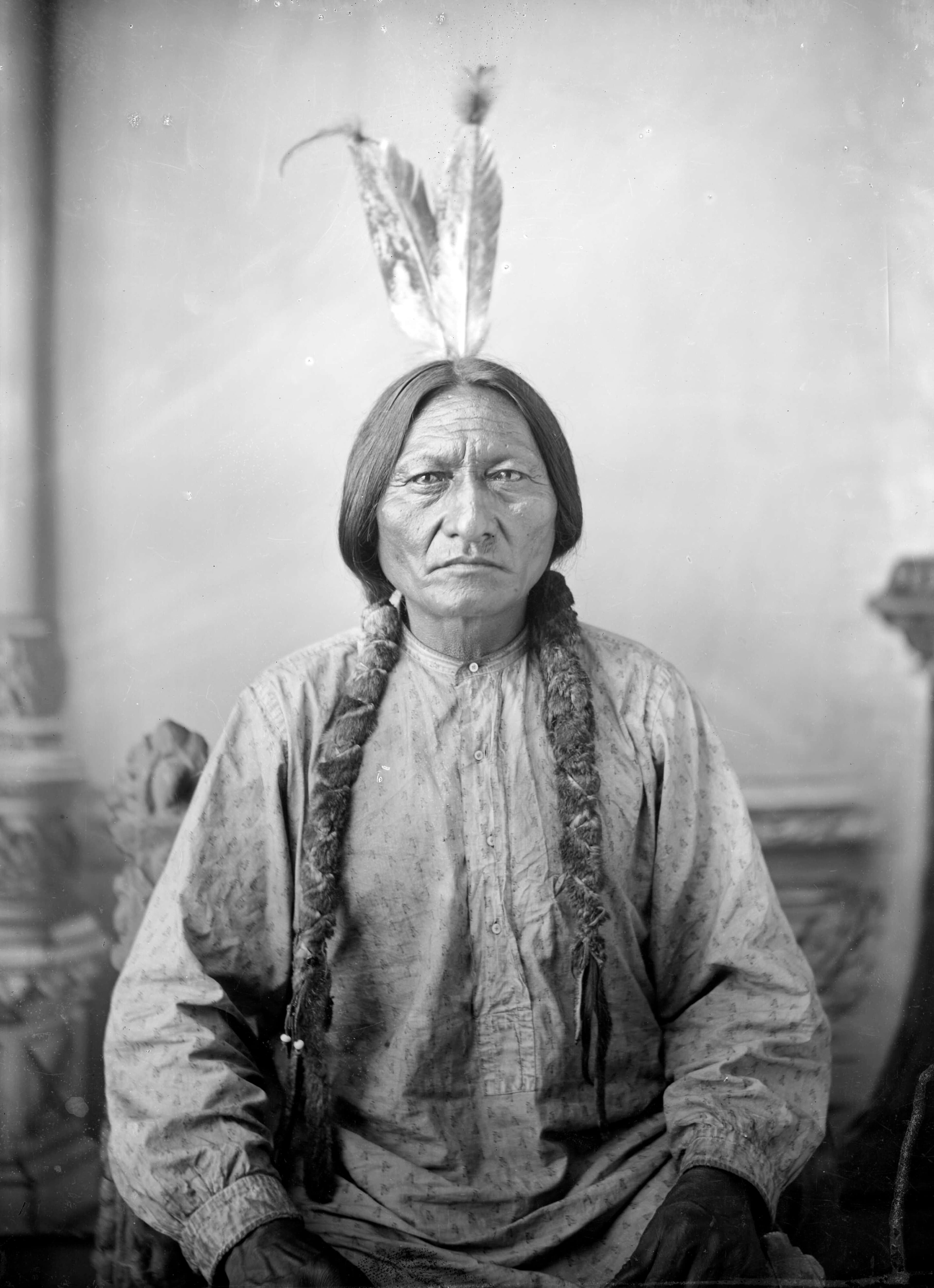
To understand the weight of Sitting Bull’s presence, one must look to the weeks before the Battle of the Little Bighorn, when the Hunkpapa Lakota leader experienced a vision of soldiers falling upside down into his camp like grasshoppers.
He was born into a world of deliberate movement, given a name that spoke of caution. His childhood nickname was Húŋkešni, or "Slow," a tribute to a quiet, unhurried temperament that his people, the Hunkpapa Lakota, prized as the mark of a deliberate mind. He was born sometime between 1831 and 1837, likely along the Yellowstone River south of what is now Miles City, Montana, or perhaps near Willow Creek in present-day North Dakota. By the time he was fourteen, the boy had proven that his slowness was not a lack of courage but a reservoir of strength. During a raid to seize horses from a Crow camp, he rode forward ahead of his father and his uncle Four Horns, striking a surprised enemy warrior to count his first coup. When the war party returned, his father celebrated the boy’s sudden transformation. He gave a grand feast, presented his son with a warrior’s horse, a hardened buffalo hide shield, and an eagle feather, and surrendered his own name to the boy: Tȟatȟáŋka Íyotake, "Buffalo Bull Who Sits Down." To the white settlers and soldiers who would spend the next three decades trying to locate, contain, or kill him, he would simply be Sitting Bull.
The transition from a youth of local horse raids to a leader of continental resistance was forced by the relentless pressure of a surging American republic. While the United States was consumed by its own Civil War in the early 1860s, tensions flared on the northern plains. In 1862, Eastern Dakota bands in Minnesota, pushed to desperation by starvation and broken government promises, rose up and killed hundreds of settlers and soldiers. The federal retaliation was swift, brutal, and indiscriminate, spilling westward into the territories of bands that had taken no part in the Minnesota uprising. By 1864, Sitting Bull found himself defending his people against a massive punitive expedition of some 2,200 soldiers commanded by Brigadier General Alfred Sully. Sitting Bull, alongside the warriors Gall and Inkpaduta, fought a fighting retreat, skirmishing with federal troops through the dry, fractured clay of the Badlands. Later that autumn, while leading an attack on a stranded military escort protecting a wagon train near what is now Marmarth, North Dakota, Sitting Bull was shot through the left hip. The bullet exited his lower back—a flesh wound, but a permanent reminder of the stakes of the new era.
As the decade wore on, the encroachment grew more systematic. Between 1866 and 1868, the Oglala leader Red Cloud waged a successful campaign against the string of U.S. army forts built to protect the Bozeman Trail through the Powder River Country. Sitting Bull supported Red Cloud’s War vigorously, leading Hunkpapa war parties in persistent hit-and-run raids against Forts Berthold, Stevenson, and Buford along the Upper Missouri. When the United States government, weary of the expense and bloodshed, sued for peace in 1868, it agreed to abandon its forts and established the Great Sioux Reservation. Red Cloud and other prominent chiefs signed the Treaty of Fort Laramie and moved their people onto the reservations, where they became increasingly dependent on government agencies for food as the great buffalo herds began to thin.
12 links to entries not yet ingested in the Library.
Sitting Bull looked at the reservation gates and refused to enter. "I wish all to know that I do not propose to sell any part of my country," he told the Jesuit missionary Pierre Jean De Smet, who had traveled into the wilderness to seek his signature on behalf of the government. While other leaders became agency chiefs, Sitting Bull chose the hard, hungry freedom of the open plains. In the years that followed, his stature grew from that of a localized war leader into one of the most significant political and spiritual figures on the continent. Some contemporaries and later historians asserted that he was formally named "Supreme Chief of the whole Sioux Nation" during this period, though others have noted that the highly decentralized, consensus-based nature of Lakota society made such a centralized title an impossibility. Yet his moral authority was undeniable. As the Northern Pacific Railway attempted to survey routes directly through Hunkpapa lands in 1871 and 1872, Sitting Bull’s warriors repeatedly attacked the survey parties and their military escorts, eventually forcing the project to a halt when the financial panic of 1873 bankrupted the railway’s backers.
The fragile peace of the northern plains shattered completely in 1874. Lieutenant Colonel George Armstrong Custer led a military expedition into the Black Hills, a sacred tract of land within the boundaries of the Great Sioux Reservation. When Custer announced the discovery of gold, a stampede of white miners flooded into the territory, violating the federal government’s treaty promises. Unable or unwilling to stop the gold rush, the Grant administration attempted to purchase or lease the Black Hills. When the Lakota refused, the government manufactured a crisis. In November 1875, President Grant ordered all Sioux bands outside the reservation boundaries to report to their designated agencies by midwinter. It was an impossible ultimatum, designed to be disobeyed. On February 1, 1876, the Interior Department declared all off-reservation bands "hostile," clearing the way for the military to hunt them down.
Rather than scattering, the free bands gravitated toward Sitting Bull. His camp became a sanctuary and a beacon of resistance. He sent out scouts to the reservations to recruit young warriors and commanded his people to share their dwindling winter resources with those who arrived destitute, including Northern Cheyenne families who had fled the destruction of their camps by federal cavalry. By the spring of 1876, Sitting Bull’s village had swelled into a massive, wandering metropolis of more than ten thousand people, representing the Hunkpapa, Sans Arc, Minneconjou, Oglala, and Northern Cheyenne.
In June of that year, as federal columns converged on the region, the allied tribes gathered for a Sun Dance. Seeking guidance, Sitting Bull underwent a grueling initiation, offering slashes of flesh from his arms before dancing for hours while staring directly into the sun until he fell into a trance. When he awoke, he revealed a vision: he had seen white soldiers, "as thick as grasshoppers," falling upside down directly into the Lakota camp. It was a prophecy of a total, catastrophic military victory.
Three weeks later, on June 25, 1876, that vision materialized on the banks of the Little Bighorn River. Custer’s 7th Cavalry, divided and overconfident, stumbled upon the margins of the massive encampment. Sitting Bull, now an elder statesman and spiritual guide, did not participate directly in the hand-to-hand fighting, but his presence and his vision animated the warriors. Led by war chiefs like Gall and Crazy Horse, the Lakota and Cheyenne forces completely annihilated Custer’s immediate battalion.
The victory at the Little Bighorn was the spectacular climax of Plains Indian resistance, but it carried the seeds of its own end. Outraged by the destruction of the 7th Cavalry, the United States government flooded the plains with thousands of fresh troops. Over the course of the following year, relentless winter campaigns wore down the free bands, forcing one group after another to surrender at the agencies. Sitting Bull still refused to capitulate. In May 1877, he led his remaining band north across the border into the North-West Territories of Canada, settling near Wood Mountain in what is now Saskatchewan. For four years, they lived in exile, but the Canadian government offered no material support, and the buffalo herds that had once sustained them were virtually gone. Facing starvation and the slow dissolution of his band, Sitting Bull finally rode south in the summer of 1881, surrendering to United States forces at Fort Buford.
Even in defeat, Sitting Bull remained a figure of immense, disruptive charisma. After spending time under guard, he eventually made his home at the Standing Rock Agency in South Dakota. His fame was such that in the mid-1880s, he was recruited by showman Buffalo Bill Cody to perform in his Wild West show. To Eastern audiences, he was a living relic of a wild, disappearing frontier, a silent, dignified presence who rode in arena processions, but to his own people, he remained a powerful symbol of uncompromised sovereignty.
By the end of the decade, a new wave of spiritual fervor was sweeping through the impoverished reservations of the West. The Ghost Dance movement, which promised the return of the buffalo, the resurrection of the dead, and the sweeping away of the white occupiers, found fertile ground among the desperate Lakota. Although Sitting Bull was not a leader of the movement, federal authorities and the Indian Service agent at Standing Rock, James McLaughlin, feared that his immense influence would be used to patronize or lead a general Ghost Dance uprising.
On the morning of December 15, 1890, a force of Standing Rock agency police, backed by U.S. officers and troops, arrived at Sitting Bull’s cabin on the Grand River to arrest him before he could join the dancers. As the police dragged the aging leader from his home, a crowd of his furious supporters gathered. A struggle ensued, and a shot was fired. In the chaotic melee that followed, the agency policemen Lieutenant Bull Head and Red Tomahawk shot Sitting Bull in the chest and head.
His body was initially taken to Fort Yates for a quiet, clinical military burial. Decades later, in 1953, members of his Lakota family exhumed what were believed to be his remains, carrying them back to the wind-swept hills near Mobridge, South Dakota, close to the country where he was born. Sitting Bull’s life spanned the violent, total transformation of the North American interior. He did not prevent the closing of the frontier or the confinement of his people, but he ensured that the world they lost would be remembered not through the terms of their surrender, but through the memory of their resistance.