Event · 57 BCE – 892 CE · Korean Kingdoms
Silla
- Also known as
- Gjerim
- Gyerim
- Gyerim
- Keyaniya Sillayê
- Kingdom of Silla
- Kraljevstvo Sila
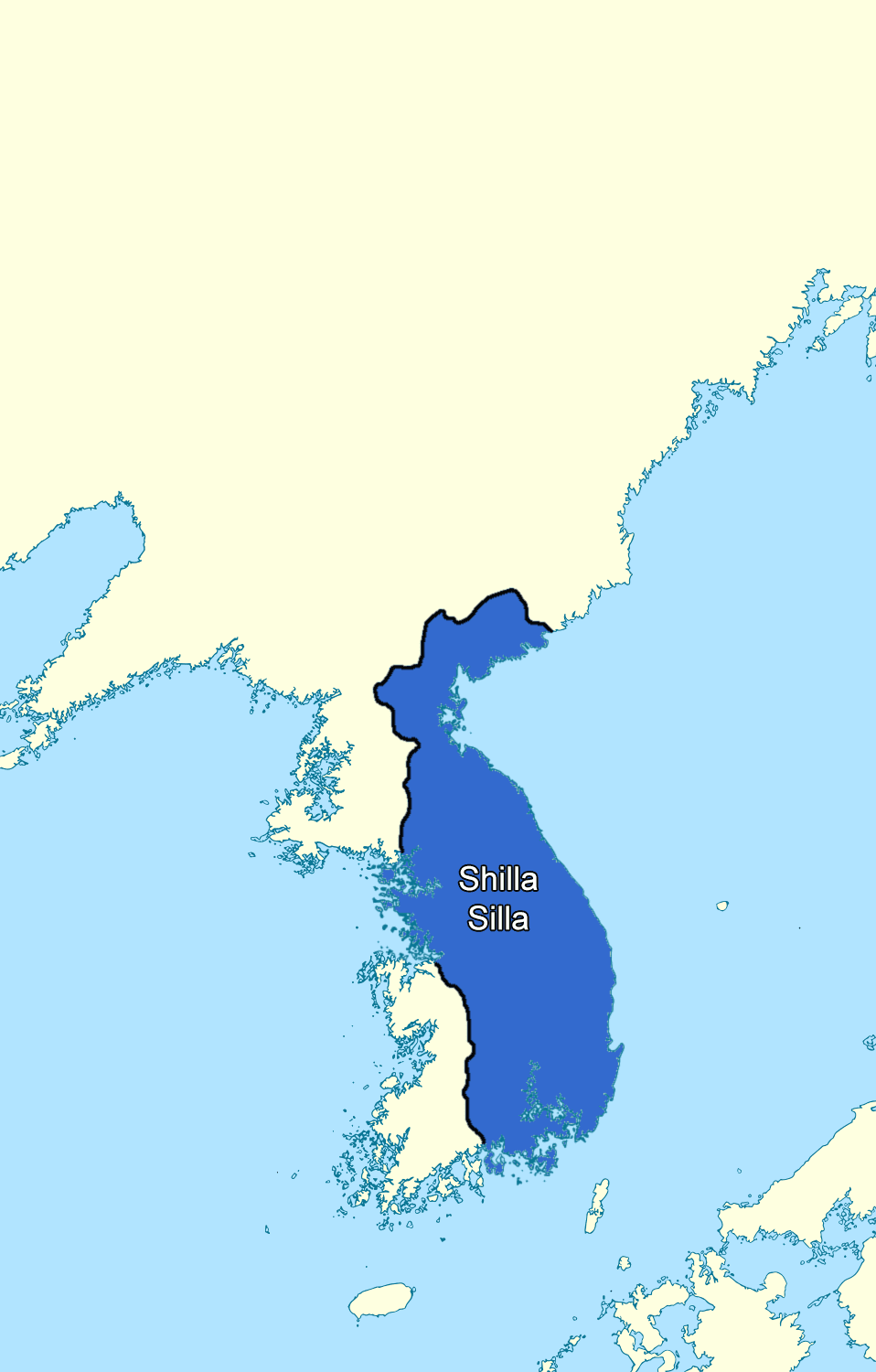
For centuries, the small state of Silla on the southern and central Korean peninsula was considered the weakest and least developed of its neighbors.
On a high mountain peak in southeastern Korea, the wind carries the scent of charcoal and the memory of a grand deception. According to the old tales, the early leader Talhae found a choice piece of land next to Mount Toham and, coveting it, secretly buried charcoal next to the house of a local official named Hogong. Talhae then claimed the property, asserting that his own ancestors had been blacksmiths who worked that very soil, pointing to the buried charcoal as proof. Hogong was tricked into surrendering his home and wealth, and Talhae eventually rose to become a king. This story of cunning and quiet displacement mirrors the larger rise of Silla itself—a kingdom that began as a minor, overlooked actor on the margins of the Korean peninsula, only to outlast, outmaneuver, and eventually swallow its grander neighbors.
For centuries, Silla was the underdog of the Three Kingdoms of Korea. Situated in the isolated southeastern corner of the peninsula, it was geographically shielded but economically and culturally stunted compared to its rivals. To the north lay Goguryeo, a militaristic empire of three and a half million people that had pushed out the last Chinese commanderies; to the west was Paekche, a sophisticated kingdom of nearly four million. Silla, by contrast, was a modest collection of roughly 850,000 souls living in 170,000 households. To its contemporaries, this small statelet was considered weak, underdeveloped, and vulnerable. Its early rulers did not even use the grand title of king, instead going by local designations like Geoseogan, Chachaung, Isageum, or Maripgan. Its origins were shrouded in a thick fog of myth: tales spoke of the founder, Bak Hyeokgeose, hatching from an egg laid by a white horse in a sacred woodland known as the "rooster forest," or Gyerim.
Behind these colorful origin myths lay a complex reality of migration, integration, and shifting alliances. Silla began as Saro-guk, a small city-state within the twelve-member Jinhan confederacy. It grew by absorbing waves of refugees: Yemaek people fleeing the fallen state of Gojoseon, displaced populations escaping the Chinese Lelang Commandery under pressure from Goguryeo, and local Jin and northern Ye peoples. Power was initially shared intermittently among three distinct clans—the Park, the Seok, and the Kim. The kingdom’s early survival depended on localized military campaigns and arbitrations. During the reign of Pasa in the early second century, Silla expanded into the interior, annexing small neighboring polities like Dabulguk, Bijiguk, and Chopalguk after a series of territorial disputes. By the early third century, the kingdom was forced to defend its sphere of influence in the Nakdong River basin, defeating a coalition of coastal states in the Eight Port Kingdoms War to secure its southwestern frontier.
Despite these local victories, Silla remained a second-tier power, constantly threatened by Paekche to its west and maritime raiders from the Japanese archipelago to the south. In the late fourth century, under King Naemul—who established the Gyeongju Kim clan’s long-standing monopoly on the throne—Silla sought the protection of the northern giant, Goguryeo. While this alliance protected Silla from its immediate enemies, it came at a steep price. Following the massive southern campaigns of the Goguryeo king Gwanggaeto, Silla lost its sovereign status, effectively becoming a vassal state. Silla’s royalty even began tracing their lineage to the Western regions, with personal gravestones and monuments claiming ancestral ties to the Xiongnu prince Kim Il-je. Whether this ancestry was genuine or a brilliant diplomatic invention designed to curry favor with the Chinese Tang court, it reflected Silla’s perpetual need to look outward, projecting its heritage onto a wider Eurasian stage to survive local pressures.
The turning point for the kingdom came when Goguryeo’s expansionist ambitions pushed too far south, symbolized by the relocation of its capital to Pyongyang in 427 CE. Sensing their mutual peril, Silla and its former rival Paekche formed an alliance to check the northern empire. It was during this period of intense geopolitical competition that Silla began to shed its provincial character. In 504 CE, King Jijeung officially standardized the name of the state as "Silla" using Chinese characters, choosing Hanja characters that carried the Confucian meaning of "daily renewal of virtue" and "encompassing the four directions." The name of Silla’s capital, Seorabeol, was so famous across Northeast Asia that it became synonymous with the state itself, known to the Japanese as Shiragi and to the Jurchens as Solgo. Centuries later, the name of this ancient capital would evolve into Syeobeul, then Syeoul, and finally into the name of the modern South Korean capital, Seoul.
By the time King Beopheung ascended the throne in the early sixth century, Silla had transformed from a loose confederacy of clans into a highly centralized, sophisticated monarchy. It finally conquered the neighboring Kaya confederacy, securing valuable agricultural lands and iron-producing regions. Silla’s leadership realized that physical expansion was not enough; they needed the administrative tools of the continent to survive. The kingdom systematically adopted Chinese bureaucratic practices, established a strict aristocratic rank system, and embraced Buddhism as the state religion to unify its diverse population. Silla, which had once been the weakest and most isolated player on the peninsula, was quietly preparing for its greatest act. Through a combination of strategic marriages, betrayal of its erstwhile ally Paekche, and a historic alliance with the Tang Dynasty of China, Silla would eventually conquer both Paekche in 660 CE and Goguryeo in 668 CE.
In doing so, this former underdog did not merely expand its borders; it redefined the cultural and political boundaries of the Korean peninsula. The legacy of Silla lies not just in its military triumphs, but in how a small, peripheral statelet managed to absorb its larger, more sophisticated neighbors and establish a unified cultural identity that would persist for over a millennium. When Silla finally fractured in the late ninth century, giving way to the Later Three Kingdoms and the eventual rise of the Goryeo Dynasty, it left behind a transformed land. What had once been a fragmented, war-torn peninsula of competing tribes and kingdoms was now a distinct, unified world, born from the patient, calculated survival of the kingdom of the rooster forest.
Connected to
- religionBuddhism
- in country · containsSilla57 BCE
+ 5 further connections to entries not yet ingested