Place · Silk Roads
Silk Road
- Also known as
- Abrid amṭalsu
- Barabara ya hariri
- Beýik Ýüpek ýoly
- Buyuk Ipak yoʻli
- Bóthar an tSíoda
- Böyek yefäk yulı
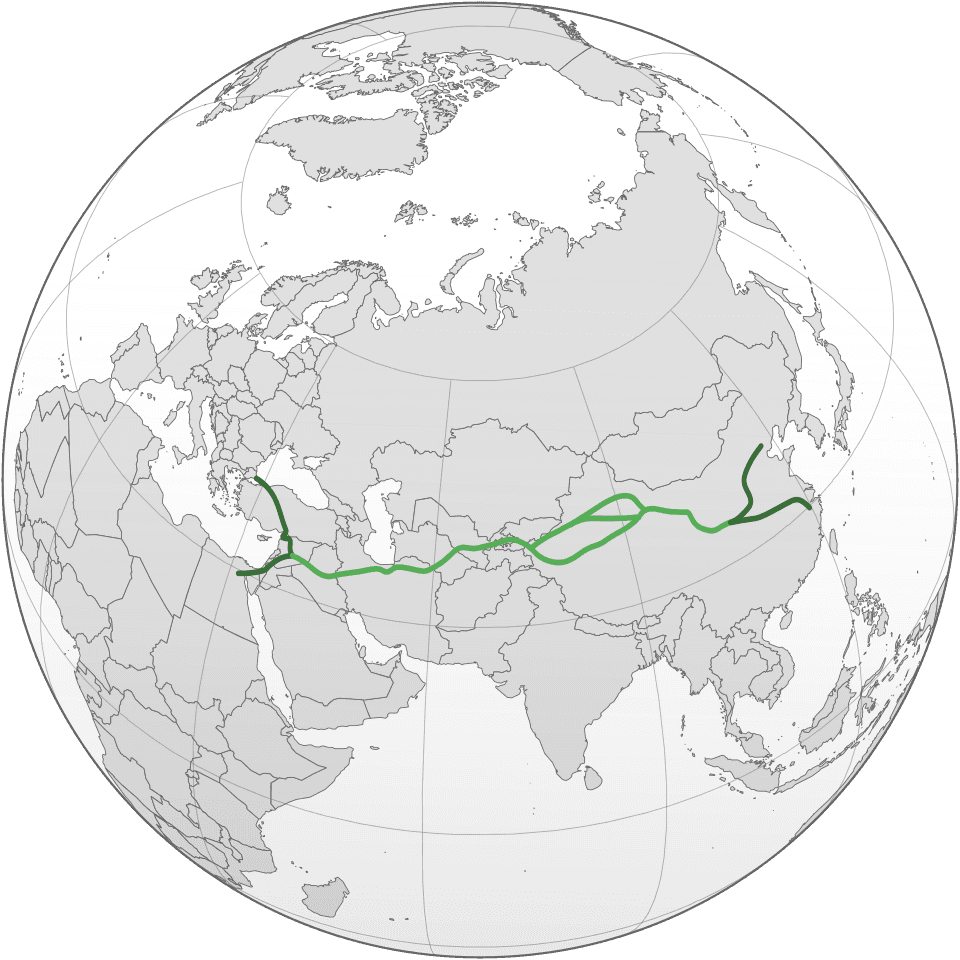
To trace the path of ancient trade across Eurasia is to abandon the idea of a single, well-paved highway.
For five thousand years, the green, milky light of jade moved across the high, wind-scoured basins of Central Asia. Long before the first Chinese dynasty consolidated its borders, caravans were tracing a path from the riverbeds of Khotan in the far west toward the fertile plains of eastern China, carrying a stone that represented the essence of immortality. To those who walked these tracks, there was no grand design, no interconnected Eurasian superhighway. There were only local water sources, predatory nomadic tribes, and the relentless geography of the Taklamakan Desert—a name that translates to "you go in, but you do not come out." It was only in 1877 that a German geographer, Ferdinand von Richthofen, cast a romantic retrospective gaze over these ancient paths and coined the term Seidenstraße—the Silk Road. Yet the name is a beautiful misnomer, a nineteenth-century Western invention that reduced an incredibly complex, chaotic, and largely decentralized network of land and sea routes into a single, elegant thread of Chinese silk.
In truth, the overland system was never a singular highway but a shifting web of high-altitude passes, desert tracks, and river valleys that defied centralized control. If there was a moment of political genesis for this network, it occurred in the late second century BCE during the Han dynasty. Driven by a desire to secure "heavenly horses" from the Fergana Valley to combat the nomadic Xiongnu, Emperor Wu sent his envoy Zhang Qian on a perilous mission westward around 114 BCE. Zhang Qian’s explorations brought Central Asia into China’s imperial purview, initiating a period of unified military control. To safeguard this fragile corridor of commerce, the Chinese state pushed the Great Wall further west, carving out a protected channel through the Gansu Corridor. At the opposite end of the continent, the rise of the Roman Empire created an insatiable appetite for exotic luxuries, while the Parthian Empire in Persia acted as the crucial, lucrative bridge between the two worlds. By the first century CE, the Roman elite, from Alexandria to Rome itself, were draped in translucent Chinese silk, a fabric so sought after that it triggered moral panics and economic anxieties about the drain of Roman gold to the East.
Yet very few individuals ever traveled the entire 6,400-kilometer length of these routes. The trade was fundamentally a relay, a vast chain of middlemen where goods changed hands dozens of times. A bolt of silk leaving the ancient Chinese capital of Chang’an would head northwest, splitting at the edge of the Taklamakan Desert into northern and southern loops to bypass the deadly sands. The northern route climbed through the Tian Shan mountains or traversed the Turpan depression, carrying dates, saffron, and pistachios from Persia; frankincense and myrrh from Somalia; and glass bottles from Roman Egypt back to China. The southern route wound through the dizzying heights of the Karakoram and Hindu Kush mountains into modern Pakistan and Afghanistan, joining the northern path at the oasis city of Merv. From Merv, the goods traveled across the Iranian plateau to the Mediterranean ports, where ships waited to carry them to the markets of Southern Europe. To survive this journey, merchants relied on caravanserais—fortified roadside inns that offered safety from bandits and the unforgiving climate.
While the overland routes captured the imagination of later historians, they did not exist in a vacuum. A vibrant southwest corridor sliced through the steep gorges of Sichuan and Yunnan into Burma and the Ganges-Brahmaputra Delta in modern Bangladesh. Through this riverine world, rich in gold and silver, merchant ships and riverboats exchanged gemstones from Thailand and Java with Indian textiles and Chinese bullion. Further south, the Maritime Silk Road connected the coastlines of East Asia, Southeast Asia, the Indian subcontinent, the Arabian Peninsula, and East Africa. Some modern historians argue that this maritime trade was far more economically significant than the overland tracks, noting that transporting goods by sea in the pre-modern era cost a mere fifth of the price of overland transport. Some even dismiss the "Silk Road" as a modern academic myth that privileges the literate, sedentary empires at the ends of Eurasia while ignoring the indispensable role of the steppe nomads who secured the middle, or India and Iran, which acted as the true economic powerhouses of the ancient and medieval worlds.
The true legacy of this interconnected web, however, lay not in the physical ledger of commodities—the tea, porcelain, horses, and gold—but in the invisible cargoes that traveled alongside them. The routes acted as a massive neural network for the transmission of human thought. Monks, pilgrims, and scholars walked the same paths as the merchants, carrying Buddhism from India to China, where it was syncretized and reshaped by local philosophies. Scientific knowledge, mathematical systems, and artistic styles flowed fluidly between civilizations. Technologies like paper and gunpowder moved westward, forever altering the political and military landscapes of the Islamic world and Europe. But this deep connectivity also possessed a dark, epidemiological underside. The same pathways that carried ideas and luxury goods also acted as conduits for pathogens, facilitating the spread of devastating plagues, including the strains that likely erupted into the fourteenth-century Black Death, decimating populations across Eurasia.
By the mid-fifteenth century, the classic era of the overland routes began to fracture. The rise of the Ottoman Empire after the fall of Constantinople in 1453 led to intense competition for control over the traditional overland passages. Faced with rising tariffs, political volatility, and the limitations of desert caravans, European polities turned their eyes to the oceans, seeking direct maritime access to the wealth of Asia. This pivot toward the sea marked the beginning of the Age of Discovery and European colonialism, shifting the focus of global trade from the heart of Eurasia to the Atlantic and Indian Oceans. Today, the ancient corridors are being reimagined. The name "New Silk Road" has been resurrected to describe massive, twenty-first-century infrastructure projects, such as the Chinese Belt and Road Initiative, which seek to overlay modern rail lines, pipelines, and deep-water ports onto the ghost tracks of antiquity. Though the caravans have vanished, the pathways they carved still dictate the flow of wealth, power, and ideas across the modern world, proving that the ancient desire to bridge the distance between East and West remains one of the defining impulses of human civilization.
Connected to
4 links to entries not yet ingested in the Library.