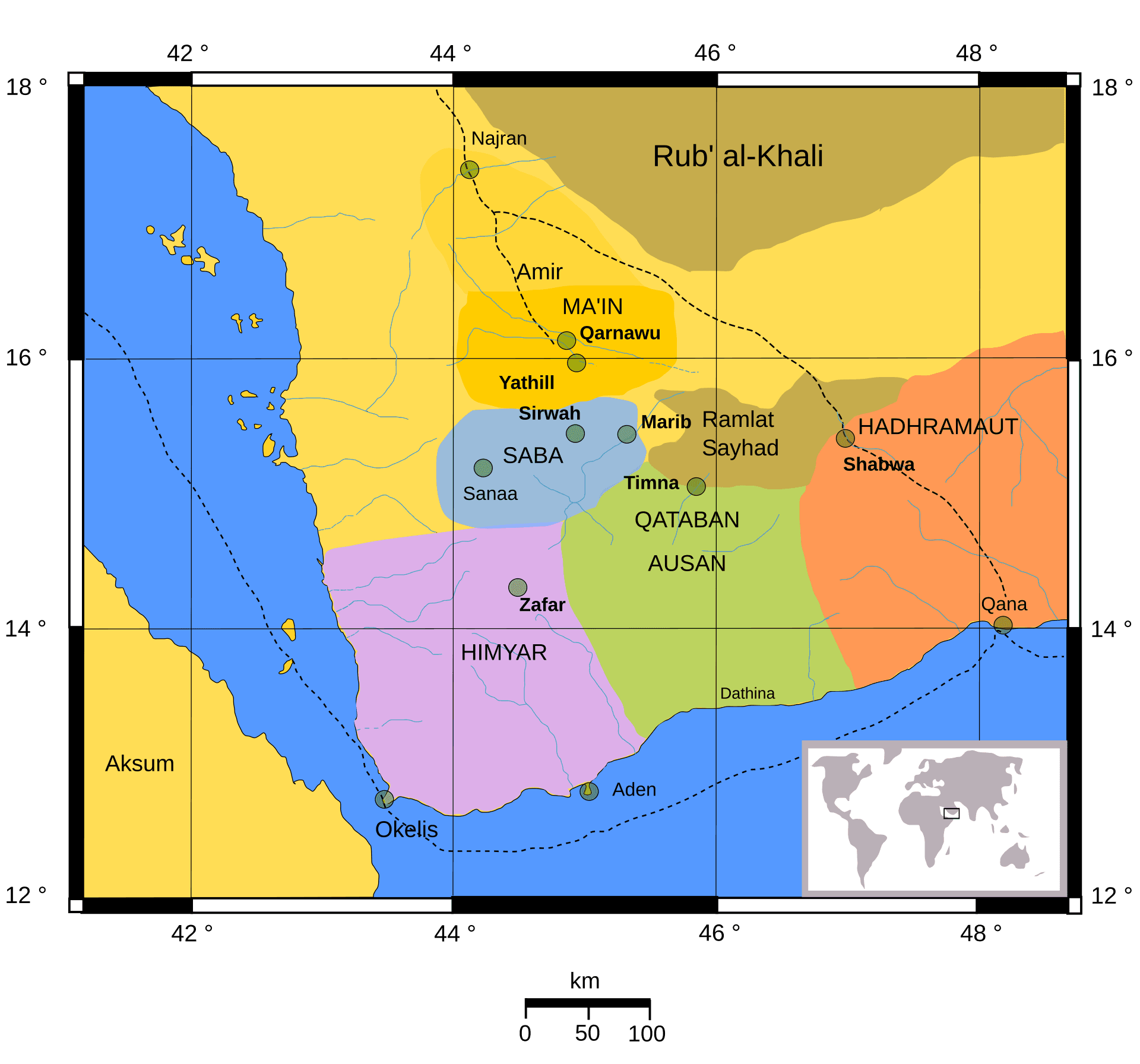
Long before the rise of modern states, a kingdom of merchants and builders flourished in the arid southern reaches of the Arabian Peninsula, its wealth carried across the ancient world on the scent of frankincense and myrrh.
High on the edge of the Sayhad desert, where the jagged highlands of modern Yemen plunge into the vast gravel plains of the Arabian interior, lies the oasis of Marib. Today, it is a place of dust and quiet ruins, but three thousand years ago, it was the beating heart of a civilization that grew fabulously wealthy on the smoke of burning trees. This was Sheba, or Saba, a kingdom that existed not merely as a territory, but as a prestigious, semi-mythical origin point for all of South Arabian civilization. To the ancient Mediterranean world, Sheba was a land of unimaginable luxury, situated at the very end of the earth—a place where the soil itself seemed to sweat gold, frankincense, and myrrh. Yet for all its legendary luster in the pages of the Hebrew Bible and the Quran, the historical Saba was a deeply pragmatic, technologically brilliant merchant state. It was a society defined not by solitary queens, but by a sprawling corporate commonwealth of tribes, colossal stone temples, and an engineering prowess that literally made the desert bloom.
The rise of the Sabaeans, beginning as a distinct culture around 1000 BCE and solidifying by the eighth century BCE, was made possible by two great mastery complexes: one over water, and the other over the seasonal winds and desert pathways. In the dry valleys of Yemen, rain fell violently but briefly, cascading down the mountains in sudden, destructive flash floods known as wadis. The Sabaeans tamed these torrents. At Marib, they constructed a monumental earthen and stone dam, an engineering marvel that diverted the seasonal deluges into a sophisticated network of canals, transforming thousands of acres of arid scrubland into a permanent, lush agricultural haven. This surplus of food anchored a growing urban culture, allowing the Sabaeans to build grand, multi-story stone palaces and heavily fortified cities like Sirwah and Marib. At the same time, they capitalized on their geographic position. The dry plateaus of South Arabia were the exclusive home of the Boswellia and Commiphora trees, from which frankincense and myrrh were painstakingly harvested. As the temples of Egypt, Mesopotamia, Greece, and Rome developed an insatiable appetite for these aromatic resins—used for religious sacrifices, funerals, and medicines—the Sabaeans became the ultimate gatekeepers of the trade.
In its earliest, most dominant phase, known to historians as the "mukarrib" period, Sheba was not ruled by simple monarchs, but by a figure known as the mukarrib—a title translating roughly to "federator" or "unifier." The mukarrib was more than a king; he was the head of a vast commonwealth of tribal communities, or , holding supreme hegemony over the entire southwestern corner of the peninsula. The zenith of this early federal empire was achieved in the eighth century BCE under a ruler named Karib'il Watar. To consolidate Sabaean dominance, Karib'il launched a series of eight relentless military campaigns, carving his victories into great stone slabs at the temple of the moon-god Almaqah in Sirwah. He crushed the rival kingdom of Awsan, subjugated Qataban and the Hadhramaut, and extended Sabaean influence from Najran in the north to the Gulf of Aden in the south, even establishing diplomatic contact with the Assyrian emperor Sennacherib. For a few centuries, Sheba was the undisputed colossus of Arabia, its merchants driving immense camel caravans northward through the desert to the Middle Euphrates, Gaza, and eventually the Nabataean stronghold of Petra.
3 links to entries not yet ingested in the Library.
Yet, the very wealth that built Sheba’s grand stone monuments also sowed the seeds of its containment. By the sixth century BCE, the conquered neighboring kingdoms of Qataban, Hadhramaut, and Ma'in began to assert their independence, chipping away at Sabaean territory and claiming their own shares of the lucrative spice trade. Sheba contracted back to its original heartland around Marib. Its rulers dropped the grand title of mukarrib, reverting to the simpler title of malik, or king. This "kingly" period was a long, slow era of survival and competition, but the catastrophic blow to the first Sabaean kingdom came not from local rivals, but from the Mediterranean. When the Roman Republic annexed Syria in 63 BCE and Egypt in 30 BCE, the geopolitical landscape shifted overnight. Seeking to locate the legendary source of the Arabian gold and spices, the Roman governor Aelius Gallus led an army into the Arabian desert in 26/25 BCE, marching all the way to the gates of Marib. Though the Romans were forced to abandon their siege due to heat exhaustion and disease, they succeeded in bypassing the overland caravan routes entirely. Roman mariners mastered the monsoon winds of the Red Sea, shifting the global trade network to maritime routes. The Sabaean caravan economy collapsed, and around the first century BCE, a rising highland neighbor, the Himyarite Kingdom, annexed the weakened Sabaean state.
Sheba, however, possessed a strange resilience. By the first century CE, the first Himyarite state fractured, allowing the Sabaean kingdom to re-emerge for a dramatic second act that lasted until the third century CE. This resurgent Sheba was fundamentally different from its predecessor. Power had shifted from the old oasis cities of the desert margin to the fierce highland tribes. The ancient temple of Almaqah at Marib remained the spiritual center of the state, but the political gravity moved west. The Sabaeans established a secondary capital at Sanaa, constructing the legendary Ghumdan Palace, a towering multi-story structure that became celebrated in later Arabic literature. Sabaean armies fought a series of sporadic, bitter civil wars against various Yemeni dynasties, all competing for the ultimate title of "King of Saba." It was a brilliant, final flowering of Sabaic culture, characterized by a unique coinage and thousands of inscriptions carved in both the formal, monumental South Arabian script and the cursive Zabūr script on wooden sticks. But the tide of history was running against them. Around 275 CE, the unified forces of the late Himyarite Kingdom permanently conquered Saba. The royal line of Sheba was extinguished forever, and the proud Sabaeans were reduced to a local tribe, their name appearing one final time in the historical record of the sixth century CE, when the citizens of Marib petitioned the reigning king for aid to repair a disastrous breach in their ancient, crumbling dam.
Though its political structures vanished, the cultural memory of Sheba became immortal, decoupled from the realities of its history. In the Hebrew Bible, the kingdom is represented by the enigmatic Queen of Sheba, who travels to Jerusalem with a train of camels bearing spices, gold, and precious stones to test the wisdom of King Solomon. This narrative—which modern historians view as a legendary reflection of early trade contacts rather than diplomatic history—blossomed into rich, distinct traditions across the Red Sea. In the Ethiopian Orthodox Tewahedo tradition, she is Makeda, the mother of Menelik I, who founded the Solomonic dynasty of Ethiopia, linking the prestige of the ancient South Arabian state directly to the Horn of Africa, where ancient Sabaean temples and inscriptions have indeed been found. In Islamic tradition, she is Bilqis, a powerful sovereign who surrenders her throne and her heart to the monotheistic God of Solomon. Even Josephus preserved an alternate legend, claiming that Sheba was the home of Princess Tharbis, a Cushite noblewoman who married Moses. Through these stories, Sheba was transformed from a historical kingdom of merchants and canal-builders into a universal symbol of exotic wealth, wisdom, and sovereign female power. It remains an enduring irony of history that a civilization which left behind over six thousand meticulously detailed stone inscriptions of its own struggles, conquests, and treaties is remembered by the world primarily through the beautiful, unwritten silhouette of a single, nameless queen.