Person · 1787 CE – 1828 CE · Southern African Civilizations
Shaka Zulu
- Also known as
- Bouddha Shaka
- Chaka
- Chaka
- Chaka
- Chaka
- Chaka
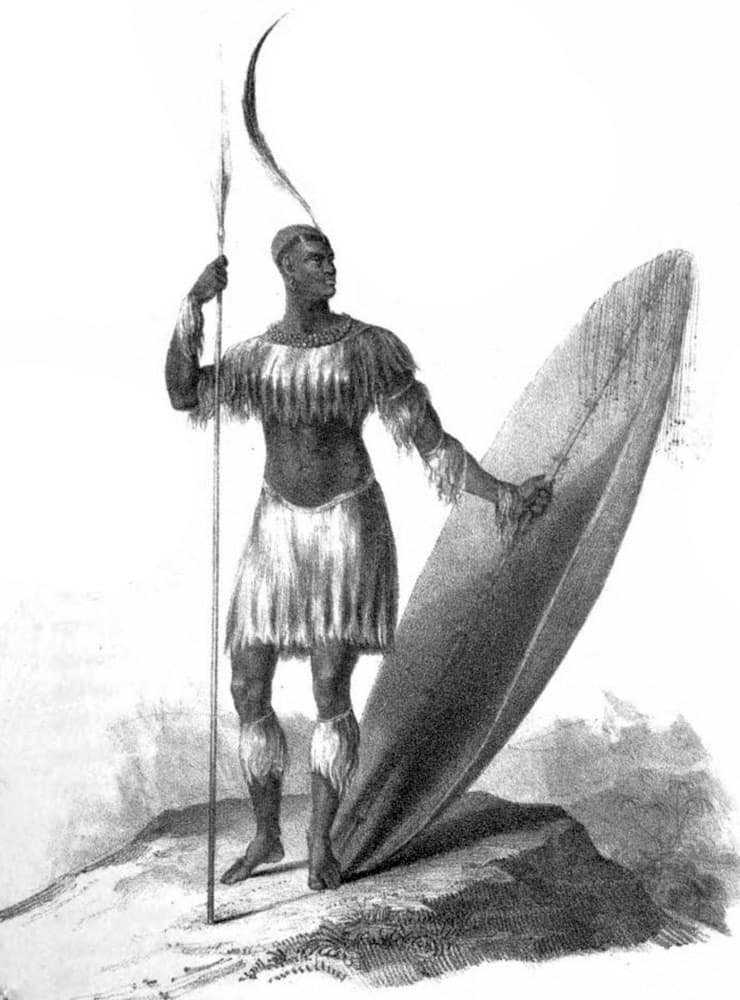
Cast out as an illegitimate child and named for an intestinal beetle, the young Zulu prince who would reshape southern Africa spent his youth in exile.
In the late eighteenth century, in the hills of Mthonjaneni, a child was born whose name meant "intestinal beetle." The boy, Shaka, was the eldest son of the Zulu king, Senzangakhona kaJama, but he was cast out as illegitimate, a royal embarrassment sent to live among his mother’s people, the Elangeni. At the time, the Zulu were not an empire; they were a modest pastoral clan, their lives measured by the movement of cattle, the cultivation of sorghum, and the seasonal rhythms of milk production. Stripped of his birthright, the young prince spent his youth adrift in a landscape of rising tensions and shifting alliances, eventually finding refuge with the Mthethwa clan, the dominant power in the region. There, under the patronage of the respected chief Dingiswayo, Shaka was initiated into an ibutho lempi—a fighting unit. It was from this position of exile, carrying the psychological weight of a spurned son, that Shaka would dismantle the traditional art of Southern African warfare and construct an empire.
Before Shaka’s rise, warfare in the region was largely ritualistic, characterized by skirmishes where opposing lines stood at a distance, shouted taunts, and threw long, flexible wooden spears called assegais. Casualties were typically low, and battles rarely resulted in the total subjugation of a rival. Shaka found this method of combat profoundly inefficient. To replace the traditional throwing spear, he introduced—or popularized, perhaps inspired by rumors of the British bayonet or through commissions from local smiths like Nzama—the iklwa, a short, heavy stabbing spear with a broad, sword-like blade. The name itself was an onomatopoeia, mimicking the wet, sucking sound the blade made as it was withdrawn from an opponent’s ribs. Shaka taught his warriors to retain their throwing spears for an initial, disorienting volley, but to close the distance immediately, engaging in brutal, hand-to-hand combat where the iklwa reigned supreme.
This lethal weaponry was paired with revolutionary tactical and defensive changes. Shaka equipped his men with massive, heavy cowhide shields, which were owned by the state and color-coded to identify different regiments (amabutho). He trained his warriors to use the left edge of these large shields to hook the right side of an enemy’s shield, wrenching it aside to expose the undefended torso for a fatal thrust. To deliver these weapons to the field, Shaka perfected the "bull horn" formation. In this tactical alignment, a heavy, seasoned force—the "chest"—would engage the enemy head-on, while two flanking wings—the "horns"—sprinted outward to encircle the enemy’s flanks and seal their retreat. A strong reserve force, the "loins," waited behind the chest with their backs turned to the battle, preventing premature excitement and remaining fresh to exploit breaches or pursue survivors.
Shaka’s ascent from a brilliant young commander to an independent monarch was catalyzed by the death of his mentor. When Dingiswayo was captured and killed by Zwide, the aggressive king of the Ndwandwe nation, the balance of power fractured. Shaka seized the Zulu throne, consolidated his hold on the Mthethwa forces, and embarked on a campaign of revenge and survival. He pursued Zwide with relentless focus. His vengeance was personal and absolute: when he captured Zwide’s mother, Ntombazi—a feared sangoma (spiritual healer)—he locked her inside a house filled with wild jackals or hyenas. After they devoured her, Shaka burned the structure to the ground.
Through decisive clashes like the Battle of Gqokli Hill, where his outnumbered forces held the high ground and utilized the bull horn tactic to devastate Zwide’s army, Shaka turned the tide. By 1825, near the Pongola River, he shattered the Ndwandwe forces. Zwide fled into exile, his generals scattered, and Shaka emerged as the undisputed master of the region, establishing his capital, Bulawayo, in Qwabe territory.
The political entity Shaka constructed was not sustained by violence alone, but by a sophisticated system of diplomacy, patronage, and cultural assimilation. For smaller, neighboring clans, Shaka preferred a diplomatic approach, offering protection and royal favor rather than destruction. Chieftains who submitted voluntarily, such as Zihlandlo of the Mkhize and Jobe of the Sithole, were integrated into the state apparatus without ever facing the Zulu army in battle. To forge a unified identity out of these disparate groups, Shaka encouraged conquered peoples to reinvent their genealogies, aligning their ancestral lineages with the Zulu to foster a shared identity. Yet, for those who resisted, the alternative was total displacement. Shaka’s reign coincided with the Mfecane (or Difaqane), a period of devastating, cascading warfare, migration, and depopulation across Southern Africa between 1815 and 1840. While historians debate the precise extent of Shaka’s personal responsibility for this upheaval, the expansion of his militarized state undoubtedly sent shockwaves through the interior, forcing entire populations to flee, migrate, or adapt to survive.
As his power grew, so too did his isolation. Shaka occasionally permitted European traders and explorers to enter his kingdom. In the mid-1820s, after surviving an assassination attempt by a hidden rival, Shaka was treated for his wounds by the British settler Henry Francis Fynn. In gratitude, Shaka granted the Europeans limited land and trading rights, though he remained highly skeptical of their culture. While he observed demonstrations of Western technology with curiosity, he steadfastly maintained that Zulu institutions and military methods were superior to those of the white foreigners.
The turning point of Shaka's reign came in October 1827 with the death of his mother, Nandi. Devastated by grief, the king’s behavior grew increasingly erratic and tyrannical. He imposed a regime of forced mourning that paralyzed the kingdom: he decreed that no crops were to be planted for a year, outlawed the consumption of milk, and ordered that any woman who became pregnant—along with her husband—be executed. Thousands of his own subjects, deemed insufficiently sorrowful, were put to death. In a bizarre extension of his grief, cows were slaughtered so that their young calves would understand the pain of losing a mother.
This reign of terror alienated the Zulu aristocracy and exhausted a population weary of constant mobilization. By 1828, Shaka’s half-brothers, Dingane and Mhlangana, realized the king’s position was fragile. In September of that year, while the bulk of the Zulu army was away on a massive military campaign to the north, leaving the royal kraal virtually unguarded, the conspirators struck. Assisted by an iNduna named Mbopa, who created a diversion, Dingane and Mhlangana confronted the king and delivered the fatal spear blows. Shaka’s body was unceremoniously dumped into an empty grain pit and covered with mud and stones.
Shaka’s death did not dissolve the kingdom he had forged. Dingane assumed the throne, executing Shaka’s loyalists to secure his own power, and began a twelve-year reign that would bring the Zulu into direct, violent conflict with Voortrekker settlers. The militarized state Shaka built, structured around age-grade regiments and a singular national identity, persisted for decades, surviving subsequent civil wars and the reigns of successor kings like Mpande and Cetshwayo. By transforming a small, localized pastoral clan into a centralized military powerhouse, Shaka permanently reshaped the demographic, political, and cultural map of Southern Africa, leaving behind a legacy that would dominate the region's history long after his unmarked grave was filled.
Connected to
11 links to entries not yet ingested in the Library.