Person · 1770 CE – 1843 CE · Post Colonial Americas
Sequoyah
- Also known as
- Alfabet Czirokezów
- Alfabet Sekwoi
- Cheroqui Sequoyah
- George Gist
- George Gist
- George Gist
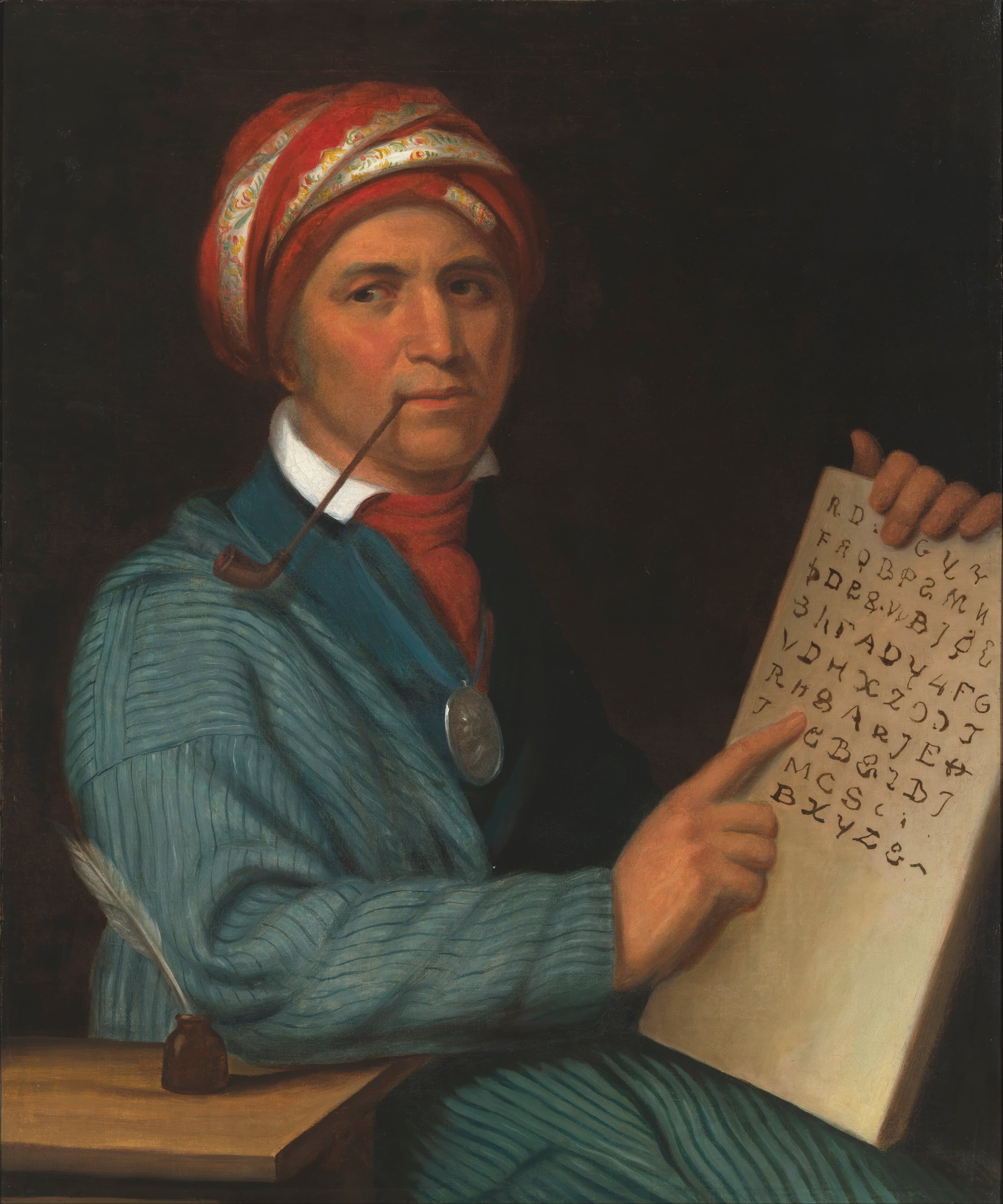
To grasp the magnitude of what Sequoyah achieved, one must look at the rate of literacy in the nineteenth-century American South.
In the first decade of the nineteenth century, in the valley of the Tennessee River, a disabled Cherokee silversmith and blacksmith named Sequoyah began contemplating what he called the "talking leaves" of the white settlers. To most of his peers, the sheets of paper covered in ink that European-Americans read and exchanged were a form of sorcery, a supernatural gift, or perhaps a clever pretense. Sequoyah rejected all of these explanations. He recognized that these marks were a technology—a method for capturing human speech and sending it across vast distances, allowing military orders to be read and family news to be preserved. Observing his white counterparts during his service in the Creek War of 1813–1814, he watched with a growing sense of urgency as they wrote letters home while he and his fellow Cherokee warriors remained silent on paper, bound to the limits of human memory. Sequoyah resolved to invent a way for his people to talk on paper, embarking on an intellectual quest that his neighbors and family initially viewed as a descent into madness.
The path to his invention was lonely, grueling, and nearly ruined him. Born around 1770 in the Cherokee town of Tuskegee, Tennessee, Sequoyah—who was also known by the English names George Gist or George Guess—grew up speaking only Cherokee. He was raised solely by his mother, Wut-teh, a woman related to prominent Cherokee chiefs, after his father, who was variously rumored to be a German peddler, a Swabian fur trader, or a Scotch-descended Continental Army officer, vanished before his birth. Unable to farm or hunt successfully due to a lifelong lameness in his knee, Sequoyah had channeled his natural intellect into craftsmanship, teaching himself to fashion exquisite spurs, bridle bits, and jewelry from silver coins. Yet when he turned his attention from his forge to the creation of a written language around 1809, his fields grew overgrown and his business withered. Neighbors whispered that he had lost his mind. His wife, convinced that his obsession was a form of dark witchcraft, went so far as to burn his initial work. Undeterred, Sequoyah began again.
His first attempt was logographic: he tried to paint a unique symbol for every single word in the Cherokee language. He quickly realized that the sheer volume of pictures required would make the system impossible for anyone to memorize. He then attempted to design a symbol for every abstract idea, but this too proved hopelessly complex. Finally, he abandoned these visual representations of meaning and turned his attention to sound. He began listening to the spoken Cherokee tongue with a jeweler’s precision, dissecting the language into its smallest acoustic components. He discovered that Cherokee speech was constructed from a finite number of repeating vocalic and consonantal combinations. By isolating these individual syllables, Sequoyah realized he did not need thousands of pictures; he needed fewer than one hundred symbols to represent every spoken word in his language.
Connected to
11 links to entries not yet ingested in the Library.