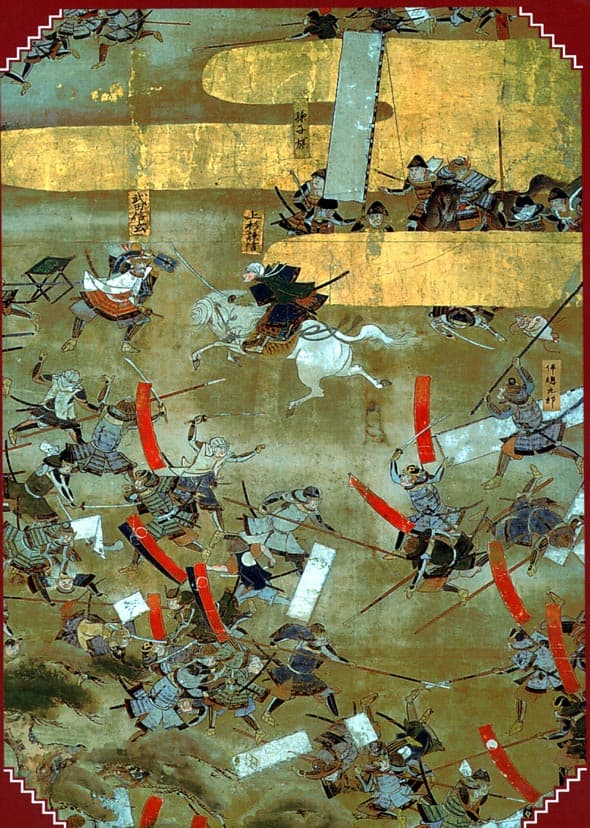
For over a century, the concept of unchallenged authority dissolved across Japan, replaced by a relentless cycle of civil wars, social upheaval, and betrayal.
In 1467, the city of Kyoto, the cultural and spiritual heart of Japan, began to burn. The initial spark was a succession dispute within the Ashikaga shogunate, a conflict that pitted the powerful warlords Hosokawa Katsumoto and Yamana Sōzen against one another in a struggle over who would inherit the office of shogun. It was an argument of surrogates and factions that quickly dissolved into the decade-long catastrophe known as the Ōnin War. By the time the primary combatants withdrew their exhausted armies in 1477, two-thirds of the capital had been reduced to ash. The grand estates of the court aristocracy, ancient Shinto shrines, and sprawling Buddhist temple complexes were gone, replaced by a charred wasteland. But the physical destruction of Kyoto was merely a symptom of a deeper, systemic collapse. In failing to govern, the Ashikaga shogunate had exposed its own irrelevance, shattering the delicate illusion of central authority. The provincial lords who had been forced to reside in the capital packed up their remaining belongings and returned to their home territories, leaving behind a vacuum. What followed was more than a century of unrelenting, decentralized warfare—an era of domestic fallout, social upheaval, and existential reinvention that would come to be known as the Sengoku period, the Age of Warring States.
At its core, the Sengoku period was defined by gekokujō—literally "the low overcoming the high"—a profound breakdown in the traditional master-servant relationships that had structured Japanese feudalism for centuries. With the central government in Kyoto reduced to a toothless spectator, the old titles and appointments granted by the shogun lost their meaning. Power was no longer inherited through lineage or secured by imperial decree; it was seized, held, and expanded by force of arms and political cunning. The shugo—the provincial military governors appointed by the shogunate—frequently found themselves betrayed by their own deputies, the shugodai, or by local landowning warriors known as kokujin. In this highly volatile environment, the old aristocratic class of warlords was swept away by a new breed of ruler: the sengoku daimyo. These were pragmatic, self-made military commanders who ruled their domains directly, without the need for central validation, building their authority on the cold realities of defensive castles, administrative efficiency, and battlefield victory.
The social fluidity of the era allowed men of obscure origins to reshape the political landscape. Hōjō Sōun, often recognized as the first true sengoku daimyo, began his rise by seizing Izu Province in 1491, bypassing the traditional channels of aristocratic succession. Elsewhere, Uesugi Kenshin emerged from the rank of to weaken, and eventually replace, his nominal lord, securing absolute power in his domain through military brilliance. This loosening of samurai culture meant that warriors were no longer exclusively born into their status; talent, ruthlessness, and luck could elevate common soldiers into the ranks of the elite. The most spectacular manifestation of this social mobility was Toyotomi Hideyoshi, who began his career as a penniless peasant, rose to become a samurai, secured his place as a premier , and ultimately ascended to the office of , the Imperial Regent of Japan.
4 links to entries not yet ingested in the Library.
Yet, this was not merely a war fought by professional soldiers. The vacuum of power allowed other, unexpected forces to assert themselves, turning the Sengoku period into a multi-sided ideological struggle. Weary of endless conflict, burdened by heavy taxation, and neglected by the refined aristocrats in Kyoto, the peasantry and townspeople began to organize their own resistance. Armed uprisings, known as ikki, erupted across the provinces. In Kaga Province, this popular unrest fused with religious fervor. Supported by the True Pure Land sect of Buddhism, the local population staged a massive revolt in 1488. In an extraordinary defiance of the samurai class, this coalition, known as the Ikkō-ikki, overthrew the regional authorities and established independent control over the entire province of Kaga, turning it into a self-governing religious collective. Throughout Japan, Buddhist temples fortified themselves, training their own monastic armies and transforming into formidable military powers that rivaled the secular daimyo.
While the provinces burned, the capital became a stage for political puppetry. In 1493, the commander Hosokawa Masamoto engineered the Meiō incident, a de facto coup in which he banished the tenth shogun, Ashikaga Yoshitane, and installed the eleventh shogun, Ashikaga Yoshizumi. This dramatic event effectively reduced the office of shogun to a hollow instrument of the Hosokawa clan, which held the position of kanrei, or shogunal deputy. For decades, the Hosokawa controlled the state through these figureheads, but the poison of gekokujō was contagious. The Hosokawa clan itself soon fractured into murderous succession disputes, symbolized by the Eishō delirium of 1507, when Masamoto was assassinated by one of his adopted heirs. The resulting decades of internal war among the Hosokawa factions further degraded what little central authority remained, leaving Kyoto as nothing more than a prize to be fought over by regional warlords who marched on the city to legitimize their conquests.
This cycle of fragmentation and localized warfare continued until the mid-sixteenth century, when a new drive toward consolidation began to emerge from the chaos. The restoration of order required a level of military modernization and political ruthlessness that the old systems could not withstand. The process of reunification was ultimately driven by three figures, retrospectively celebrated as the "Great Unifiers": Oda Nobunaga, Toyotomi Hideyoshi, and Tokugawa Ieyasu. Nobunaga began the process of dismantling the Sengoku chaos with his march on Kyoto in 1568 to install Ashikaga Yoshiaki as shogun—an event many historians mark as the beginning of the transition out of the Sengoku era. When Yoshiaki proved troublesome, Nobunaga expelled him in 1573, bringing a definitive end to the Muromachi shogunate that had existed since 1336.
By the late sixteenth century, the nature of Japanese warfare had shifted from localized skirmishes to massive, coordinated campaigns aimed at national hegemony. Nobunaga’s successor, Toyotomi Hideyoshi, enforced this transition by issuing the Sōbujirei in 1587, a sweeping imperial decree that prohibited private wars between daimyo, transforming the state's monopoly on violence. The long era of territorial expansion through private warfare effectively ended in 1590 with the capitulation of the late Hōjō clan at the siege of Odawara, which brought the last major independent daimyo under central vassalage. Though subsequent conflicts—the decisive Battle of Sekigahara in 1600, the final destruction of the Toyotomi clan at the siege of Osaka in 1615, and the suppression of the Shimabara Rebellion in 1638—would occur before the Tokugawa shogunate achieved absolute, uncontested stability, the wild, mercurial age of the sengoku daimyo had drawn to a close.
The legacy of the Sengoku period was a profound restructuring of Japanese society. The fluid, chaotic century forced the evolution of administrative laws, defensive architecture, and military organization, leaving behind a highly organized, militarized bureaucracy. The castle towns built by the daimyo to secure their frontiers grew into the major urban centers of the modern era. Yet, the memory of gekokujō—of a world turned upside down, where vassals slew their lords and peasants ruled provinces—haunted the collective consciousness of the ruling class. When peace was finally secured under the Tokugawa shogunate, it was built upon a rigid, highly stratified social order designed specifically to ensure that the social mobility, religious uprisings, and decentralization of the Sengoku era could never happen again.