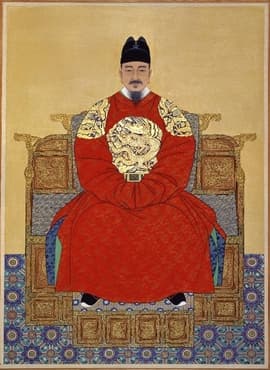
When King Taejong of the Joseon dynasty bypassed his troubled eldest son in 1418 to crown his studious third son, Yi To, he unleashed a golden age that would permanently redefine Korean civilization.
In the autumn of 1418, a twenty-one-year-old prince named Yi To ascended the throne of Joseon inside Gyeongbokgung, the sprawling Northern Palace of Hanyang. He did so under a cloud of systemic uncertainty and family drama. He was not the eldest son, nor had he been groomed for the crown. His father, King Taejong, was a formidable and ruthless monarch who had secured his own path to power through two bloody, fratricidal succession crises known as the Strife of the Princes. To prevent a third such disaster, Taejong had spent years trying to mold his eldest son, Grand Prince Yangnyŏng, into a suitable heir. But Yangnyŏng was a wild, rebellious spirit who preferred womanizing and neglecting his studies to the tedious arts of Confucian statecraft. When Yangnyŏng brought a courtier’s pregnant concubine into the palace in defiance of his father’s direct orders, the aging king wept with frustration, recognized the prince’s inability to govern, and stripped him of his title. Turning past his agreeable second son, Taejong looked to his third: Yi To, a young man so obsessively bookish that, during his childhood, his father had once confiscated his library to save his failing eyesight, only for the boy to secretly read a missed volume dozens of times over.
Though the young king, posthumously known as Sejong, had taken the throne, he did not yet hold the reins of absolute power. Taejong remained in the wings as king emeritus until his death in 1422, retaining a firm grip on the military and veto power over major state decisions. This period of shared rule, far from being a period of paralysis, provided Sejong with a rare kind of political incubator. While his father managed the brutal, necessary mechanics of consolidating a young dynasty—Joseon was barely a quarter-century old—Sejong was free to study the blueprints of empire. When he finally stood alone, he inherited a remarkably stable state, surrounded by a cadre of experienced administrators and military officers. Sejong did not squander this inheritance; instead, he set about transforming the Korean peninsula from a fragile, militarized kingdom into an intellectual powerhouse, seeking to build a society where cosmic order, scientific precision, and humanistic governance aligned.
Central to Sejong’s vision of statecraft was the reestablishment of the Hall of Worthies in 1420. This was no mere advisory council, but an elite, state-funded think tank populated by the finest minds of the realm. To foster deep, uninterrupted scholarship, Sejong initiated a practice known as saga toksŏ, effectively granting his scholars paid research sabbaticals free from the daily burdens of administrative work. The Hall of Worthies became the engine of an unprecedented intellectual golden age. Under Sejong's direct encouragement and active participation, these scholars tackled the practical anxieties of Korean life. They compiled the , a revolutionary agricultural manual based on the actual farming techniques of local peasants rather than imported Chinese treatises, which drastically improved crop yields. They cataloged the vast, 365-volume medical compendium , systematizing traditional treatments. In astronomy and mathematics, Sejong’s court labored to assert Korea’s intellectual independence. When a solar eclipse in 1432 occurred two days later than predicted by the imported Chinese calendar, Sejong commissioned a flurry of scientific research. The result was the , the first native Korean calendar, which allowed Joseon astronomers to calculate the movements of celestial bodies with pinpoint accuracy relative to Hanyang, rather than Beijing.
12 links to entries not yet ingested in the Library.
To turn these celestial calculations into terrestrial tools, Sejong patronized brilliant inventors, most notably the low-born engineer Chang Yŏngsil. Together with the crown prince, Yi Hyang, they transformed Gyeongbokgung into a laboratory of the early modern world. They constructed elaborate armillary spheres, planispheres, and ingenious public sundials. In 1434, Chang designed a self-striking water clock, and in 1441, the court invented the ch'ŭgugi, a bronze rain gauge designed to measure precipitation across the provinces—beating European equivalents by nearly two centuries. Paired with the sup'yo, a river-stage stream gauge, these instruments allowed the state to predict floods, assess potential crop yields, and systematically reform land taxes. Rather than levying flat, predatory taxes on the peasantry, Sejong’s administration adjusted tax rates based on seasonal rainfall and soil quality, ensuring agricultural stability without depleting the royal treasury.
While Sejong labored to map the heavens and the soil, he also had to secure the physical boundaries of his kingdom. Joseon was bordered by a volatile northern frontier and threatened by maritime raiders to the south. In 1419, early in his reign, Sejong launched the Ōei Invasion of Tsushima Island, successfully suppressing the Japanese pirates who had plagued the southern coastline and establishing a stable trade agreement that brought decades of maritime peace. In the north, along the Yalu and Tumen rivers, Sejong faced the Jurchen tribes, whose frequent raids disrupted frontier settlements. Through a series of aggressive military campaigns, Sejong pushed the northern borders of Korea to the geographical limits they occupy today, building forts and systematically relocating southern peasants to assimilate and secure the rugged northern frontier.
Yet, this expansionist, scientific king was also a man caught in a profound spiritual and philosophical tension. Sejong’s reign marked a massive, institutional shift toward Neo-Confucianism, as the state sought to dismantle the deep-seated political influence of Buddhism. Sejong dutifully oversaw these reforms, purging Buddhist temples of their vast wealth and political sway to align the bureaucracy with Confucian ideals of civic virtue. Yet, in the quiet of his private quarters, Sejong was a devout Buddhist. As his health began to fail him in his later years—plagued by chronic illnesses that eventually forced him to delegate daily government affairs to his son in 1445—he increasingly vocalized his personal faith. He commissioned Buddhist texts and built a private chapel within the palace, sparking fierce, bitter arguments with his own Confucian ministers, who viewed his personal devotion as a betrayal of the state's foundational philosophy.
This tension between the elite, classical world of Hanja—the complex Chinese characters used by the educated nobility—and the lived reality of the common Korean peasant ultimately inspired Sejong’s most enduring legacy. Although the detailed story of its creation belongs to another chapter of history, it was Sejong’s profound frustration with his illiterate subjects' inability to appeal to the courts or read royal decrees that drove him to secretly spearhead the creation of Hangul, the native Korean alphabet. Designed to be so simple that "a wise man can acquaint himself with them before the morning is over; a stupid man can learn them in the space of ten days," the new script was fiercely opposed by the Confucian elite, who feared it would isolate Korea from the civilized Chinese cultural sphere. But Sejong persisted, viewing literacy not as a privilege of the high-born, but as the fundamental right of a governed people.
When Sejong died in the spring of 1450 at the age of fifty-two, he left behind a kingdom radically redefined. He was buried in the tomb Yeongneung, and his court bestowed upon him the temple name Sejong, meaning "epochal ancestor"—a title history has validated. In modern memory, he remains one of only two Korean monarchs decorated with the epithet "the Great." In South Korea, his name is synonymous with the nation's cultural and scientific identity, gracing currency, research stations, and entire cities. Even in the divided political landscape of the modern peninsula, where some northern texts have historically viewed him through a skeptical Marxist lens as a feudal oppressor, his linguistic legacy remains the unbreakable thread of a shared Korean civilization. Sejong's reign was the moment Joseon stopped looking outward for its definition of the world, choosing instead to measure its own rain, write its own sounds, and chart its own place beneath the stars.