Event · 218 BCE – 201 BCE · Roman Republic and Empire
Second Punic War
- Also known as
- 2. pun háború
- 2. puniske krig
- 2nd Punic War
- Ail Ryfel Pwnig
- Al Doilea Război Punic
- Amgaru Abuniq Wis-sin
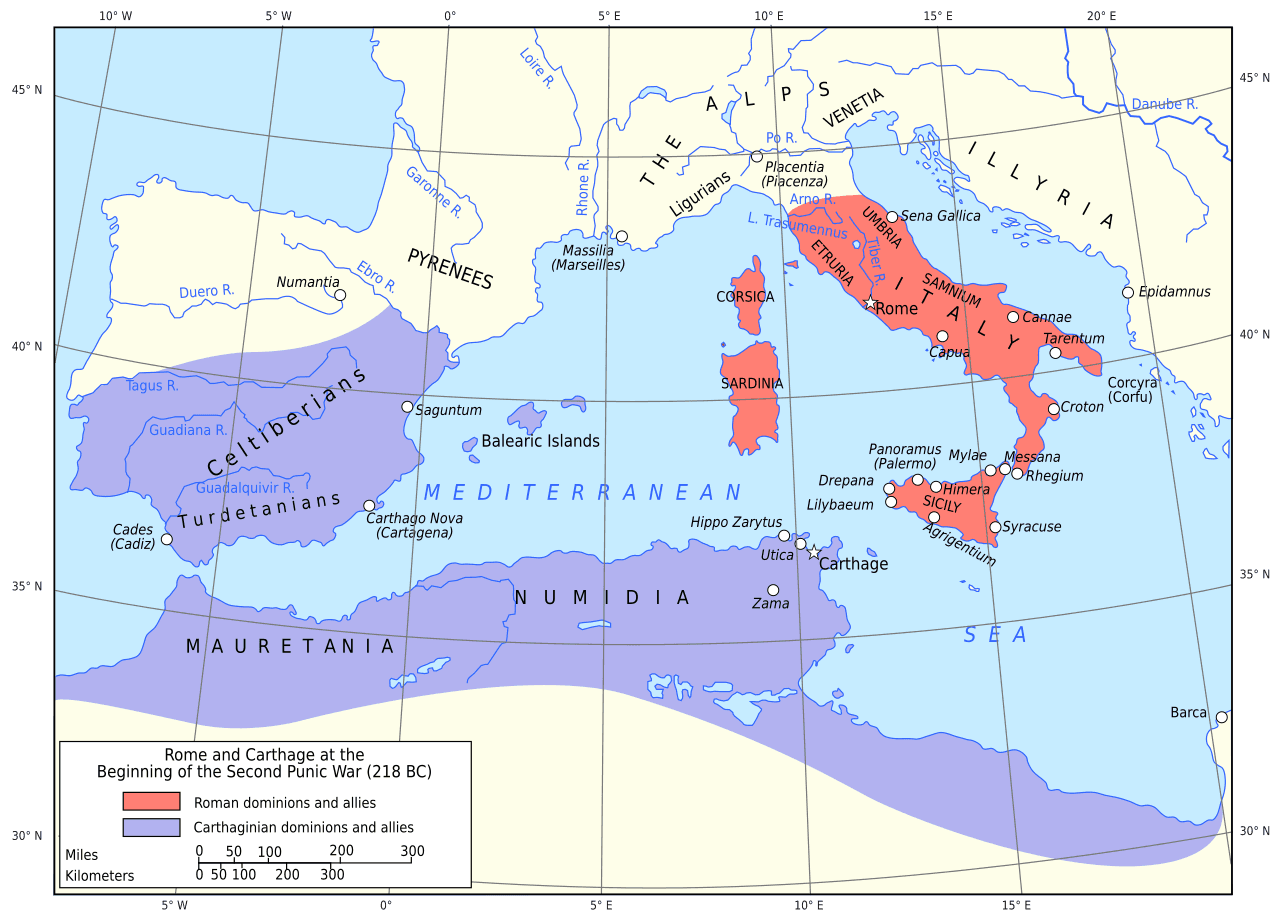
For seventeen years, the western Mediterranean was consumed by a struggle for absolute supremacy between Rome and Carthage, a conflict that escalated into a global conflagration drawing in Macedonia, Syracuse, and the kingdoms of Numidia.
In the late third century BCE, the western Mediterranean was not yet a Roman lake, but a arena contested by two radically different titans. To the north was Rome: an agrarian, land-hungry republic whose strength lay in the relentless, citizen-militia legions it could summon from the Italian soil. To the south, situated on the tip of modern Tunisia, was Carthage: a glittering maritime empire of Phoenician merchant-princes, built on trade and defended by armies of foreign mercenaries. The first war between them, concluded in 241 BCE after twenty-three grueling years of attrition, had stripped Carthage of Sicily. But peace was merely an intermission. Deprived of its island possessions, Carthage looked westward to the silver-rich lands of Iberia to rebuild its wealth and power. It was here, in 219 BCE, that a brilliant, young Carthaginian general named Hannibal besieged and sacked the pro-Roman city of Saguntum. When Carthage refused to repudiate the act, Rome declared war in the spring of 218 BCE. They anticipated a standard, predictable conflict—one consul sailing for Africa, another for Iberia. They did not expect a military genius to reinvent the geography of war.
Hannibal’s response was an act of strategic audacity that redefined ancient warfare. Rather than waiting for a Roman invasion, he took the initiative, marching an army of perhaps fifty thousand infantry, nine thousand cavalry, and thirty-seven war elephants overland from Iberia, through the wild territories of Gaul, and straight toward the formidable wall of the Alps. The crossing was a logistical nightmare of freezing temperatures, hostile mountain tribes, and treacherous passes. Thousands of men, horses, and beasts of burden fell into the ravines. Yet, by the autumn of 218 BCE, Hannibal descended into the plains of Cisalpine Gaul—modern northern Italy—with a hardened, albeit reduced, strike force. The Romans, stunned by his sudden appearance on their northern doorstep, scrambled to redirect their forces. Hannibal quickly rallied the local Gallic tribes, who were eager to throw off the yoke of recent Roman expansion. In rapid succession, he demonstrated a tactical sophistication that left the Roman military establishment reeling.
The initial encounters at the Trebia River in late 218 BCE and Lake Trasimene in 217 BCE were not merely defeats for Rome; they were masterclasses in deception and ambush. At Trasimene, Hannibal utilized the morning mist and the surrounding hills to trap a Roman army of some twenty-five thousand men against the lakeshore, virtually destroying it. In response, Rome raised the largest army it had ever assembled—an immense force of eight legions, numbering upwards of eighty thousand men—to crush the invader through sheer, brute force. The two sides met in 216 BCE on the dusty plains of Cannae, near the Adriatic coast. It was here that Hannibal executed his masterpiece. Employing a crescent-shaped line that bowed outward toward the Romans, he placed his weaker Iberian and Gallic infantry in the center, flanked by his elite Libyan veterans. As the dense mass of Roman infantry pushed forward, the Carthaginian center intentionally yielded and bowed backward, drawing the Romans deep into a trap. Meanwhile, the superior Carthaginian and Numidian cavalry swept the Roman horse from the field and wheeled to attack the Roman rear. Enveloped on all sides, the Roman legions were compressed into a helpless mass. By the day's end, some seventy thousand Roman soldiers lay dead.
Connected to
- participated inMacedonia808 BCE
- participated inRoman Republic509 BCE
+ 12 further connections to entries not yet ingested