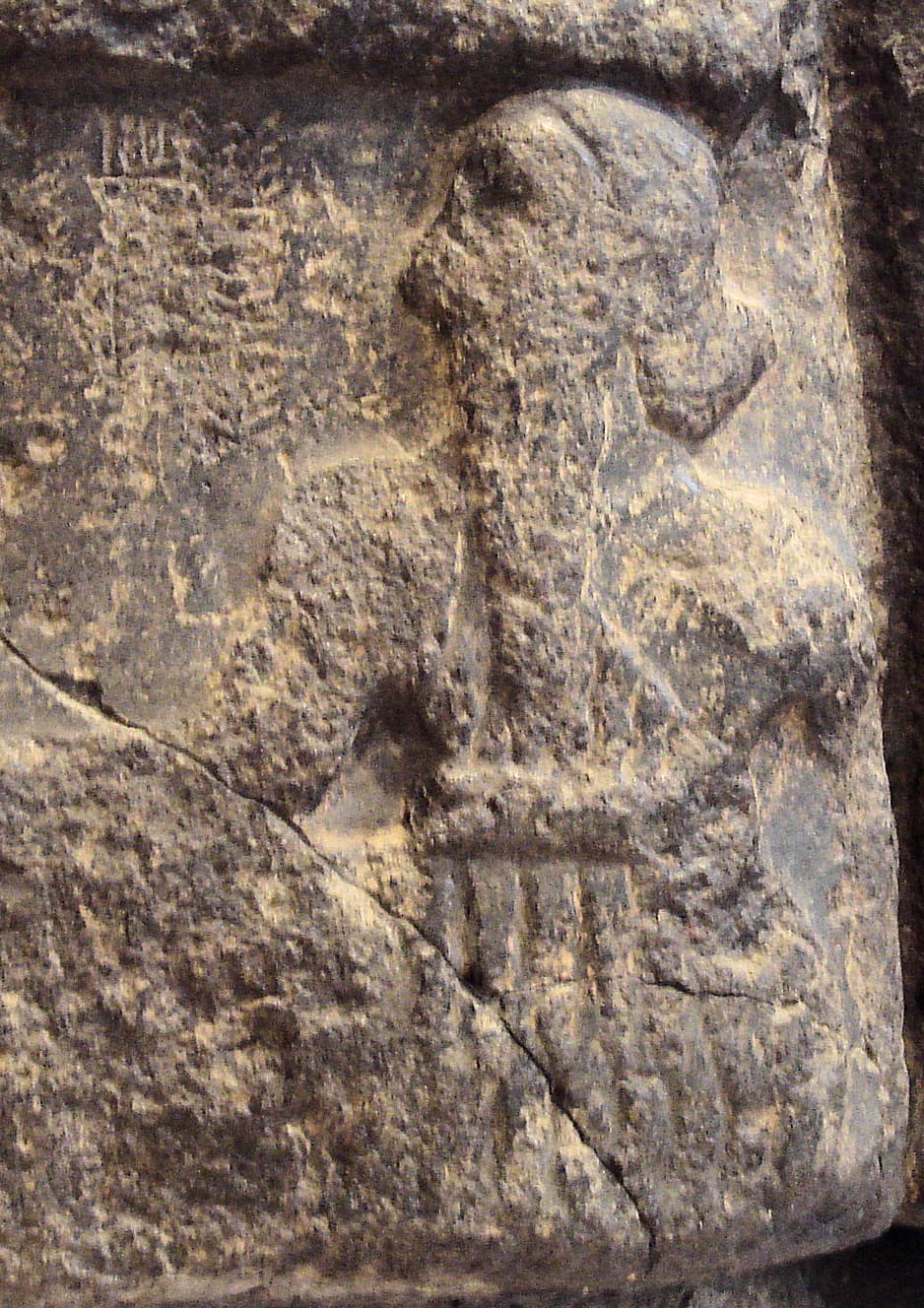
Before he became the first person in recorded history to rule over an empire, the man we know as Sargon of Akkad served as a cup-bearer to King Ur-Zababa in the city-state of Kish.
Some time in the twenty-fourth century BCE, a man who called himself Šarru-kēn—meaning "the king is legitimate," a name whose very insistence suggests he was anything but—marched the defeated king of Uruk to the city of Nippur. This fallen monarch, Lugalzagesi, had briefly united the ancient, squabbling city-states of Sumer under a single hegemony. Sargon did not merely defeat him; he bound him in a collar and paraded him like a beast through the monumental gates of the temple of Enlil, the chief god of the Mesopotamian pantheon. It was a calculated piece of political theater. In a world where authority had always been local, tied to the patron deities of individual walled cities, Sargon was demonstrating a new kind of power. He was not just another king of Kish or Uruk; he was the master of a vast territorial canvas, establishing a model of centralized rule that would haunt the historical imagination of the Near East for two millennia.
We know Sargon today as the world’s first empire builder, but his origins are preserved in a hazy architecture of legend and politically charged memory. To the later scribes of the Neo-Assyrian Empire, writing some fifteen hundred years after his death, Sargon was a Moses-like figure of humble birth: the son of a gardener, cast adrift on the Euphrates in a basket of reeds. The contemporary and near-contemporary records, though sparser, offer a different kind of drama. The Sumerian King List notes that Sargon began his career as the cup-bearer to Ur-Zababa, the king of Kish. The cup-bearer was no mere domestic servant; he was a high official of the court, a position of ultimate trust in an era where poison was a standard tool of statecraft. How Sargon transitioned from pouring wine for the king of Kish to seizing the crown remains a blank space in the historical record, but he did not stop at the borders of Kish. After usurping power, he bypassed the traditional centers of southern Mesopotamia to establish a new, sovereign capital. He named it Akkad.
The exact location of Akkad remains one of the great unsolved mysteries of Near Eastern archaeology, its ruins still lost beneath the shifting silts of the Mesopotamian plain. Yet from this ghost city, Sargon projected a military force unlike anything the ancient world had seen. Moving south into the fertile, canal-crossed heartland of Sumer, his armies systematically dismantled the independent city-states that had defined human civilization for a thousand years. He conquered Ur and E-Ninmar, laid waste to the territory from Lagash to the Persian Gulf, and destroyed the walls of Umma. Sargon recorded that, to mark the absolute nature of his victory over the south, he marched his troops to the shores of the Lower Sea—the Persian Gulf—and washed his weapons in its salt waters, a symbolic cleansing of the blood of conquest and a declaration of ultimate boundary.
+ 12 further connections to entries not yet ingested
Sargon’s ambitions, however, were not bounded by the alluvial plains of the Tigris and Euphrates. Turning his eyes northwest, he followed the river valleys upward into the Levant and Upper Mesopotamia. In the town of Tuttul, he bowed before the West Semitic god Dagan, an act of piety that was rewarded, according to Sargon's inscriptions, with the submission of the "Upper Land." His armies marched through Mari, Yarmuti, and the wealthy trading hub of Ebla, pushing as far as the "Cedar Forest" of the Amanus Mountains in modern Turkey and Lebanon, and the "Silver Mountains" of the Taurus range. To the east, he crossed the Zagros foothills to strike down the powerful Elamite and Marhashi polities, listing their vanquished generals and kings on the pedestals of his triumphal statues. His inscriptions boast of victories over thirty-four cities in total.
This was not a traditional raider's campaign of plunder and retreat, but the engineering of a global trade network centered on his person. In the docks of Akkad, Sargon boasted, ships from Meluhha in the Indus Valley, Magan in Oman, and the island of Dilmun in the Persian Gulf rode at anchor. To maintain this vast territory, Sargon bypassed the traditional local aristocracies, appointing loyal Akkadian governors to run the conquered Sumerian cities. He maintained a massive central administration, supported by a standing army or court of 5,400 men who "ate bread daily before him"—a logistics feat that required an unprecedented level of agricultural extraction and centralized tribute.
Yet, the very scale of the Akkadian experiment contained the seeds of its own unraveling. As Sargon grew old, the immense, disparate territories he had bound together by sword and administrative decree began to strain against the center. The Chronicle of Early Kings records that in his twilight years, "all the lands revolted against him, and they besieged him in Akkad." The aging conqueror was forced to take the field once more, successfully breaking the siege and destroying the rebel hosts. He turned his armies north to Subartu, crushing another insurrection and hauling its spoils back to his capital.
But these late-career victories could not stave off a darker twilight. Later Babylonian chronicles, interpreting the past through a lens of divine justice, claimed that Sargon’s ultimate hubris lay in his relationship with the older, sacred landscape. He was said to have dug up the soil from the sacred trenches of Babylon to build a counterpart city next to his own capital of Agade. This act of sacrilege allegedly angered the great lord Marduk, who punished the empire with famine. Sargon's final years were described not as a triumphant peace, but as a restless, unending struggle: "From the rising of the sun unto the setting of the sun they opposed him and gave him no rest."
Sargon died around 2279 BCE, leaving his empire to his sons and eventually his grandson, Naram-Sin, under whom the Akkadian dynasty would reach both its artistic peak and its eventual collapse. Though his dynasty endured for barely a century before falling to the Gutian invaders, Sargon had permanently altered the trajectory of human governance. Before him, the city was the world; after him, the world was something to be gathered, administered, and ruled by a single, supreme king. For thousands of years, long after Akkad had dissolved back into the clay from which it was built, kings from Nineveh to Babylon would assume the name Sargon, hoping to inherit a fragment of the legitimacy that the first Sargon had so forcefully carved out for himself.