Person · 335 CE – 380 CE · Gupta and Medieval India
Samudragupta
- Also known as
- Ma-đà-la-cấp-đa
- Samudra Gupta
- Samudra Gupta
- Samudra Gupta
- Samudra-Gupta
- Samudragupto
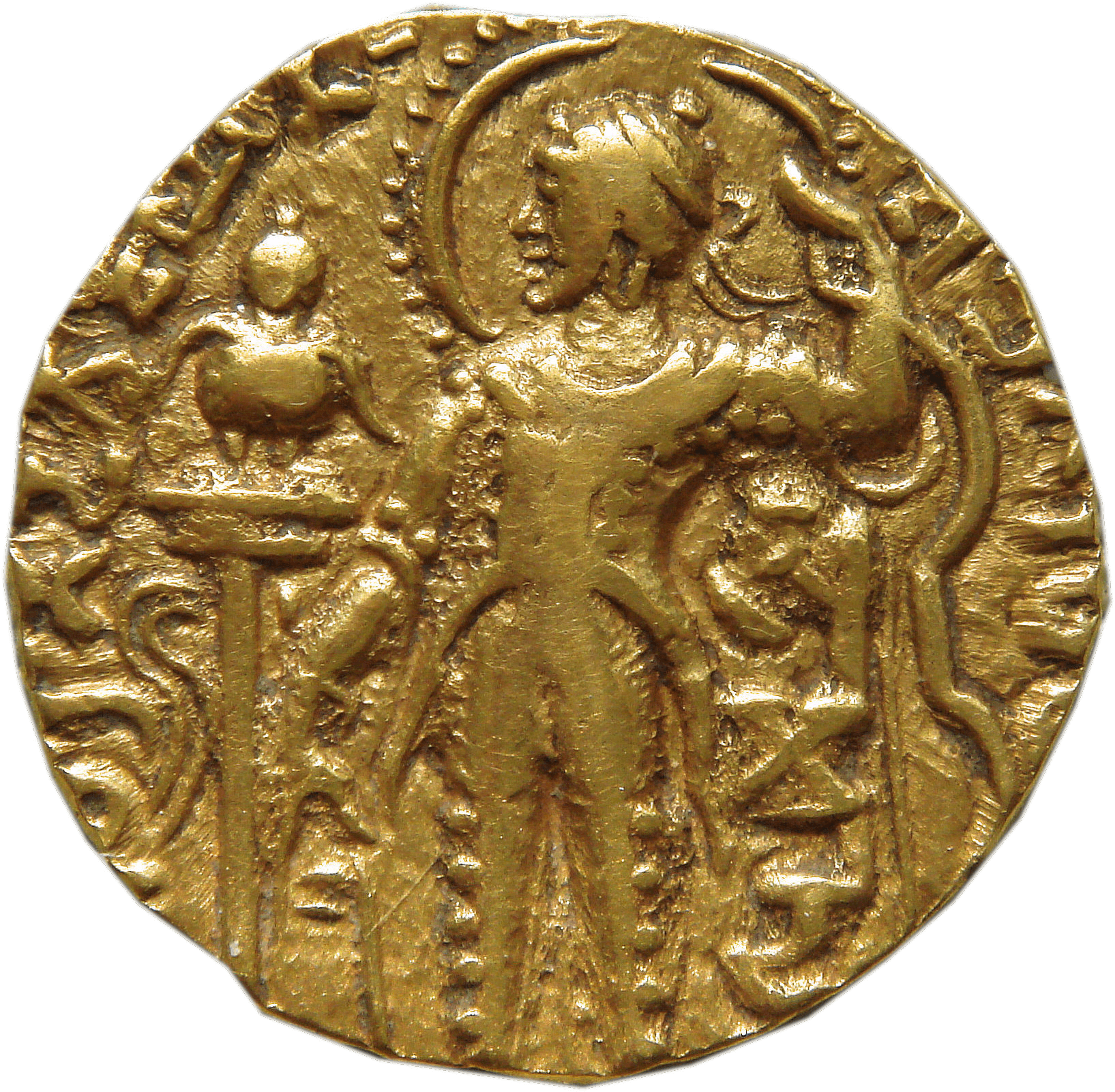
An emperor's legacy is rarely preserved in both the clang of iron and the pluck of a string, yet Samudragupta commanded both with equal mastery.
In the final decades of the fourth century CE, a masterfully engraved sandstone pillar stood in the ancient city of Prayag, at the sacred confluence of the Ganges and Yamuna rivers. The monument was already centuries old, having been erected by the Mauryan emperor Ashoka to broadcast his message of Buddhist pacifism and moral conquest. But a new ruler had claimed the stone. Beneath the ancient, gentle edicts, a court poet named Harisena carved a very different kind of testament. Written in elegant, classical Sanskrit, this prashasti (eulogy) sang the praises of Samudragupta, the second emperor of the Gupta dynasty. It described a monarch whose body was "adorned with the beauty of a hundred wounds" left by battle-axes, arrows, spears, and swords—scars that were not disfigurements, but "marks of glory." Where Ashoka had preached the cessation of violence, Samudragupta used the very same stone to declare himself the "exterminator of all kings." He was a ruler who sought nothing less than dharani-bandha: the binding of the earth under a single imperial umbrella.
This transition from localized kingship to continental empire began in the shifting politics of northern India around 335 CE. Samudragupta’s father, Chandragupta I, had laid the foundations of Gupta power in the fertile plains of Magadha, marrying Kumaradevi, a princess of the prestigious Licchavi clan. When the time came to secure the succession, Chandragupta bypassed traditional seniority, calling the young Samudragupta before the royal court. As recorded on the Prayag pillar and a fragmentary stone inscription at Eran, the old emperor declared his son a "noble person," bid him to "protect the earth," and formally appointed him heir. The court scribes noted that while the assembly rejoiced, the faces of those of "equal birth"—implying rival Gupta princes or neighboring dynasts—bore a distinctly "melancholy look." Some historians read this as a polite euphemism for a succession crisis. Golden coins issued by a mysterious ruler named Kacha, bearing the title "exterminator of all kings" and closely resembling Samudragupta's own coinage, suggest a brief, forgotten civil war. Whether Kacha was a rebellious brother or merely Samudragupta's original name before he assumed the grander title of Samudra ("the Ocean") remains one of the dynasty's unsolved mysteries.
Once secure on the throne, Samudragupta initiated a series of military campaigns that fundamentally reshaped the geopolitics of the subcontinent. In the northern heartland of Aryavarta, his policy was one of utter annihilation. He "uprooted" neighboring kings like Achyuta, Nagasena, and Ganapati-naga, rulers of the upper Ganges valley and western Uttar Pradesh. Their kingdoms were not merely made tributary; they were annexed directly into the growing Gupta administrative machine. Farther west, in the Punjab, the Gupta armies moved against the Kota dynasty, capturing their ruler while Samudragupta, according to Harisena's poetic phrasing, "played" or pleased himself in his capital of Pushpa-pura (Pataliputra)—a literary flourish suggesting that the campaign was so effortless it required no royal oversight. At its peak, his directly administered empire stretched from the Ravi River in the west to the dense forests of the Brahmaputra in the east, and from the Himalayan foothills down into central India.
But the defining campaign of Samudragupta’s reign was his grand march to the south, into the region known as Dakshinapatha. Leading an army through the formidable, malaria-ridden wilderness of central India, he emerged on the eastern coast in modern-day Odisha and pushed south along the Bay of Bengal, advancing as far as Kanchipuram, the stronghold of the Pallava kingdom. Here, Samudragupta encountered a world entirely different from the Ganges plains, governed by kings like Mahendra of Kosala and Vyaghra-raja of Mahakantara. Rather than annexing these distant territories, which would have been impossible to govern from Pataliputra, the emperor adopted the ancient Indian political ideal of the dharma-vijayi—the "righteous conqueror." As codified in Kautilya's Arthashastra, a righteous conqueror does not seize the lands of a defeated foe, but rather restores them to their thrones in exchange for their submission and tribute. Samudragupta captured twelve southern kings, stripped them of their pride, and then graciously released (anugraha) them. By reinstating them as vassals, he secured both the southern trade routes connecting India to Southeast Asia and a vast network of loyal, wealthy client states.
To solemnize his undisputed supremacy, Samudragupta revived a grand Vedic ritual that had fallen into disuse: the Ashvamedha, or horse sacrifice. A specially selected stallion was set free to wander for a year, accompanied by an imperial army; any king who failed to challenge the horse's passage was understood to have accepted the emperor’s suzerainty. At the end of the year, the horse was returned to the capital and sacrificed in a lavish ceremony. To commemorate this event, Samudragupta minted exquisite gold coins depicting the sacrificial horse standing before a decorated altar, while the reverse showed his queen, Dattadevi, holding a fly-whisk. These coins, along with others showing the emperor playing the veena (a stringed lutelike instrument), present a deliberate paradox. He was a ruthless conqueror who remained undefeated in battle, yet he wished to be remembered as a sensitive patron of the arts, a poet of high merit, and a master musician whose performances put the celestial spirits to shame.
When Samudragupta died around 380 CE, he left behind an empire that had transformed northern India from a fragmented patchwork of warring clans and tribal oligarchies into a cohesive, centralized state. His expansionist policies were continued and consolidated by his son, Chandragupta II, ushering in what modern historians would call the Golden Age of classical India—an era of unparalleled achievements in literature, mathematics, astronomy, and art. The administrative and cultural structures Samudragupta forged through iron and ink survived for generations, serving as the template of imperial authority in South Asia. Yet his most enduring monument remains the sandstone pillar at Prayag. There, carved into the very same stone that carried Ashoka’s messages of peace, Harisena’s verses preserve the memory of a king who took the chaotic diversity of the subcontinent and, through the sheer force of his will, bound it together under one imperial name.
Connected to
- child · father ofChandragupta II4th c. CE
- citizen ofGupta Empire320 CE
+ 9 further connections to entries not yet ingested