For thousands of years, the ocean-spanning people of the South Pacific recognized a sacred center in the volcanic peaks of Savai'i and Upolu.
On the morning of November 7, 1918, a small passenger and cargo vessel named the SS Talune slipped its moorings in Auckland, New Zealand, and set a course northeast across the Pacific. On board was a quiet passenger: the highly contagious, lethal strain of pneumonic influenza known as the Spanish flu. When the ship arrived in the harbor of Apia on the northern coast of Upolu, the New Zealand administration governing the territory made a catastrophic error, permitting the vessel to berth in direct breach of quarantine regulations. Within seven days, the virus had breached the shoreline, igniting an epidemic that swept through the mountainous interior and leapt across the narrow channels to the neighboring islands. By the time the fever broke, approximately one-fifth of the Samoan population was dead. It was one of the most devastating demographic disasters of the twentieth century, and it occurred under the watch of a young colonial administration that had assumed control of the islands just four years prior. The tragedy forever altered the relationship between the Samoan people and their foreign administrators, hardening a resolve for self-determination that would take more than four decades to fully realize.
To understand the weight of this loss, one must look to the unique, deeply rooted social fabric of the Samoan archipelago, a chain of volcanic islands stretching across the South Pacific. Settled roughly 3,500 years ago by the Lapita people—highly skilled Austronesian navigators who journeyed eastward from Southeast Asia and Melanesia—Samoa developed a singular language and cultural identity. The islands themselves, formed of Miocene volcanic hotspots, rise dramatically from the ocean, their flanks scored with lush, fertile valleys and encircled by protective, often treacherous coral reefs. For centuries, the people of these islands maintained intimate social, political, and genetic ties with neighboring Fiji and Tonga, their histories bound by interisland voyaging and political marriages. Samoan society organized itself around the matai system, a complex hierarchy of chiefs and family heads. At its apex stood two principal royal families: the Sā Malietoa, whose lineage had famously defeated Tongan occupiers in the thirteenth century, and the Sā Tupua, descendants of the great sixteenth-century Queen Salamasina. Power was balanced among four great titles—Malietoa, Tupua Tamasese, Mataʻafa, and Tuimalealiʻifano—each representing deep historical lineages that commanded immense spiritual and political authority.
This ancient political ecosystem was violently disrupted in the nineteenth century as Western empires woke to the strategic and commercial value of the Pacific. To the European explorers who first sighted them—beginning with the Dutchman Jacob Roggeveen in 1722 and followed by the Frenchman Louis Antoine de Bougainville in 1768—the islands were known as the "Navigator Islands," a tribute to the exceptional seafaring prowess of their inhabitants. By the 1830s, the arrivals were no longer merely passing through. British missionaries from the London Missionary Society, American whalers seeking fresh water and timber, and German traders establishing vast copra and cocoa plantations began to slice up the islands' economy. The late nineteenth century saw Samoa transformed into a dangerous geopolitical chessboard. The United States, Great Britain, and the German Empire each backed rival Samoan factions in a series of civil wars, hoping to secure exclusive harbor rights—such as the magnificent deep-water port of Pago Pago for the Americans or Apia for the Germans.
+ 7 further connections to entries not yet ingested
The tension reached a terrifying climax in March 1889, when warships from all three empires crowded into Apia's narrow harbor, guns primed for a global conflict. War was averted only by a sudden, ferocious hurricane on March 15 that wrecked or grounded six of the warships with heavy loss of life, sparing only the British vessel Calliope, which miraculously managed to steam out to the open sea. The respite was temporary. In 1899, following another civil war and the shelling of Apia by British and American ships, the imperial powers bypassed the Samoans entirely. Through the Tripartite Convention of 1899, they partitioned the archipelago. The United States took the smaller, eastern islands, which became American Samoa. The German Empire claimed the larger, western islands, establishing German Samoa. Great Britain withdrew its claims altogether in exchange for concessions in Tonga, the Solomon Islands, and West Africa.
German rule over Western Samoa, directed by Governor Wilhelm Solf from 1900 to 1914, sought to centralize authority by dismantling traditional political structures. Solf abolished the kingship, banned the traditional native governments of Upolu and Savai'i, and placed all land and title disputes under colonial control. When a non-violent indigenous resistance movement, the Mau a Pule, arose in 1908 to defend traditional governance, Solf summarily banished its leader, Lauaki Namulau'ulu Mamoe, to Saipan in the Mariana Islands. Yet German rule was short-lived. In August 1914, at the outbreak of World War I, Great Britain requested that New Zealand seize the German wireless station in Apia. A New Zealand expeditionary force landed unopposed on Upolu, bloodlessly occupying the colony. Following the war, the League of Nations formalized this occupation, granting New Zealand a Class C Mandate over Western Samoa—a trusteeship that continued under the United Nations after World War II.
For the Samoans, New Zealand rule was marked by administrative paternalism and a profound lack of cultural understanding, a friction that had been inflamed by the horrors of the 1918 influenza pandemic. The memory of that preventable tragedy, combined with the suppression of traditional leadership, fueled a growing national consciousness. The desire to reclaim their sovereignty, to preserve the matai system, and to govern themselves according to fa'a Samoa (the Samoan way) became an unstoppable tide. Throughout the decades of New Zealand administration, which was overseen by the Department of Island Territories, Samoan leaders patiently negotiated, protested, and organized, asserting their readiness for self-determination.
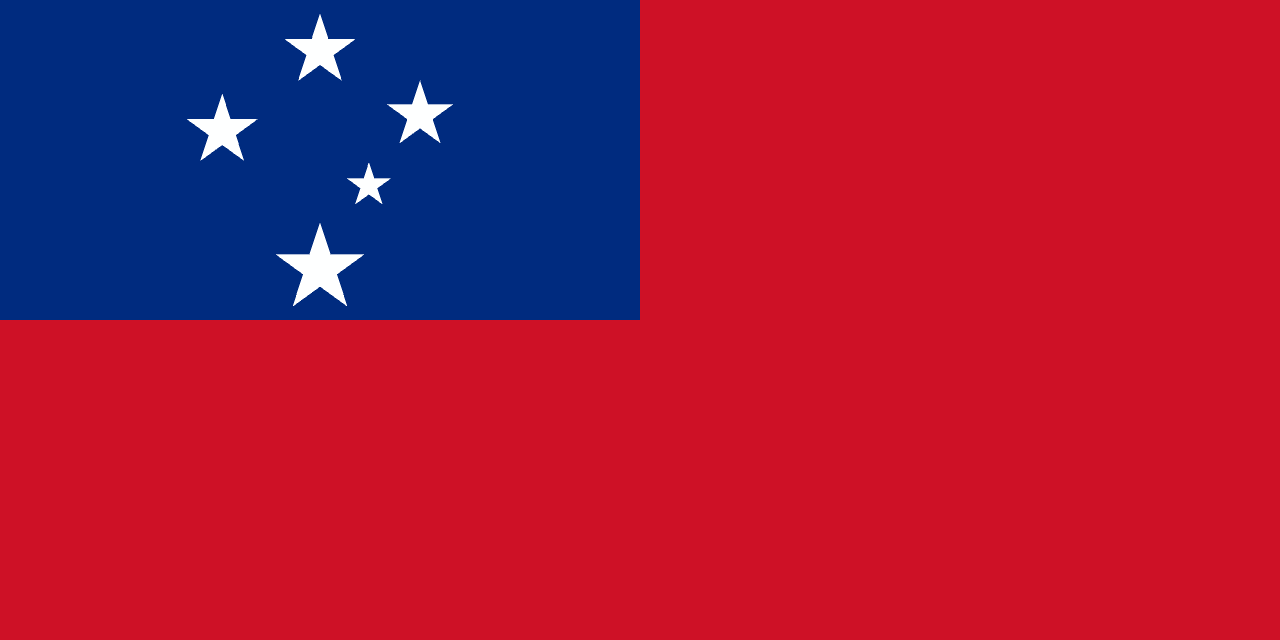
The culmination of this long struggle arrived on January 1, 1962, when Western Samoa officially declared its independence. It was a historic milestone: Western Samoa became the very first independent small island nation in the Pacific, paving the way for the decolonization of the wider region. The new nation adopted a unitary parliamentary democracy, uniquely blending British Westminster systems with the traditional matai structure. At the moment of transition, the country chose to preserve its cultural core, ensuring that its highest traditional leaders would hold the office of head of state.
On July 4, 1997, the nation took a final symbolic step toward reclaiming its pre-colonial identity by officially dropping "Western" from its name, becoming simply the Independent State of Samoa. Though the change drew protests from neighboring American Samoa, which feared the name change diluted its own distinct identity, the transition was a powerful assertion of historic continuity. Today, Samoa consists of two large, inhabited volcanic islands, Savai'i and Upolu—home to the capital city of Apia and the grave of the writer Robert Louis Stevenson on Mount Vaea—alongside the smaller inhabited islands of Manono and Apolima, and several uninhabited islets. While New Zealand retains responsibility for Samoa's defense, the nation stands as a fully sovereign member of the United Nations, the Commonwealth of Nations, and the Pacific Islands Forum. The path from the devastating arrival of the Talune to the triumphant flag-raising of 1962 remains a testament to a people who, having survived both the diseases and the divisions of empires, successfully reclaimed the "holy center" of their world.