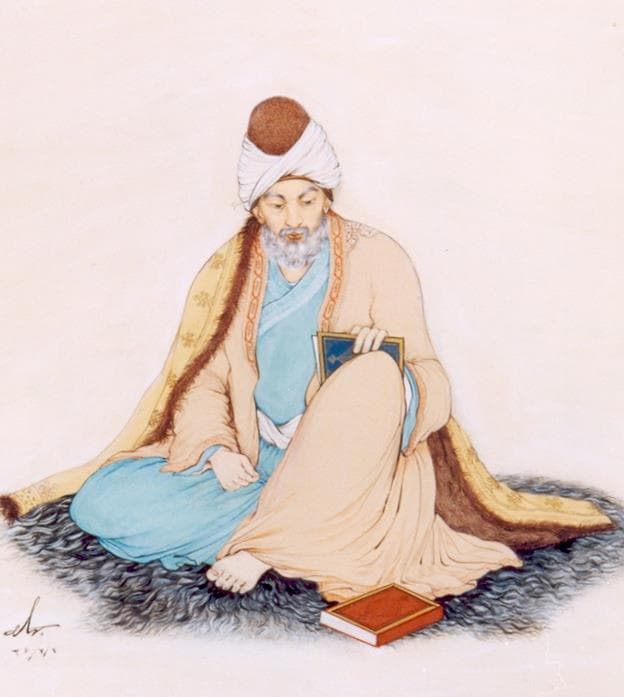
The name by which the world knows him, Rumi, is a geographical accident, a Persian word meaning the Roman, earned because he settled in Konya—a city that had only recently belonged to the Eastern Roman Empire.
On a late autumn day in 1244, a stranger in a coarse wool cloak slipped unnoticed into the bustling markets of Konya. He was Shams-e Tabrizi, a wandering dervish of no fixed abode, who had spent a lifetime praying for a companion who could "endure his company." At the age of thirty-seven, Jalal al-Din Muhammad was already the pride of Konya—a highly respected Islamic jurist, a sober academic, and the inheritor of his father’s prestigious teaching chair at the local madrassa. When the two men crossed paths on November 15, the encounter acted as a sudden, violent solvent on Jalal al-Din’s structured life. The sober jurist was instantly consumed by the ecstatic, wild mysticism of the wanderer. For months they became inseparable, lost in a mutual spiritual infatuation that scandalized the conservative religious establishment of Konya and alienated Jalal al-Din’s family. Then, on the night of December 5, 1248, Shams was called to the back door of their quarters. He stepped out into the dark and vanished forever, leaving behind a wake of rumors that he had been murdered, perhaps with the complicity of the scholar’s own jealous younger son.
This shattering loss did not destroy Jalal al-Din; instead, it cracked him open. The respected scholar of Islamic law, once bound by the strictures of orthodoxy and intellectual decorum, transformed into a grief-stricken ascetic who began to spin in circles around the columns of his home, chanting verses of longing. He sought his lost companion in the streets of Konya and even journeyed back to Damascus, where he had once studied, before a profound realization quieted his frantic search: "Why should I seek? I am the same as He. His essence speaks through me. I have been looking for myself!" Out of this agonizing transfiguration emerged the poet the West knows simply as Rumi—a name derived from Rûm, the Arabic and Persian designation for the Anatolian peninsula that had, until relatively recently, belonged to the Eastern Roman Empire.
The journey that brought Rumi’s family to this frontier of the Islamic world was one of forced flight and survival. Born in 1207 in Wakhsh, a small village on the eastern bank of the Wakhsh River in present-day Tajikistan, Rumi was the son of Baha ud-Din Walad, a prominent preacher, theologian, and mystic of the liberal Hanafi school. Cultural life in Wakhsh was deeply connected to the nearby metropolis of Balkh, a historic cradle of Persian literature and Sufi thought. But when the Mongol armies began their devastating sweep across Central Asia between 1215 and 1220, Baha ud-Din gathered his family, his disciples, and whatever belongings they could carry, and fled westward.
According to traditional accounts, during this westward exodus through the province of Khorasan, the migrating family stopped in the city of Nishapur. There, the young Rumi allegedly met Farid al-Din Attar, one of the towering giants of Persian mystical poetry. Watching the father walk ahead of the boy, Attar is said to have remarked, "Here comes a sea followed by an ocean," before gifting the eighteen-year-old Rumi a copy of his Asrarnama, a book detailing the soul’s entrapment in the physical world. Whether this meeting is historical fact or hagiographical legend, the influence of Attar, along with the poet Sanai, would define Rumi’s internal landscape. "Attar was the spirit, Sanai his eyes twain," Rumi would later write. "And in time thereafter, came we in their train."
For years, the family wandered. They traveled to Baghdad, made the pilgrimage to Mecca, passed through Damascus, and spent seven years in Karaman, where Rumi’s mother and brother died, and where Rumi married his first wife, Gowhar Khatun. Finally, in 1228, at the invitation of the Seljuk Sultan Ala-eddin Key-Qobad, the family settled permanently in Konya, the capital of the Sultanate of Rum. It was a cosmopolitan borderland, a place where Persian culture, Islamic theology, and the lingering Greek and Christian influences of the old Byzantine Empire mingled. When Rumi’s father died, the twenty-five-year-old Rumi stepped smoothly into his father’s shoes as the city's premier molvi, or Islamic teacher. He spent the next decade mastering both the outer legalities of the Shariah and the inner, mystical paths of the Sufis under the guidance of his father’s former student, Sayyed Burhan ud-Din Muhaqqiq Termazi. By his mid-thirties, Rumi’s life was a model of civic and religious stability.
But Shams’s arrival and subsequent disappearance shattered this orderly existence, unlocking a torrent of spontaneous poetic creation. Rumi began composing thousands of lyric verses, collected in the massive Divan-e Shams-e Tabrizi, attributing his own poetry to his missing beloved, effectively writing in Shams's voice. Over time, Rumi found new companions to mirror his soul—first Salah ud-Din-e Zarkub, a simple goldsmith, and later Hussam-e Chalabi, a favorite student who served as his scribe.
It was during a walk through the Meram vineyards outside Konya that Hussam suggested Rumi write a grand, structured work in the tradition of the great Persian masters—something that could guide spiritual seekers and be set to music by wandering troubadours. In response, Rumi smiled and pulled from his turban a slip of paper. On it were written the opening eighteen lines of what would become his magnum opus, the Masnavi: "Listen to the reed and the tale it tells, / How it sings of separation..." For the remaining twelve years of his life, Rumi dictated the six volumes of this vast, sprawling work to Hussam, pacing his rooms, walking the streets, and whispering verses that blended theology, folklore, humor, and sublime mysticism.
The Masnavi would eventually be hailed by many in the Persian-speaking world as the "Qur'an in Persian," widely regarded as the most important work of Islamic literature after the holy book itself. Through its verses, Rumi constructed a theology of divine love and separation, using the metaphor of the reed flute—cut from its rushes, crying out to return to the reedbed—to describe the human soul’s yearning for the Divine. Rumi's poetry did not reject his orthodox Islamic roots; rather, it viewed the ritual and law of Islam as a doorway into an expansive, universal experience of the divine presence.
When Rumi fell terminally ill in December 1273, he did not view his impending death as an end, but as a long-awaited wedding night—the moment the reed would finally be reunited with the reedbed. He predicted his own departure with joy, composing verses that urged his followers not to weep at his grave. He died on December 17, 1273, and was buried in Konya beside his father, beneath a dome that would soon become a major place of pilgrimage.
In the wake of his death, Rumi's son, Sultan Walad, and his loyal disciples organized his followers into the Mevlevi Order. They institutionalized the ecstatic, spinning movements Rumi had practiced in his grief into the Sama ceremony, a highly stylized ritual of spinning meditation that earned them the Western moniker of the "Whirling Dervishes." Beyond the rituals of the order, Rumi's literary legacy shaped the entire Turko-Persian cultural sphere, stretching from the Balkans to India. Centuries later, his poetry crossed oceans and language barriers, eventually making this thirteenth-century Islamic jurist from the edge of the Roman world one of the best-selling and most widely read poets in the modern West. His shrine in Konya remains a living monument, a place where the physical geography of Rome and the spiritual geography of Islam continue to meet in a quiet, perpetual spin.
“It was during a walk through the Meram vineyards outside Konya that Hussam suggested Rumi write a grand, structured work in the tradition of the great Persian masters—something that could guide spiritual seekers and be set to music by wandering troubadours. In response, Rumi smiled and pulled from his turban a slip of paper. On it were written the opening eighteen lines of what would become his magnum opus, the Masnavi: "Listen to the reed and the tale it tells, / How it sings of separation..." For the remaining twelve years of his life, Rumi dictated the six volumes of this vast, sprawling work to Hussam, pacing his rooms, walking the streets, and whispering verses that blended theology, folklore, humor, and sublime mysticism.”
missing
“When Rumi fell terminally ill in December 1273, he did not view his impending death as an end, but as a long-awaited wedding night—the moment the reed would finally be reunited with the reedbed. He predicted his own departure with joy, composing verses that urged his followers not to weep at his grave.”