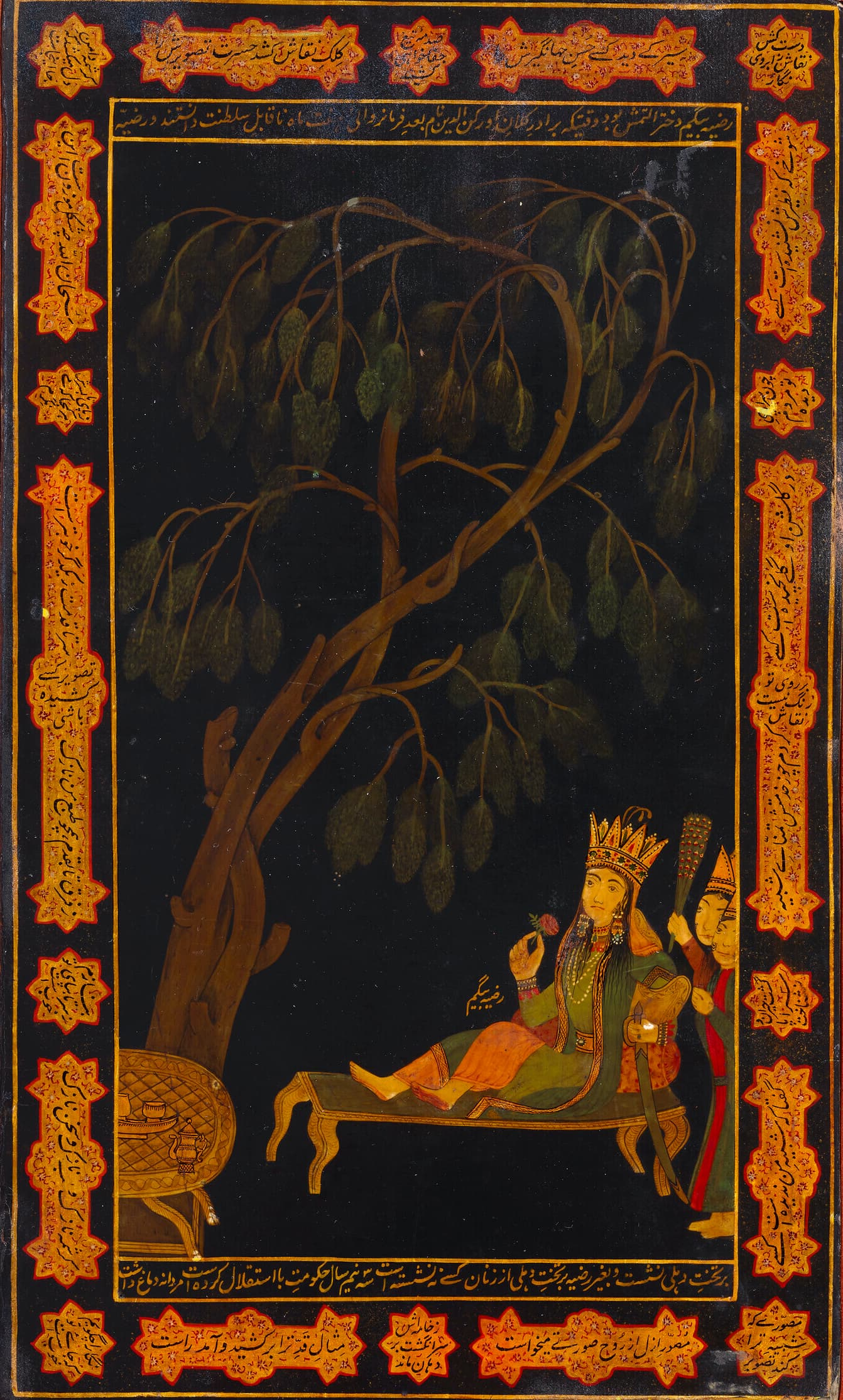
When Shamsuddin Iltutmish marched his armies out of Delhi in 1231, he bypassed his surviving sons and left his daughter, Raziyyat-Ud-Dunya Wa Ud-Din, in charge of the imperial capital.
On a Friday morning in November 1236, a woman dressed in the vibrant red robes of a seeker of justice appeared before the congregation gathered at the grand mosque of Delhi. Her name was Raziyyat-ud-Dunya wa-ud-Din, though she would be remembered simply as Razia. Her father, the formidable Mamluk Sultan Shamsuddin Iltutmish, had died months earlier, leaving a realm sliding rapidly into chaos. His designated successor, Razia's half-brother Ruknuddin Firuz, had proven inept, abandoning the treasury to pursue his pleasures while his ambitious mother, Shah Turkan, ruled from the shadows with a regime of executions and terror. Now, Shah Turkan’s assassins were closing in on Razia herself. Standing before the assembled citizens, Razia did not plead for her life; instead, she struck an extraordinary bargain with the public. She asked them to depose the ruinous regime and place her on the throne. If she failed to govern with justice and meet their expectations, she declared, they had every right to strip her of power and execute her.
The crowd, galvanized by her audacity, stormed the royal palace. They seized Shah Turkan, threw open the gates to the soldiers and nobles who pledged allegiance to the princess, and placed Razia upon the throne of Delhi. It was a political ascension without precedent. While the Muslim world had seen powerful women rule from behind screens or as regents, Razia became the sovereign in her own right—the first female Muslim ruler of the Indian subcontinent, and the only one who would ever govern from Delhi. Her rise was propelled not by the backroom intrigues of the palace guards, but by a popular uprising of the city’s common folk. When Ruknuddin rushed back to Delhi to reclaim his crown, Razia’s forces arrested him; his brief, chaotic seven-month reign was ended, and he was executed shortly thereafter.
Yet the crown Razia inherited was a poisoned chalice. The Delhi Sultanate was not a stable, hereditary monarchy but a volatile military state ruled by a powerful oligarchy of Turkic slave-officers—the mamluks—who viewed the empire as their collective property. To these elite commanders, a monarch was meant to be a convenient figurehead, a puppet to legitimize their own provincial fiefdoms. The prospect of a woman ruling with independent authority was an existential threat to their status, but their immediate opposition was political rather than purely theological. Within weeks of her coronation, a formidable coalition of Turkic governors, led by the imperial prime minister Nizamul Mulk Junaidi, marched on Delhi, establishing a siege-camp outside its walls.
Hemmed in by enemies, Razia displayed the tactical cunning that would define her brief reign. Rather than risking a direct military confrontation with the superior rebel forces, she led her army out to the banks of the Yamuna River and engaged in a war of nerves and whispers. She secretly sowed distrust among the rebel commanders, convincing two of the key governors, Malik Izzuddin Muhammad Salari and Malik Izzuddin Kabir Khan Ayaz, to defect to her side. Together, they plotted to arrest the remaining rebel leaders. When the conspiracy leaked, the rebel coalition dissolved in panic. Junaidi fled into the rugged Sirmaur hills, where he eventually died; another prominent rebel, Alauddin Jani, was hunted down and killed, his head brought back to Delhi as a grim warning to those who doubted the female Sultan's resolve.
+ 11 further connections to entries not yet ingested
With the rebellion crushed, Razia set about ruling with an assertiveness that stunned her contemporaries. She understood that to survive, she had to dismantle the monopoly of the Turkic nobility. She began elevating non-Turkic officers—the Taziks—to key administrative and military posts. Most controversially, she promoted Malik Jamaluddin Yaqut, an officer of Abyssinian origin, to the prestigious position of Amir-i Akhur, the Master of the Stables. The appointment of an African slave to a post traditionally reserved for high-ranking Turkic aristocrats was a calculated provocation. It signaled that merit and loyalty to the crown, not ethnic lineage, would govern her court.
At the same time, Razia shed the physical constraints of her gender. The contemporary historian Minhaj-i-Siraj recorded that while she had initially observed purdah—reigning from behind a screen guarded by female soldiers—she soon abandoned these concessions to modesty. She cast aside her veil, donned the traditional masculine garments of a sovereign: the heavy woolen cloak (qaba) and the conical hat (kulah). She rode into the dust and heat of Delhi's streets on the backs of war elephants, fully visible to her subjects. She stopped minting coins bearing her father's name, replacing them with currency that bore her own title: Sultan Jalalat al-Duniya wal-Din. To the modern ear, the term "Sultana" is often applied to her, but in the thirteenth century, that word denoted merely the wife of a king. Razia’s coins, inscriptions, and decrees claimed the absolute, masculine authority of the state: she was the Sultan.
For nearly four years, Razia held her fractured empire together through sheer force of will. She dispatched armies to assert Delhi’s authority over the hostile Chahamana rulers of Rajasthan, managed the threat of Shia dissidents who attempted to seize the central mosque of Delhi, and navigated the geopolitical shifts of Central Asia. When the governor of Ghazni sought a military alliance with Delhi against the terrifying advance of the Mongol Empire, Razia responded with cool diplomatic pragmatism. She welcomed his envoy with lavish gifts and pensioned him off with local revenues, but flatly refused to embroil her young empire in a disastrous war with the Mongols.
But the resentment among the Turkic military elite was mutating into an organized conspiracy. To the proud Turkic commanders, the sight of a woman riding astride an elephant in male garb, bypassing their authority to elevate an Abyssinian favorite, was an intolerable humiliation. Later chroniclers, writing generations after her death, would seize upon her close relationship with the Abyssinian Yaqut, spinning salacious tales of romantic intimacy to explain her downfall. Yet the contemporary records suggest a far more prosaic reality: the Turkic nobles used the pretext of moral outrage to mask a coordinated coup d’état.
The trap was sprung in the spring of 1240. The conspiracy was orchestrated by two of the most powerful men in the realm: Ikhtiyaruddin Aitigin, whom Razia had recalled to Delhi as her lord chamberlain, and Ikhtiyaruddin Altunia, her childhood companion whom she had appointed governor of the strategic fortress of Tabarhinda. In April of that year, Altunia launched a staged rebellion in the north. Unaware of the wider plot unfolding behind her, Razia marched her army out of Delhi to crush him. It was a fatal mistake. The moment she arrived at Tabarhinda, her loyal officers were arrested. Yaqut, her trusted Abyssinian general, was murdered by the conspirators. Razia was seized and imprisoned in the lonely, wind-swept fortress of Tabarhinda, while back in Delhi, the conspirators placed her half-brother, Muizuddin Bahram, on the throne.
Even in defeat, Razia refused to accept her deposition. Recognizing that her captor, Altunia, felt cheated by his fellow conspirators in Delhi—who had claimed the finest spoils of office for themselves—Razia turned her considerable charm and political intellect upon her jailer. She proposed an alliance. She married Altunia, uniting her remaining loyalists with his provincial army in a desperate bid to reclaim her crown.
In October 1240, the newlywed sovereigns marched toward Delhi at the head of a hastily assembled force. But the tide of history had turned. Near Kaithal, they were met by the imperial army of Delhi, commanded by her brother Bahram. Razia’s forces were decisively defeated. Left with few options, she and Altunia fled the battlefield, but their luck had run out. On October 15, 1240, exhausted and abandoned by their retreating troops, the couple was captured and killed by local highwaymen.
Razia’s reign lasted a mere three years, six months, and six days, but its impact reverberated through the centuries. In his great chronicle, Minhaj-i-Siraj lamented her demise with a passage that captured the tragic paradox of her existence. She was, he wrote, a great sovereign, endowed with all the admirable attributes of a monarch: sagacious, beneficent, a patron of the learned, a dispenser of justice, and a leader of armies. "But," the chronicler concluded with the chilling resignation of his era, "of what advantage were all these attributes to her, since she was not born of the gender of men?" Razia’s brief, brilliant tenure on the throne of Delhi stood as a dramatic, solitary defiance of the medieval political order—a moment when the trajectory of an empire was bent, if only briefly, by the sheer will of a woman who refused to be merely a spectator to power.