Person · 1303 BCE – 1213 BCE · Ancient Egypt
Ramesses II
- Also known as
- 2
- II Ramzes
- II. Ramses
- II. Ramszesz
- Nagy Ramszesz
- Ozymandias
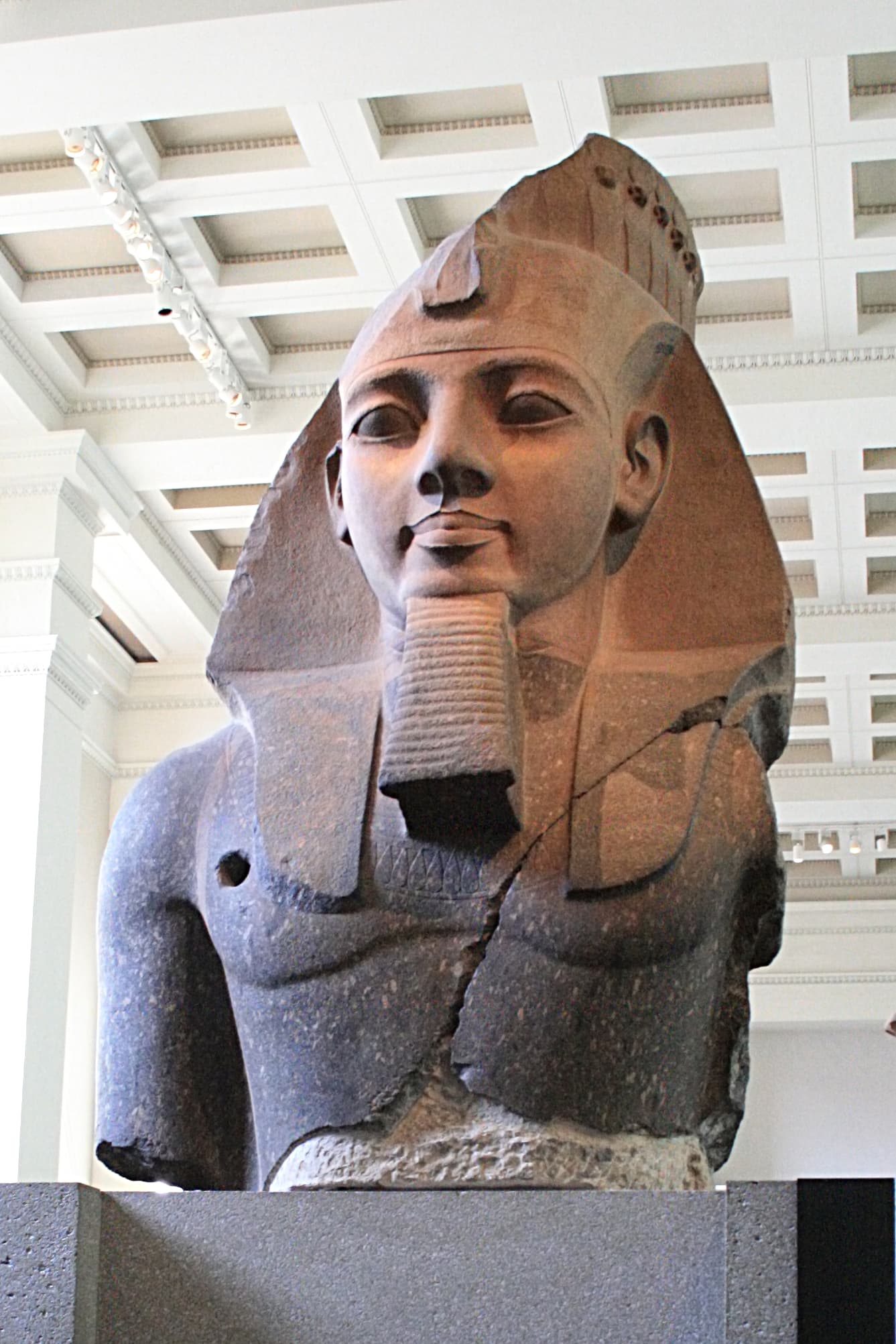
Greatness in ancient Egypt was measured by the sheer scale of one's shadow, and no pharaoh cast a longer one than Ramesses II.
In the late spring of 1274 BCE, near the dusty banks of the Orontes River in what is now Syria, the young Pharaoh Ramesses II sat in his golden chariot, staring down disaster. He was twenty-five years old, five years into a reign he intended to make immortal, yet his hubris had led him straight into a trap. Having marched his army through Canaan for an exact month, Ramesses had been deceived by false intelligence into believing the Hittite forces were leagues to the north. Instead, the Hittite king Muwatalli II was waiting just beyond the city walls of Kadesh. With terrifying suddenness, a mass of Hittite chariots smashed through the advancing Egyptian lines, scattering the pharaoh’s second division and swarming his royal camp. In that desperate hour, outmaneuvered and severely outnumbered, Ramesses did not flee. He rallied his personal bodyguard, charged repeatedly into the Hittite ranks, and held the ground until reinforcements arrived to turn a massacre into a bruising stalemate.
The Battle of Kadesh did not yield the grand territorial conquest Ramesses envisioned, but the narrative he constructed around it became the defining masterpiece of his long life. Returning to Egypt, he had the clash carved onto the walls of nearly every major temple, portraying himself as a solitary, god-like colossus who had single-handedly rescued his army from the brink of annihilation. It was a bravado that characterized his entire sixty-six-year reign. Ramesses II was not born to the ultimate crown; his grandfather, Ramesses I, had been a common military officer and vizier whom the childless pharaoh Horemheb designated as successor. When his father, Seti I, took the throne, the teenage Ramesses was made prince regent at around the age of fourteen, embarking on a lifelong quest to legitimize his dynasty’s grip on the Nile. By the time he died at ninety or ninety-one, having celebrated an unprecedented thirteen or fourteen royal Sed festivals to renew his divine strength, he had so thoroughly saturated the landscape of Egypt with his image, his name, and his monuments that for centuries of successor pharaohs, he was known simply as the "Great Ancestor."
To sustain a kingdom that could project such colossal authority, Ramesses relied on an army of some 100,000 men, a staggering force for the Late Bronze Age. His early campaigns were tactical and protective. In his second regnal year, he turned his attention to the Mediterranean coast, where Sherden sea pirates—likely hailing from Ionia, southwest Anatolia, or Sardinia—were prey-seeking raiders devastating Egyptian maritime trade. Ramesses deployed his fleet and troops along strategic coastal choke points, patiently luring the pirates into an ambush near the mouth of the Nile. The victory was complete. Rather than slaughtering the survivors, the pharaoh absorbed them, and soon these Sherden warriors, distinguished by their round shields, massive Naue II swords, and horned helmets with central spheres, served as the pharaoh’s personal bodyguards, standing beside him in his subsequent campaigns.
The stalemate at Kadesh had left Egypt’s northern frontier highly volatile, restricting its sphere of influence to Canaan while Syria fell to the Hittites. Sensing Egyptian vulnerability, Canaanite princes, encouraged by Hittite promises, began to revolt. Ramesses responded with relentless campaigning. In his seventh regnal year, he split his forces, sending his son Amun-her-khepeshef to chase Šhasu tribesmen across the Negev to the Dead Sea, while he personally captured Jerusalem and Jericho. Reunited in Moab, father and son marched on Damascus, reclaiming the region of Upi and restoring Egypt’s administrative grip. In his eighth and ninth years, Ramesses pushed even further north, besieging and capturing the city of Dapur, a feat of northern penetration not seen since the reign of Thutmose III more than a century earlier. Yet these northern victories were elusive; cities changed hands like sand in the wind, and by his tenth year, Ramesses had to march on Dapur yet again, boastfully claiming to have fought the battle for two hours before even putting on his corslet, accompanied by six of his youthful sons.
Realizing that neither empire could decisively crush the other, Ramesses eventually pivoted from endless war to pioneering diplomacy. In the twenty-first year of his reign, he concluded a formal peace treaty with the Hittites, establishing a stable frontier that allowed him to turn his formidable energies inward. He shifted the geopolitical gravity of Egypt by constructing a brand-new capital in the Nile Delta, Pi-Ramesses, which served as a bustling military base, a diplomatic hub, and a manufacturing powerhouse. In this industrial metropolis, state factories produced weapons, chariots, and shields on an astronomical scale—churning out an estimated thousand weapons a week and hundreds of chariots a fortnight to secure the empire's borders.
In tandem with his military architecture, Ramesses initiated a building campaign of unparalleled scale across Egypt and Nubia, constructing towering temples at Abu Simbel, Karnak, and his own mortuary temple, the Ramesseum. These were not merely acts of vanity; they were theological statements. Ramesses was one of the very few pharaohs to be actively worshipped as a living deity during his lifetime. By carving his name deeply into the stone of these monuments—often erasing the cartouches of his predecessors to insert his own—he ensured that his physical presence would merge permanently with the landscape of the Nile.
The pharaoh died on August 13, 1213 BCE, having outlived many of his contemporary rivals, wives, and older children. He was buried with immense solemnity in tomb KV7 in the Valley of the Kings, though his journey did not end there. As the New Kingdom eventually fractured and grave robbers plundered the royal tombs, priests of the Twenty-First Dynasty quietly moved his mummy to the safety of the Royal Cache at Deir el-Bahari, where it remained undisturbed for nearly three millennia until its rediscovery in 1881. Today, his physical remains lie on display in the National Museum of Egyptian Civilization in Cairo. Centuries after his death, Greek travelers would look upon the colossal, fallen ruins of the Ramesseum and transliterate his throne name, Usermaatre Setepenre, into a name that would echo through Western literature as a symbol of the inevitable decay of empire: Ozymandias. Yet, while the stone monuments of lesser kings crumbled entirely into dust, the legacy of Ramesses II survived precisely as he intended—not as a historical footnote, but as the enduring archetype of pharaonic majesty itself.
Connected to
12 links to entries not yet ingested in the Library.