Person · 1861 CE – 1941 CE · World Wars Era
Rabindranath Tagore
- Also known as
- Bhanu Singha Thakur
- Bishwakabi
- Bishwakabi
- Biswakabi
- Daiqgwzwj
- Gurudev
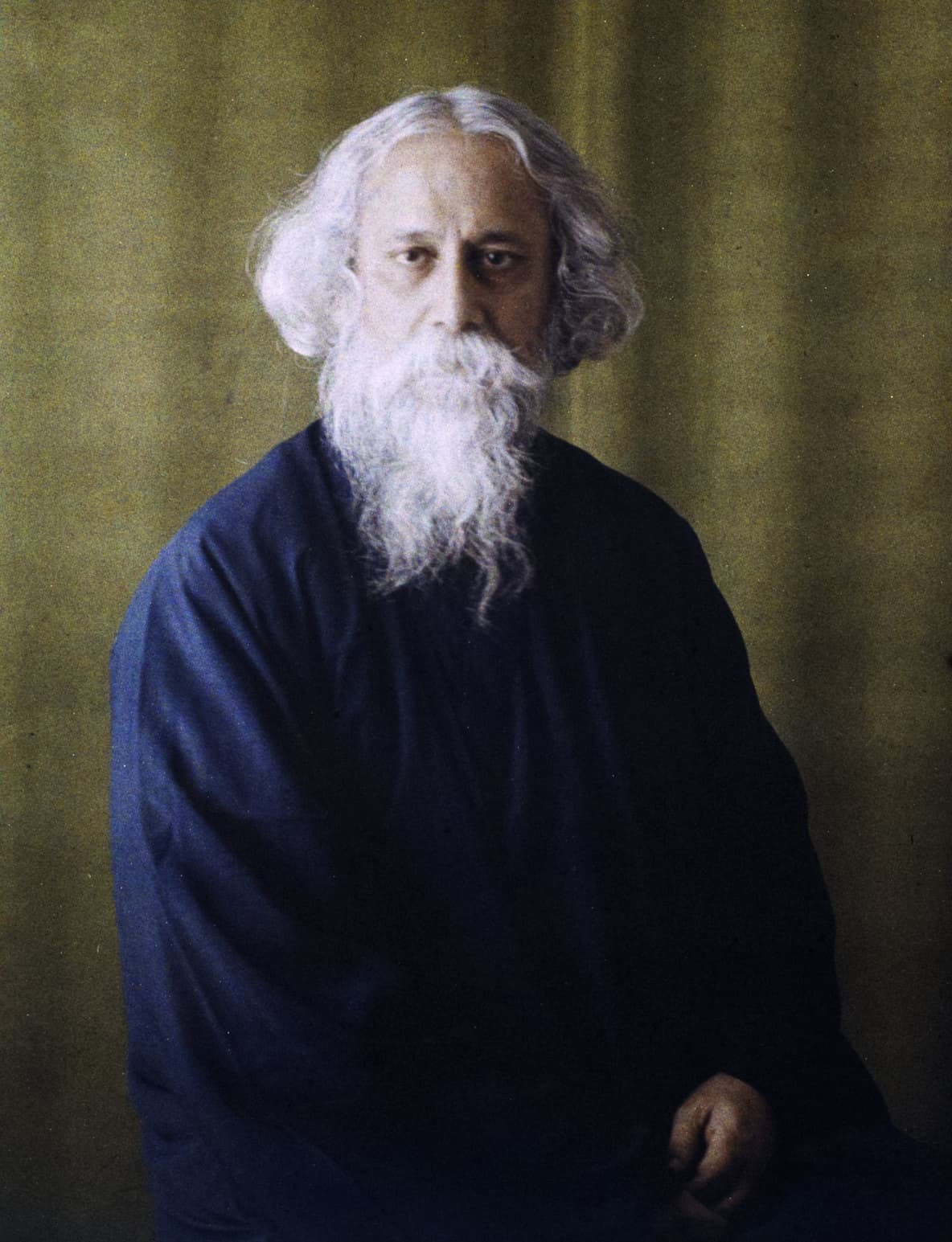
At only sixteen years old, a young Bengali Brahmin from Calcutta published a collection of poems under the pseudonym Bhanusimha, meaning Sun Lion.
In 1877, the literary salons of Bengal were electrified by the sudden appearance of a manuscript attributed to Bhānusiṃha, a newly discovered seventeenth-century Vaishnava poet. Written in the Maithili style of the medieval master Vidyapati, the verses possessed a lyrical grace and devotional depth that immediately convinced the region’s foremost critics they were looking at a long-lost classic. The true author of this historic recovery was a sixteen-year-old boy named Rabindranath Tagore, who had penned the poems as a clever literary prank. The pseudonym he chose, Bhānusiṃha, translated simply to "Sun Lion"—a play on his own name, Rabindranath, which means "Lord of the Sun." This early episode of mimicry and masterful invention did more than show a teenager’s precocious wit; it marked the emergence of a figure who would systematically dismantle, rebuild, and modernize the entire architecture of Bengali literature, music, and art.
Tagore was born on May 7, 1861, in the sprawling Jorasanko mansion in Calcutta, the youngest of thirteen surviving children of Debendranath Tagore and Sarada Devi. His family stood at the absolute vanguard of the Bengal Renaissance, a nineteenth-century cultural flowering that sought to reconcile classical Indian traditions with the modern world. The Jorasanko estate was a hive of artistic and intellectual ambition, where literary magazines were edited, Western and Indian classical music echoed through the halls, and original plays were staged in the courtyard. Tagore’s eldest brother, Dwijendranath, was a poet and philosopher; another brother, Satyendranath, broke imperial racial barriers to become the first Indian appointed to the elite Indian Civil Service; his sister Swarnakumari was a pioneering novelist. Tagore’s mother died during his early childhood, and his father, a spiritual reformer of the Brahmo Samaj, was often away on long journeys. Left largely to the care of servants and older siblings, young "Rabi" developed a deep-seated aversion to the rigid discipline of formal schooling. His academic career at the local Presidency College lasted exactly one day. He believed that traditional classrooms stifled the spirit, arguing in his later years that true education should never merely explain, but must instead stoke curiosity.
To compensate for his truancy, his brother Hemendranath took charge of his physical and intellectual development. Tagore’s daily regimen was rigorous: swimming the Ganges, trekking through hills, practicing gymnastics, judo, and wrestling, alongside private tutoring in anatomy, mathematics, history, Sanskrit, and English. A turning point came at age eleven, following his upanayan (coming-of-age) ceremony, when his father took him on a months-long journey across the subcontinent. They traveled to the family’s estate in Shantiniketan and onward to the Himalayan hill station of Dalhousie. Along the way, during a month-long stay in Amritsar, the young Tagore sat morning after morning inside the Golden Temple, listening to the continuous chanting of gurbani and Nanak bani echoing over the water. This early encounter with Sikh devotional music left a lasting imprint, inspiring him to write six poems on Sikh history and numerous articles for children's magazines about figures like Guru Gobind Singh and Banda Bahadur. By the time he returned to Calcutta, his intellectual universe had expanded far beyond the borders of Bengal.
In 1878, his father dispatched him to England to study law at University College London, hoping he would qualify for the bar. Tagore instead abandoned his lectures to study Shakespeare’s plays and the prose of Thomas Browne on his own, while developing a keen appreciation for English, Irish, and Scottish folk melodies. He returned to Bengal in 1880 without a degree, but with a growing desire to synthesize European artistic freedoms with the rich heritage of his homeland. Shortly after his return, in 1883, he married ten-year-old Mrinalini Devi, a union common for the era, which produced five children. The decade that followed took Tagore away from the intellectual salons of Calcutta and into the rural heart of Bengal, where his father sent him to manage the vast ancestral estates in Shilaidaha, in what is now Bangladesh.
This period in Shilaidaha, known as his Sadhana phase, was the most transformative of his life. Living on the Padma, a luxurious family house-boat that drifted along the river, Tagore came into intimate contact with the daily lives of the peasantry. As he collected token rents and interacted with local villagers, he was struck by the "voluptuous poverty" of the countryside, a theme that would animate the eighty-four stories of his collection Galpaguchchha. Here, on the river, he also encountered the Bauls—a group of wandering mystic minstrels whose radical humanism and ecstatic music deeply moved him. He became a champion of the songs of Lalon Shah, integrating their folk-hewn simplicity into his own compositions. Tagore began writing in a highly colloquial, naturalistic Bengali, spurning the archaic, Sanskritized registers of his predecessors.
By 1901, Tagore had moved his family to Shantiniketan, a rural property in West Bengal, to realize a radical educational vision. He founded an ashram centered on an experimental school where children studied outdoors under groves of trees, a library, and a marble-floored prayer hall called the Mandir. This period of intense institutional building was shadowed by immense personal tragedy. Within a few short years, his wife Mrinalini, two of his children, and his father all died. Coping with grief, Tagore poured his spiritual longing into a series of poems that would eventually become the collection Gitanjali (Song Offerings).
In 1912, during a voyage to London, Tagore translated some of these poems into English free verse. When he shared them with literary figures like William Butler Yeats and Ezra Pound, the impact was immediate. The India Society published a small run, and in November 1913, Tagore was awarded the Nobel Prize in Literature—becoming the first non-European and the first Asian to win a Nobel Prize in any category. The Swedish Academy praised the "profoundly sensitive, fresh and beautiful" quality of his poetry, which brought a message of spiritual peace to a Western world on the brink of industrial warfare.
This global recognition thrust Tagore into the role of an international sage, a position he used to critique the rising tide of nationalism that eventually triggered the First World War. Though he deeply loved his country and composed the songs that would become the national anthems of both India ("Jana Gana Mana") and Bangladesh ("Amar Sonar Bangla"), Tagore was a committed universalist. He denounced the British Raj and advocated for Indian independence, yet he feared that narrow, aggressive nationalism would replicate the worst errors of Western imperialism. His political stance was tested in 1919 following the Jallianwala Bagh massacre, where British troops fired on an unarmed crowd in Amritsar. In a blistering letter to the Viceroy, Lord Chelmsford, Tagore renounced the knighthood King George V had bestowed upon him four years earlier, declaring that "badges of honour make our shame glaring in their incongruous context of humiliation."
In his later years, Tagore continued to build his educational sanctuary, founding Visva-Bharati University in 1921 to foster a dialogue between East and West, and partnering with the agricultural economist Leonard Elmhirst to launch the Institute for Rural Reconstruction in the nearby village of Surul. He wrote essays, painted hundreds of expressionistic canvases, and composed over two thousand songs—a genre now known as Rabindra Sangeet—which remain central to the daily life and emotional vocabulary of Bengal.
When Tagore died on August 7, 1941, in the Jorasanko mansion where he had been born eighty years earlier, India was still under colonial rule, and the world was once again engulfed in global war. He did not live to see the formal independence of the subcontinent, yet his lifework had already laid the cultural foundations for it. By liberating the Bengali language from its classical shackles and asserting the intellectual equality of Asian thought on the global stage, Tagore did not merely participate in the Bengal Renaissance; he came to embody it. His legacy endures not only in the institutions he founded or the anthems sung by millions, but in his insistence that the true measure of a civilization lies in its capacity for universal sympathy and creative freedom.
Connected to
- religionHinduism
+ 12 further connections to entries not yet ingested