Organization · Islamic Caliphates
Quraysh
- Also known as
- B. Quraysh
- Bani Quraisy
- Bansa Quraisy
- Banu Quraish
- Banu Quraish
- Banu Quraysh
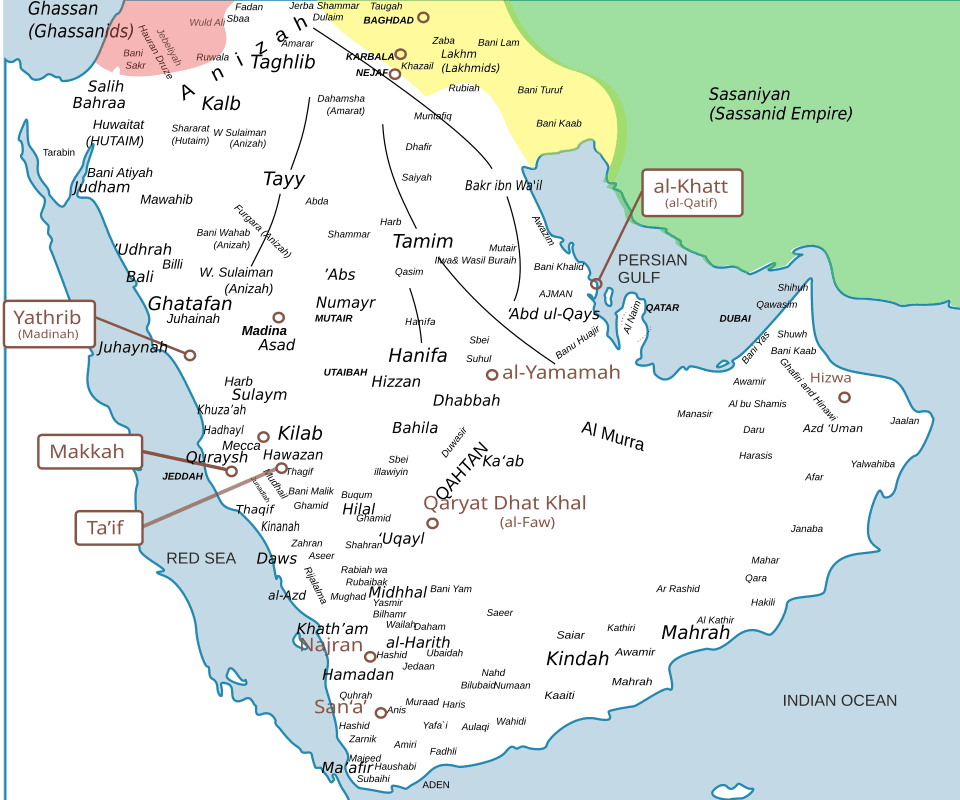
Long before they became the bitterest adversaries and then the ultimate custodians of Islam, the Quraysh made their fortune on the shifting sands of the Arabian Peninsula.
There is a term in classical Arabic, taqarrush, which denotes a coming together, a drawing in of scattered things, a gathering. Long before they were the custodians of the holiest sanctuary in Arabia, the people who would become the Quraysh were precisely this: a fragmented diaspora of nomadic clans, drifting along the margins of the western desert, living in the shadow of their larger Kinana relatives. They were a people of the outer wastes, possessing neither a city nor a common name. According to genealogical tradition, they traced their lineage back to Fihr ibn Malik, a descendant of the northern Ishmaelite patriarch Adnan, who had once defended the ancient sanctuary of Mecca against South Arabian invaders. Yet for generations, Fihr’s descendants remained fractured, watching from the dry hills as other tribes—most notably the Yemeni Khuza’a—held the keys to the Kaaba, the great cube-shaped shrine that sat in the valley of Mecca, already a magnet for pilgrims from across the peninsula.
The transformation of these wanderers into the architects of an empire began in the fifth or sixth century with Qusayy ibn Kilab. A figure of singular ambition, Qusayy did not merely claim his ancestry; he mobilized it. He rallied the scattered offspring of Fihr, seized control of the Kaaba from the Khuza’a, and brought his people into the Meccan hollow. For the first time, they were called the Quraysh—either from taqarrush, commemorating their unification, or, as some philologists suggested, from qirsh, the shark, the dominant beast of the deep. Qusayy portioned out the scarce real estate of the valley, settling his closest kin immediately around the sanctuary, a group that became known as the Quraysh al-Bītah, the "Quraysh of the Hollow." Those of more distant lineage were settled on the arid periphery, designated as the Quraysh al-Zawahir, the "Quraysh of the Outskirts."
At its inception, this Meccan settlement was not the glittering commercial hub of Islamic lore, but a austere sanctuary town. The early Quraysh were not yet merchants; they were priests, guardians, and hosts. Qusayy structured the town’s entire existence around the seasonal rhythms of the pilgrimage. He established municipal offices that were essentially liturgical duties: the keeping of the sanctuary keys, the custody of the war banner, and the rifada and siqaya—the solemn responsibilities of providing food and fresh water to the dusty pilgrims who arrived to circle the Kaaba. These early Quraysh lived off the taxes levied on visitors and the prestige of their sacred custody. Yet the seeds of their later commercial genius were sown in this early religious monopoly. They learned to manage crowds, to ration resources in a waterless wilderness, and to mediate disputes among fiercely independent desert tribes who observed a sacred truce during the pilgrimage months.
When Qusayy died, the fragile unity of the tribe threatened to dissolve. The classic tribal disease of succession rivalry split his descendants into two bitter factions. On one side stood the al-Ahlaf, the Confederates, who backed Qusayy’s eldest son, Abd al-Dar, the designated keeper of the keys. On the other were the al-Mutayyabun, the Perfumed Ones—so named because they dipped their hands in a bowl of scented oil to seal their pact—who championed the younger, more charismatic Abd Manaf. Though open warfare was averted, this internal division permanently shaped Meccan politics, carving the tribe into competing networks of clans that would spend the next century vying for wealth, prestige, and influence.
It was during the late sixth century that the Quraysh engineered the economic revolution that redefined western Arabia. The catalyst was a brutal conflict known as the Fijar War, fought during the holy season when bloodshed was traditionally forbidden. Sparked by the murder of a caravan escort, the war pitted the Quraysh and their Kinana allies against a confederation of Qaysi tribes. Though the Quraysh suffered early defeats, they ultimately triumphed, securing undisputed control over the trade routes running through the Najd. They extended their influence north to Ta'if, a cooler, fertile mountain town where wealthy Meccans began purchasing estates.
With the trade routes secured, the Quraysh transformed themselves from local shrine-keepers into international financiers. They established a highly sophisticated caravan system that beat a steady, seasonal rhythm across the Near East. In the winter, their caravans traveled south to the monsoonal ports of Yemen, collecting spices, perfumes, and textiles from the Indian Ocean and East Africa. In the summer, they headed north to the markets of Gaza, Damascus, and Bosra, trading these luxury goods to the Byzantine Romans.
To protect these massive investments, the Quraysh did not rely on military might alone, but on a complex web of diplomatic and financial alliances. They negotiated treaties with the Roman governors of Syria and the nomadic Bedouin tribes who controlled the desert corridors, offering them a share of the profits in exchange for safe passage. Back in Mecca, clans like the Banu Umayya and the Banu Makhzum accumulated staggering fortunes. They were no longer merely buying and selling; they were organizing capital, managing credit, and coordinating labor. A new class of sophisticated, urban managers emerged in the middle of the Arabian desert—men who possessed a rare genius for organization and a deep cynicism toward anything that threatened the bottom line.
This hyper-capitalist environment, however, created severe internal strains. The ancient tribal ethos, which demanded that the strong protect the weak and share their wealth, was increasingly discarded in favor of individual profit. When a visiting Yemeni merchant was robbed of his goods by a prominent Meccan, several clans, including the Banu Hashim—the descendants of Abd Manaf who held the rights to the pilgrimage services—reformed the Hilf al-Fudul, a covenant dedicated to protecting the defenseless against the predatory excesses of the newly rich clans like the Banu Umayya.
It was into this atmosphere of extreme wealth, social stratification, and spiritual malaise that Muhammad ibn Abdullah of the Banu Hashim began to preach in the early seventh century. Initially, the ruling elite of the Quraysh paid little attention to the orphan-turned-merchant who claimed to receive revelations from the one true God. But as Muhammad’s message grew more radical, directly attacking the polytheism that underpinned both the sanctity of the Kaaba and the lucrative pilgrimage trade, indifference turned to hostility. To the merchant barons of the Banu Umayya and Banu Makhzum, Islam was not merely a theological heresy; it was an economic threat.
The subsequent decade of persecution forced the early Muslim community to flee Mecca, culminating in the Hijrah of 622 CE, when Muhammad and his followers migrated north to the oasis of Medina. What began as a local religious dispute quickly escalated into a protracted, devastating war between Medina and Mecca. Muhammad, recognizing that the lifeblood of the Quraysh was their commerce, launched a series of daring raids on their northern caravans. The Quraysh responded with military force, leading to the seminal battles of Badr, Uhud, and the siege of Medina known as the Battle of the Trench.
Yet even in war, the pragmatism of the Quraysh eventually reasserted itself. Recognizing that the conflict was exhausting their resources and disrupting the trade routes, the Meccan leadership, spearheaded by the pragmatic Abu Sufyan of the Banu Umayya, opted for diplomacy. In March 628 CE, they signed the Treaty of al-Hudaybiya, agreeing to a ten-year truce. It was a masterstroke of political realism. The treaty allowed Muhammad to perform the pilgrimage the following year, during which he reconciled with his own clan, marrying Maymuna bint al-Harith. Brilliant Meccan military commanders like Khalid ibn al-Walid and Amr ibn al-As, sensing the shifting geopolitical winds, converted to Islam, bringing their peerless strategic talents to the young Muslim state.
The end came not with a bloody conquest, but with an almost quiet capitulation. When a client clan of the Quraysh violated the truce, Muhammad marched on Mecca with an army of ten thousand men. Recognizing the futility of resistance, Abu Sufyan met Muhammad outside the city walls to secure amnesty. In 630 CE, the Muslim army entered Mecca virtually unopposed. The idols within the Kaaba were smashed, but the people of Mecca were spared. In a final act of taqarrush, the old Qurayshi elite did not perish; they simply integrated. They converted to the new faith and immediately assumed its leadership.
Though Muhammad’s death in 632 CE plunged Arabia into uncertainty, the structural and administrative legacy of the Quraysh endured. For the next several centuries, the leadership of the rapidly expanding Islamic empire remained an exclusive franchise of the tribe. The four Rightly Guided Caliphs, the grand dynastic empires of the Umayyads and the Abbasids, and even the rival Fatimids of North Africa all claimed descent from the branches of the Quraysh. The tribal association that had once huddled in the dry hollow of Mecca had redefined the borders of the known world, proving that the managerial discipline, diplomatic tact, and organizational genius forged in the desert trade routes could govern an empire stretching from the Atlantic to the borders of China.
Connected to
5 links to entries not yet ingested in the Library.