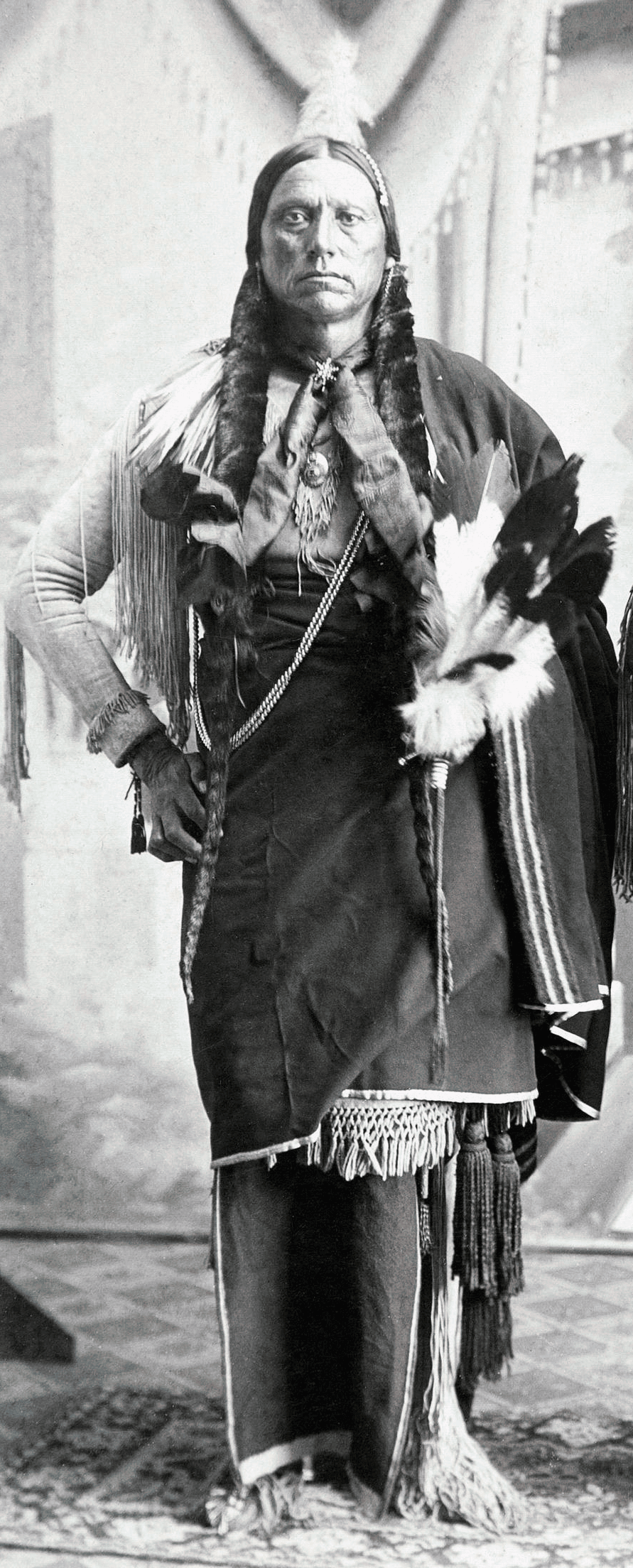
The bloodlines of the southern plains met in Quanah Parker, a man born around 1850 to a Kwahadi Comanche chief and an Anglo-American woman captured as a child and fully assimilated into the tribe.
In March 1871, a woman named Cynthia Ann Parker died of voluntary starvation in Texas. To the white settlers of the frontier, she was a tragic symbol of pioneer vulnerability—abducted as a nine-year-old child during the 1836 Fort Parker massacre, she had spent twenty-four years assimilated into the Nokoni band of the Comanche Nation before Texas Rangers captured her and dragged her back to her biological family against her will. To her eldest son, she was Nadua, the wife of the Kwahadi warrior chief Peta Nocona. When she was torn from her adopted people, she left behind a teenage son who carried her memory in his very name. In the Comanche language, kwana means "an odor" or "a smell." While it was customary for Plains warriors to discard childhood names for more masculine, active titles upon reaching maturity, the young man chose to remain Quanah. He bound himself permanently to the mother he had lost, carrying her name into the final, desperate campaigns of the Comanche wars and, eventually, into the halls of American power.
Quanah Parker’s lineage was a map of the shifting, violent borders of the southern plains. His paternal grandfather was Iron Jacket, a Kwahadi chief who rode into battle wearing a Spanish coat of mail, appearing invulnerable to his enemies until he was killed in action. Raised among the Kwahadis—the "Antelope" band, known as the most remote and uncompromising of the Comanche groups—Quanah grew up during the twilight of Comancheria’s hegemony. By the early 1870s, the world of the southern plains was collapsing. The U.S. Army, led by Colonel Ranald S. Mackenzie, was pursuing a relentless strategy of containment, while Anglo-American commercial hunters systematically slaughtered the American bison, the absolute foundation of Comanche life, toward extinction.
The crisis culminated in May 1874, when a Comanche medicine man named Isatai’i summoned the various bands of the nation to a Sun Dance along the Red River. Though the Sun Dance was traditionally a Kiowa ritual and alien to Comanche culture, the desperation of the era drew the bands together. Isatai’i claimed he possessed medicine that would render warriors invulnerable to white men's bullets. Seeking to avenge fallen kinsmen and halt the destruction of their hunting grounds, Quanah Parker joined other prominent chiefs, including Isa-Rosa and Tabananika, in organizing a massive war party. Their target was not the U.S. Cavalry, but rather the commercial heart of the ecological destruction: the buffalo hide merchants stationed at Adobe Walls, a trading post in the Texas Panhandle.
On June 27, 1874, a force of approximately 250 Comanche and Cheyenne warriors swept down into the valley, expecting an easy victory over unsuspecting merchants. But the raid was compromised before it began; a local saloonkeeper, warned of a potential attack, had kept his patrons awake and drinking through the night. When the warriors struck at four in the morning, they met a garrison of sober, well-armed men barricaded behind two-foot-thick sod walls. The raiders’ courage and Isatai’i's spiritual promises shattered against the long-range, large-caliber Sharps rifles of the hide hunters. Quanah was wounded when a bullet ricocheted off a powder horn around his neck and lodged near his shoulder blade. Forced to seek cover behind a rotting buffalo carcass after his horse was shot from under him, he was eventually rescued and brought out of range.
11 links to entries not yet ingested in the Library.
The failure at Adobe Walls was more than a tactical defeat; it triggered a massive military response from Washington. The ensuing Red River War saw Colonel Mackenzie systematically hunt down the remaining free bands. The decisive blow fell on September 28, 1874, at the Battle of Palo Duro Canyon, where Mackenzie’s forces razed a major Comanche winter camp and slaughtered nearly 1,500 horses—destroying the tribe's wealth, mobility, and capacity to wage war. By the spring of 1875, starvation and winter had achieved what bullets could not. In late May, Quanah Parker led the Kwahadi band into Fort Sill in the Indian Territory. The surrender marked the end of the nomadic Comanche lifestyle and the beginning of a profound transition.
Once on the reservation, the federal government bypassed traditional tribal structures. Quanah had never been elected principal chief by his people—the Comanche nation had historically functioned as a loose confederation of independent bands rather than a centralized state—but the U.S. authorities appointed him as the principal chief of the entire nation to simplify administration. It was a role that required an extraordinary act of reinvention. The warrior who had spent his youth raiding Texas settlements became an astute political and economic diplomat, navigating the very system that had conquered his people.
Quanah recognized that the survival of the Comanche now depended on adaptability. Though he initially opposed the opening of tribal lands to Anglo-American ranchers, he soon observed the shifting tides of the Western economy. He forged powerful alliances with prominent Texas cattlemen, most notably Samuel Burk Burnett and Charles Goodnight. By 1880, Quanah was actively building his own herds, and by 1884, his negotiations secured the first "grass" payments for the Comanche, Kiowa, and Apache tribes, leasing nearly one million acres of reservation grassland to Texas cattle barons who needed pasture during severe droughts. Burnett, whom the Comanches called Mas-sa-suta ("Big Boss"), became a lifelong friend, sharing a mutual respect that was eventually symbolized by the Parker family presenting the Burnett family with Quanah’s own war lance.
With the wealth accumulated from ranching and leasing, Quanah constructed a large, two-story residence near Cache, Oklahoma, known as the Star House. He became an influential national figure, traveling to Washington, D.C., as an emissary for Native American rights, and even riding in the inaugural parade of President Theodore Roosevelt, with whom he went on hunting trips. In 1902, he was elected deputy sheriff of Lawton, Oklahoma, serving as a pillar of the local establishment.
Yet, Quanah’s adaptation was never an outright assimilation. He fiercely defended his cultural autonomy and that of his people. He flatly rejected Protestant Christian monogamy, maintaining a polygamous household. While he encouraged the Christianization and education of the Comanche people to help them navigate the white man's world, he personally championed a syncretic spiritual alternative: the Native American Church. He became a leading practitioner and advocate of peyote ceremonies, traveling extensively to defend the legal and religious use of the sacred plant against federal prohibition efforts. Through this movement, he helped preserve a distinct, pan-Indian spiritual identity during a period of intense forced Americanization.
Quanah Parker died on February 23, 1911, and was buried at Chief’s Knoll on the grounds of Fort Sill. Following his death, the United States government and the Comanche nation retired the title of "Chief," replacing it with the bureaucratic designation of "chairman." In this way, Quanah is remembered as the "Last Chief of the Comanche." His legacy remains etched across the geography of the southern plains, where cities, schools, and highways bear his name. Far more than a relic of a vanished frontier, he remains a study in the complex art of survival—a leader who preserved the core of his people's identity by mastering the language and institutions of the society that had sought to destroy them.