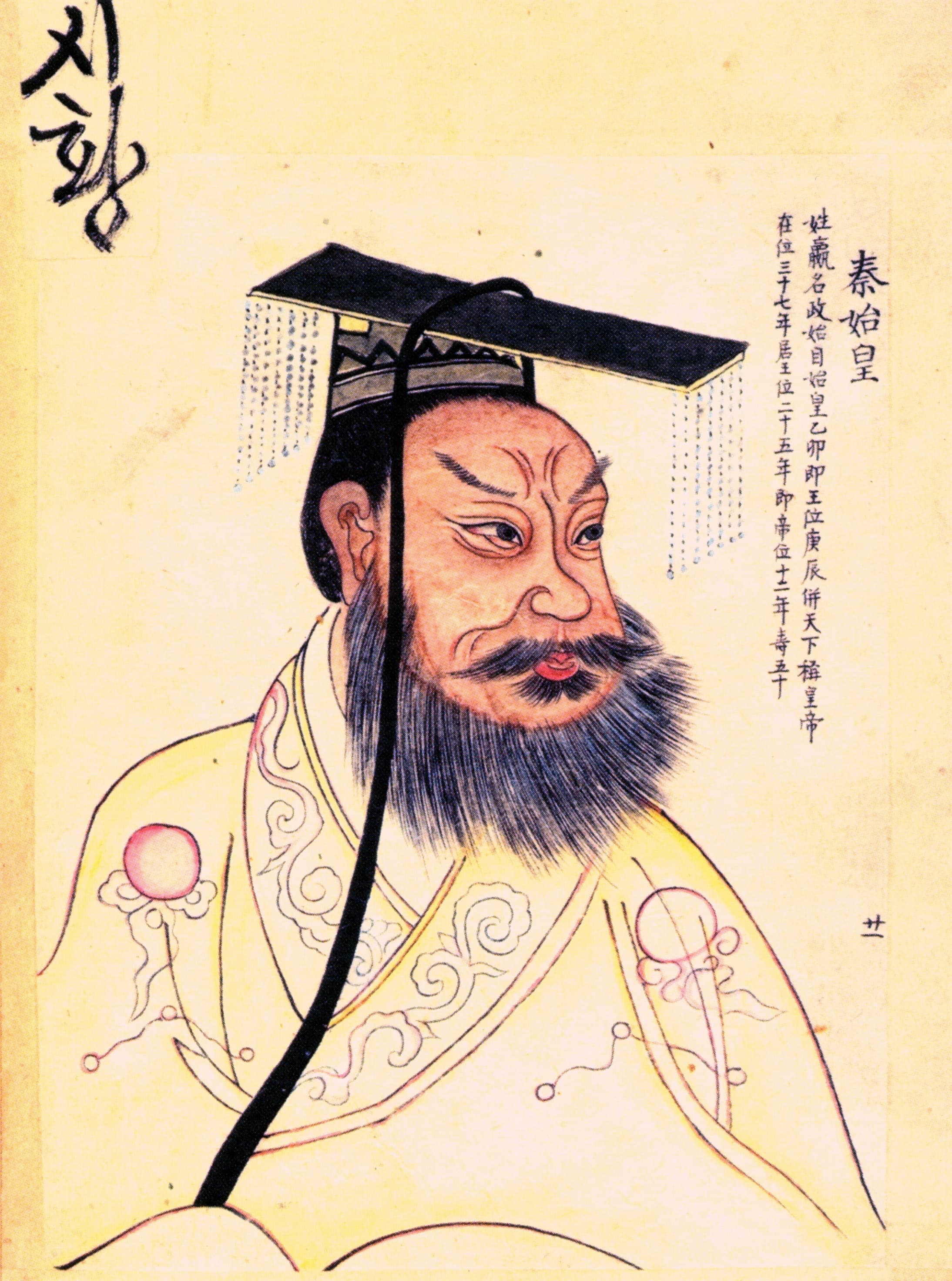
In the third century BCE, a single ruler dismantled the fragmented world of the Warring States to forge a unified empire, discarding the traditional title of king to fashion himself as Huangdi—the first emperor of China.
To understand the man who ended China’s classical age and forged its imperial future, one must begin not with his grand palaces or his terracotta legions, but with a panic-stricken young king scrambling around a pillar, unable to unsheathe his own sword. The year was 227 BCE. Ying Zheng, the twenty-two-year-old ruler of the western state of Qin, sat on his throne when an envoy from the rival state of Yan approached him. The envoy’s assistant trembled with a fear so conspicuous it drew remarks, but the envoy himself, a man named Jing Ke, remained calm. He carried two diplomatic offerings: the severed head of a Qin defector and a map of the fertile Dukang region, which Yan proposed to cede. As Jing Ke unrolled the map before the king, the parchment gave way to a hidden dagger.
What followed was a dark comedy of court protocol and existential terror. By Qin law, no courtier in the audience hall was permitted to carry a weapon, and the royal guards stationed below could not ascend without a direct imperial command. As Jing Ke lunged, Ying Zheng leaped back, his ceremonial sword so long and his panic so great that the weapon jammed in its scabbard. He fled around the chamber’s massive pillars, pursued by the dagger-wielding assassin, while his unarmed ministers could do nothing but scream advice: “Put the sword on your back, Your Majesty! Put the sword on your back!” Slinging the scabbard behind him, Ying Zheng finally drew the blade, struck down his assailant, and survived. It was neither the first nor the last time his life would hang on a thread of absolute, violent isolation.
Ying Zheng was born in 259 BCE in Handan, the capital of the rival state of Zhao, under a cloud of political hostage-taking and whispered illegitimacy. His father, Prince Yiren of Qin, was living as a diplomatic hostage to guarantee a fragile truce when he fell in love with a concubine belonging to Lü Buwei, an extraordinarily wealthy merchant from Wey. The merchant surrendered the woman, who became Lady Zhao, and she gave birth to the future emperor in the first month of the lunar calendar, prompting his name, Zheng. History, written largely by the scholars of the subsequent Han dynasty who detested him, long preserved a scandalous rumor: that Lady Zhao was already pregnant by the merchant Lü Buwei when she married the prince, making the builder of the Chinese empire the bastard son of a low-born trader. While modern scholarship widely dismisses this as a later Confucian fabrication designed to slander a ruler who despised their class, the rumor added a layer of psychological hostility to a childhood already spent in the shadow of war.
When Ying Zheng’s father died in 246 BCE after a brief three-year reign, the thirteen-year-old boy inherited the throne of Qin, though the real levers of state remained in the hands of Lü Buwei, who served as regent. This tutelage was marked by domestic intrigue of the highest order. As the young king grew older, Lü Buwei feared the youth would discover his ongoing liaison with the Queen Dowager. In a bizarre move of self-preservation, the regent introduced the Queen to Lao Ai, a man disguised as a eunuch by having his beard plucked. The ruse succeeded too well. Lao Ai and the Queen secretly fathered two sons, and the counterfeit eunuch grew wealthy and arrogant. In 238 BCE, while the king was away at the ancient capital of Yong, Lao Ai forged the Queen Mother’s seal, raised an army, and attempted a coup d’état.
12 links to entries not yet ingested in the Library.
The young king’s response was swift and merciless. His loyal forces crushed the rebellion, placing a bounty of one million copper coins on Lao Ai’s head. When captured, the pretender was tied to five horse-drawn carriages and torn to pieces. His entire family to the third degree was executed; the two hidden half-brothers were murdered; and the Queen Dowager was placed under permanent house arrest. Lü Buwei, implicated in the disaster, was banished and eventually drank a cup of poisoned wine in 235 BCE to preempt a more agonizing death. At twenty-four, Ying Zheng had cleared his court of regents, pretenders, and family rivals, including his legitimate half-brother Chengjiao, who had earlier rebelled and surrendered to Zhao, leaving his retainers to be executed. The king stood alone, assisted now by a brilliant, ruthless new chancellor named Li Si.
With his domestic house in order, Ying Zheng turned the military machine of Qin toward its neighbors. For centuries, the Warring States period had carved China into competing kingdoms. Qin, located in the mountainous west, had long been regarded by the eastern states as a semi-barbaric march, but it possessed a highly disciplined society organized around Legalism—a philosophy that rejected moralizing Confucian ideals in favor of total state control, strict laws, and agricultural and military efficiency. One by one, the rival states fell before Qin’s relentless armies. Between 230 and 221 BCE, Han, Zhao, Yan, Wei, Chu, and Qi were systematically conquered, their ruling houses extinguished, and their lands annexed.
When the last state, Qi, surrendered in 221 BCE, Ying Zheng achieved what no ruler before him had done: he unified the fractured lands of the old Zhou dynasty into a single, cohesive realm. To match this unprecedented achievement, he rejected the traditional title of wang (king). Working with Li Si, he coined a new title: Huangdi. Combining huang (the shining or splendid epithet of Heaven used by the mythical Three Sovereigns) and di (the high god of the Shang dynasty used by the legendary Five Emperors, notably the Yellow Emperor), he became Qin Shi Huang—the First Emperor of Qin. He decreed that his successors would be named the Second Emperor, the Third Emperor, and so on, down through ten thousand generations. He took the first-person pronoun Zhen for his exclusive imperial use and declared his presence so sacred that he was to be addressed in person only as "Your Majesty" and in writing as "Your Highness."
Having conquered the known world, the First Emperor set about standardizing it. Together with Li Si, he dismantled the feudal system that had fractured China for half a millennium, replacing it with a centralized administrative structure of commanderies and counties ruled by appointed bureaucrats rather than hereditary lords. To prevent future rebellions, he ordered the private weapons of the empire confiscated, melted down, and cast into twelve colossal bronze statues. He unified the currency into circular copper coins with square holes and standardized weights, measures, and even the axle width of carts so they could travel smoothly along his newly constructed national road system. Most profoundly, he standardized the written Chinese script, bridging the linguistic divides of his vast territories with a uniform written tongue that remains the foundation of Chinese literacy to this day.
To defend this fragile new unity from the nomadic Xiongnu of the north, the emperor dispatched his general Meng Tian to conquer the Ordos Plateau and directed the connection of existing regional fortifications into a precursor of the Great Wall. To the south, his generals pushed deep into the Yue lands of Hunan and Guangdong, permanently drawing these southern regions into the Chinese cultural sphere. Yet these monumental public works came at a crushing human cost. Millions were conscripted to build his roads, his wall, and his gargantuan city-sized mausoleum.
This relentless drive for uniformity eventually sparked intellectual resistance. In traditional histories, Qin Shi Huang is notorious for the "burning of books and burying of scholars," an episode where he allegedly ordered the destruction of philosophical and historical texts that did not conform to Legalist doctrine and executed scholars who criticized his regime. While modern historians debate the scale and exact nature of these purges, the memory of them cemented his reputation as a ruthless tyrant among later generations of Confucian historians.
As the emperor aged, he became obsessed with his own mortality. He began to refer to himself as Zhenren ("The Immortal") and embarked on five grand tours of his eastern empire, searching for the mythical islands of the eastern sea where the elixirs of eternal life were said to reside. It was during his fifth tour of eastern China, in 210 BCE, that the First Emperor died, likely poisoned by the very mercuric compounds his alchemists had prepared to grant him immortality.
Fearful of a rebellion if the emperor's death became known before they could secure their own power, Li Si and the eunuch Zhao Gao concealed his demise. They returned his carriage to the capital in the heat of summer, hiding the smell of his decomposing body by surrounding his imperial carriage with cartloads of rotting fish. His body was laid to rest in his massive, unfinished mausoleum at Mount Li, guarded by a subterranean army of thousands of unique, life-sized terracotta warriors—soldiers designed to protect him in the afterlife just as they had in the world of the living.
The Qin dynasty did not last ten thousand generations; it collapsed into rebellion and civil war mere years after his death, replaced by the Han dynasty. Yet the administrative framework Qin Shi Huang established—the concept of a unified, bureaucratic Chinese state governed from a single center—survived the fall of his lineage. His title, Huangdi, would be claimed by every ruler of China until the fall of the Qing dynasty in 1911 CE. He had demolished the old world so thoroughly that, despite the briefness of his reign, China could never return to what it was before.