Place · Pre Columbian North American
Pueblo Bonito
- Also known as
- Пуэбло-Бонито
- פואבלו בוניטו
- „Gyönyörű Falu”
- プエブロ・ボニート
- 博尼托鎮
- 푸에블로 보니토
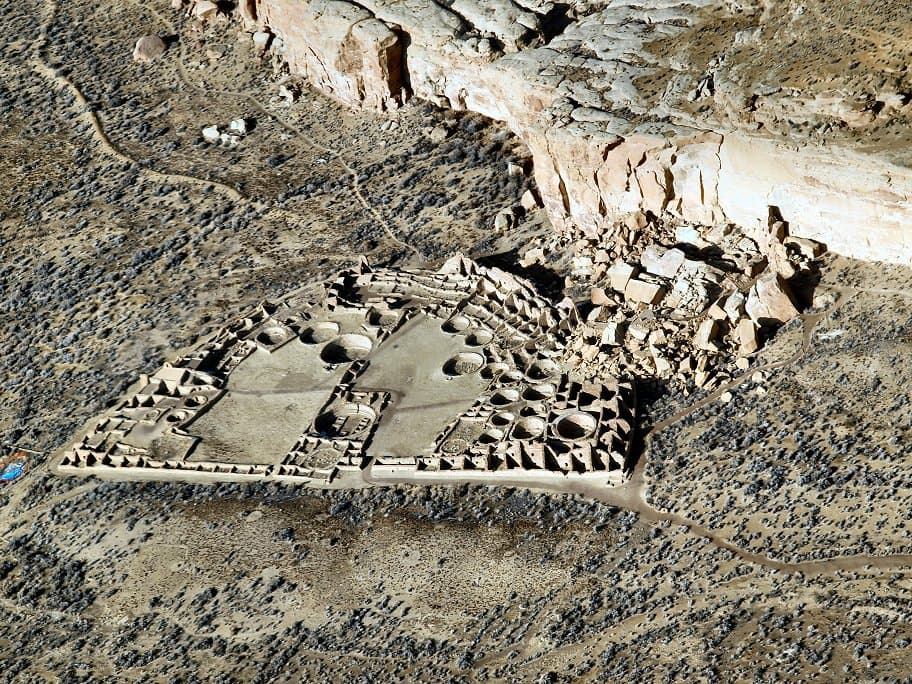
The builders of Pueblo Bonito knew that the massive, thirty-thousand-ton sandstone cliff they chose to nestle their home against was fractured.
High against the sheer sandstone cliffs of northern New Mexico’s Chaco Canyon, a massive, crescent-shaped ruin sits in the shadow of a geologic hazard. For centuries, a towering, thirty-thousand-ton block of stone known to the Navajo as tse biyaa anii'ahi—the leaning rock gap, or Threatening Rock—teetered directly above the northern perimeter of the site. The ancient builders who broke ground here in the ninth century CE were acutely aware of the danger; rather than choosing another location, they reinforced the base of the fractured cliff with structural masonry, binding their architectural masterpiece to the very stone that menaced it. When the 97-foot-high rock finally collapsed in January 1941, pulverizing a section of the rear wall and several rooms, it brought a dramatic close to a thousand-year-old standoff. Yet the ruin below, known to history as Pueblo Bonito, remains the undisputed crown jewel of the Ancestral Puebloan world: a sprawling, multi-tiered monument to human organization, astronomical precision, and deep-time lineage.
To look at Pueblo Bonito is to see a physical manifestation of order imposed on a rugged landscape. Covering three acres, the "great house" is divided into two symmetrical halves by a precisely aligned north-south wall running through a vast central plaza. On either side of this division sits a Great Kiva—a massive, subterranean ceremonial chamber—surrounded by more than thirty smaller kivas. Encircling this public core is a semi-circular sweep of terraced rooms that once rose four and five stories high, boasting walls up to three feet thick constructed with a sophisticated core-and-veneer masonry. To support the staggering weight of the upper levels, the builders filled many of their lower-level rooms with structural debris, creating a dense, cellular mountain of stone. It was a monumental undertaking. Archaeologists estimate that constructing the main structure of Pueblo Bonito demanded some 805,000 man-hours, a collective labor that yielded approximately 800 rooms connected by a labyrinth of interior doorways, some carved into distinctive T-shapes.
For decades after the site was first brought to wider attention in 1849 by U.S. Army Lieutenant James H. Simpson and his guide Carravahal—who bestowed the Spanish name meaning "beautiful town"—investigators assumed the structure was a bustling prehistoric city. Early twentieth-century excavators, including Richard Wetherill and George H. Pepper, imagined thousands of people packed into the dense grid of rooms. Modern science, however, has quieted that assumption. The scarcity of usable hearths within the ruins suggests a permanent population of fewer than 800 people, with some architectural analyses placing the resident peak at just twelve households, or roughly 70 individuals. These year-round residents lived primarily on the ground floor near the central plaza, their quarters leading into deeper, darker interior chambers used almost exclusively for storage. Furthermore, the canyon floor lacks the significant trash middens that invariably accumulate around long-term residential hubs, and only 50 to 60 burials have ever been discovered across the entire three-acre site.
Instead of a city, Pueblo Bonito is now understood as a grand ceremonial and administrative theater, a sacred destination that drew travelers from vast distances. Its architecture is aligned with the cosmic clock, built to track the subtle, shifting cycles of both the sun and the moon—movements also carved into the petroglyphs on the canyon walls above, where images of six-toed feet date back to the late tenth or early eleventh centuries. Inside the rooms, archaeologists have unearthed artifact assemblages that point to a rich, esoteric ritual life. Among these were eight wooden flutes, carved in a style ancestral to modern Native American flutes, found together in a single northwestern chamber. Elsewhere, excavators found ceramic incense burners, human effigy vessels, and cylindrical pottery jars.
These cylindrical jars, though rare in the American Southwest, are common in Mesoamerica. In 2009, chemical analysis of pottery sherds from Pueblo Bonito’s cylindrical vessels revealed traces of cacao—imported from at least 1,200 miles away. This discovery was the first definitive proof that chocolate, a substance loaded with ritual and elite significance in Central America, had been carried into the territory of the modern United States centuries before the arrival of the Spanish. The presence of these vessels, along with the sheer scale of the storage rooms, indicates that Pueblo Bonito was a highly connected hub of exchange, receiving exotic luxuries from the deep south while distributing influence across the high deserts of the Colorado Plateau.
The political and spiritual authority that directed this vast network appears to have been remarkably stable, concentrated in the hands of a single, elite family line. The key to this social hierarchy was found in Room 33, a chamber dating to the site's earliest construction phase in the ninth century. Unlike most Chacoans, who were buried outside the great houses, the individuals in Room 33 were interred within the heart of the stone structure. At the center of this crypt lay the oldest burial: a man who had died violently, laid to rest with thousands of turquoise and shell beads, pendants, bracelets, and anklets—the richest archaeological burial ever documented in the American Southwest. Over the next 330 years, thirteen other men and women were buried in this same room alongside prestigious grave goods. Recent archaeogenomic analysis of these remains revealed that nine of the individuals shared identical mitochondrial DNA. Because mitochondrial DNA is passed down solely from mothers to their children, the discovery provides the first concrete archaeological evidence of a powerful, matrilineal dynasty in Chaco Canyon. For more than three centuries, leadership and status at Pueblo Bonito were inherited through the female line, a social structure that directly mirrors the matrilineal systems practiced by many of their modern Pueblo descendants today.
This three-century golden age, however, was bound to an ecological clock. When construction began in the ninth century, pack rat middens from the era indicate that Chaco Canyon was not the barren wash it is today, but a woodland rich in ponderosa pines. The builders harvested these forests relentlessly, using the massive trunks as first-floor support beams and clearing the valley of timber for construction and firewood. This systemic deforestation, compounded by a prolonged regional drought, triggered a ecological collapse. Without the tree canopy and root systems to hold moisture, the valley’s water table dropped precipitously, rendering the once-cultivable canyon floor dry and infertile.
By 1126 CE, the fields could no longer sustain even the small, elite core of residents and the pilgrims who gathered there. The Ancestral Puebloans abandoned the great house, leaving their monument to stand empty beneath the leaning cliff. When Wetherill and Pepper excavated the site between 1896 and 1900, funding their work through New York philanthropists B. Talbot and Frederick E. Hyde Jr., they shipped crates of invaluable artifacts to the American Museum of Natural History. Wetherill’s subsequent attempt to homestead the ruins was blocked by the federal government in 1904, ensuring that the stone crescent remained public land. Today, Pueblo Bonito stands as a monument of human self-expression and ecological vulnerability. It remains a place where stone, sky, and lineage once converged, leaving behind an architectural footprint that still mirrors the pathways of the sun.
Connected to
4 links to entries not yet ingested in the Library.