Person · 430s BCE – 350s BCE · Classical Greece
Plato
- Also known as
- Aflatun
- Aflaṭun
- Aflotun
- Aplaton
- Aristocle
- Aristocles
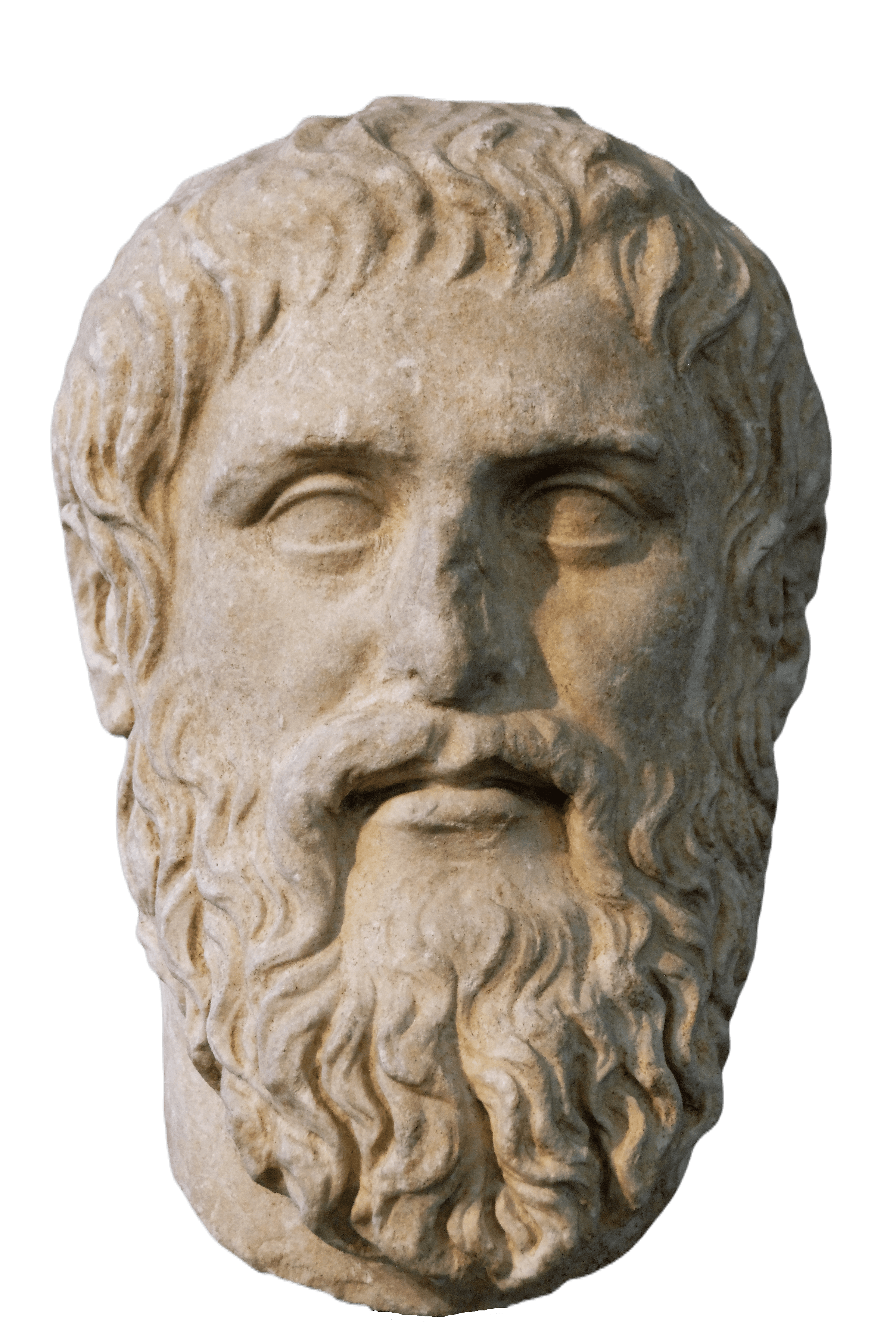
To burn one’s own tragedies and lyric poems after a single encounter with a teacher is the act of a young man experiencing a quiet intellectual revolution.
In the year 399 BCE, an Athenian jury sentenced a seventy-year-old veteran and street philosopher named Socrates to death by drinking hemlock. To the democratic authorities of Athens, the execution was a necessary piece of civic hygiene, a way to rid the bruised city of a gadfly who had embarrassed its elites and allegedly corrupted its youth. But to a young, well-born Athenian of athletic build and aristocratic pedigree named Plato, the execution of his teacher was a catastrophic betrayal of reason by the mob. Plato had expected to follow his family’s traditional path into public office; his mother was a descendant of Solon, the legendary father of Athenian democracy, and two of his relatives, Critias and Charmides, had recently ruled the city as part of the oligarchic junta known as the Thirty Tyrants. Plato had watched that brutal regime try to implicate Socrates in their crimes, and he had watched the restored democracy that followed put Socrates on trial and kill him. Disillusioned with the politics of blood and ballot, Plato burned the lyric poetry and tragedies of his youth, turned his back on public life, and set out to conquer the world not through decrees, but through the architecture of the human mind.
What followed was a life of intellectual migration, born out of a profound crisis of certainty. For nearly fifteen years after Socrates’ death, Plato wandered the Mediterranean world, absorbing the contradictory currents of early Greek thought. In Athens, he studied with Cratylus, a disciple of Heraclitus, who argued that the physical world was a river of endless mutation where nothing remains stable long enough to be truly known. Seeking an antidote to this exhausting flux, he studied with Hermogenes, a thinker in the tradition of Parmenides, who conversely maintained that change was an illusion and that reality was a single, eternal, and unmoving whole. Seeking further precision, Plato traveled to southern Italy to study with the Pythagoreans, particularly the mathematician Archytas of Tarentum. In their tightly organized, mystical community of like-minded thinkers, Plato found a revelation: the physical world might be a realm of decay and illusion, but mathematics offered a gateway to a changeless, eternal reality. Pythagoras taught that the cosmos was structured on numerical principles and that physical objects were merely crude, imperfect imitations of eternal mathematical forms. Plato synthesized these disparate visions into his own masterwork of metaphysics, the Theory of Forms. He proposed that the things we perceive with our senses—a beautiful person, a just law, a drawn circle—are merely fleeting shadow-plays cast upon the wall of a cave. The true realities, the Forms of Beauty, Justice, and Circularity, exist in a timeless realm beyond human sight, accessible only to the disciplined intellect.
Around 383 BCE, Plato returned to Athens and established a permanent space for this intellectual discipline. Northwest of the city, in a sacred olive grove named after the Attic hero Hecademus, he founded the Academy. At first, it was nothing more than a modest house with a garden, where students and thinkers gathered in the open air to debate mathematics, astronomy, and the nature of the good life. Among the early arrivals were brilliant mathematicians like Theaetetus and Eudoxus of Cnidus, and later, a brilliant young student from Stagira named Aristotle. The Academy was not a university in the modern sense, but a collaborative retreat that quickly drew the attention—and the ridicule—of Athenian society. Just as Socrates had been lampooned on the comic stage, Plato’s students became targets for the writers of Middle Comedy. In one surviving fragment from a lost play by the comic poet Epicrates, two Academy students are depicted in a state of high-minded absurdity, locked in a fierce, agonizing debate over how to scientifically classify the genus of a pumpkin.
Yet Plato’s ambitions were never merely academic; he remained haunted by the failure of Athenian politics and obsessed with the practical application of philosophy. This obsession drew him repeatedly into the volatile court of Syracuse, a powerful Greek city-state in Sicily. Plato first visited Syracuse around 385 BCE, during the reign of the tyrant Dionysius I. While the tyrant grew hostile to the philosopher’s moralizing, his brother-in-law, a nobleman named Dion, became Plato’s most devoted disciple. When Dionysius I died in 367 BCE, Dion saw an opportunity to put Platonism into practice. He summoned Plato back to Syracuse to tutor the new young ruler, Dionysius II, hoping to mold him into history’s first true "philosopher king." Plato accepted the challenge, but the experiment devolved into a courtly nightmare. Dionysius II grew intensely jealous of Dion, exiled him from the city, and effectively kept Plato as a gilded hostage. Though Plato returned to Athens, he was lured back to Syracuse a third time in 361 BCE, only to find himself trapped once more by the capricious young tyrant. It took the intervention of Plato’s Pythagorean friend Archytas to secure his release. The Sicilian dream ended in tragedy: Dion eventually returned with an army to overthrow his nephew, only to be assassinated himself a few years later by Calippus, an Athenian associate.
Defeated in his geopolitical ambitions, Plato spent his final two decades inside the quiet confines of the Academy, writing and revising the texts that would preserve his philosophy for millennia. Unlike almost all of his contemporaries, whose writings survive only in scattered fragments, Plato’s complete body of work is believed to have survived intact. He chose to write not in dry treatises, but in the lively, dramatic form of the dialogue, using his late mentor Socrates as a recurring literary character. Because Plato never speaks in his own voice, and because his Socrates is famously steeped in irony, scholars have debated for thousands of years where Socrates' historical views end and Plato's own begin. In his early dialogues, such as the Apology, Plato captured the urgent, questioning spirit of his teacher, who claimed to know nothing but that he knew nothing. In middle works like the Republic, Plato used Socrates to articulate his own elaborate visions of an ideal, highly structured state ruled by guardians. In his final years, Plato produced a series of complex, stylistically unified works—including the Timaeus, the Sophist, and his longest, unfinished work, the Laws—which was edited after his death around 348 or 347 BCE by his student, Philip of Opus.
Plato’s death did not quiet his voice; instead, it initiated a historical echo that grew louder with the centuries. His Academy endured for generations, and his ideas, reshaped by later thinkers into Neoplatonism, became a foundational intellectual scaffolding for Christian, Jewish, and Islamic theology, providing the philosophical language used to reconcile faith with reason. In the twentieth century, the British philosopher Alfred North Whitehead famously remarked that the safest general characterization of the European philosophical tradition is that "it consists of a series of footnotes to Plato." By retreating from the violent, democratic assemblies of Athens to the quiet grove of Hecademus, Plato did not abandon politics. He simply realized that the most durable empires are not built with walls or navies, but with the concepts that define how humanity understands justice, truth, and the nature of reality itself.
Connected to
12 links to entries not yet ingested in the Library.